
Parking blocked: Cala Varques becomes harder to reach — a reality check
Parking blocked: Cala Varques becomes harder to reach — a reality check
The island council has blocked access to the former Ma‑4014 near Cala Varques with concrete bollards and markings. To visitors this sounds like order, to residents like an act of self‑defense. What's missing from the debate — and which solutions could work in the long term?
Parking blocked: Cala Varques becomes harder to reach — a reality check
Concrete bollards, barrier tape and a gate for residents: what happens next on the Ma‑4014?
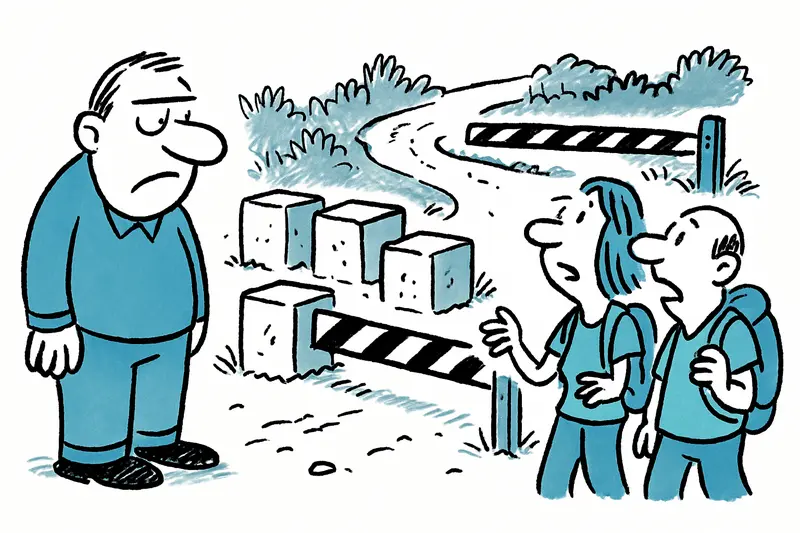
On the edge of the former Ma‑4014, the small access road to Cala Varques, concrete bollards now stand like mute witnesses to a problem that has grown over the past summers. Visitors had been using the side track as an improvised parking area — hundreds on hot days — making it difficult for residents to reach the connecting route between Porto Cristo and Portocolom. The island council has reacted: bollards at one end, white-and-red markings at the other, and a gate announced so that only residents can pass.
Key question: Was blocking the access road appropriate — and what consequences does this quick solution have for the people on site and for the cove itself?
Critical analysis: The measure is clearly pragmatic. Concrete bollards and markings stop the chaos quickly; they prevent cars from parking in ribbons of gravel and pine needles and from blocking emergency access routes. This mirrors other quick fixes reported elsewhere, such as the New Barrier at La Muleta: When the Evening Sun Is Now Only Reachable on Foot. But such interventions are rarely final solutions. In the short term, residents benefit from a quieter street; in the long term the problem often shifts only a few hundred metres away. Without alternative parking options or targeted traffic management a displacement effect arises: visitors search for new, previously less burdened routes to the bay.
What is missing from the public discourse: the debate is confined to 'prevent access' versus 'keep access'. Hardly anyone talks about rescue and emergency access, designated parking areas at a safe distance from the cove, or a regulated access system during the high season. The voices of the people who live there are also barely heard: concerns about delivery traffic, waste collection, ambulances and tradespeople often remain background noise. These issues are highlighted in Beyond the Parking Lottery: Son Espases and the Daily Parking Chaos.
An everyday scene: on a cool morning one climbs the Carrer de la Mar in Porto Cristo, hears the clatter of the market trader, smells strong coffee and olive oil. A fisherman parks his small van to load fish crates; a family with backpacks looks for the way to the cove and stands puzzled when they see the concrete bollards. An older man who walks his dog every morning shakes his head: 'The field used to be a place to pass through, now it's like a fenced backyard.'
Concrete solutions: we need a multi‑track concept. First: designated, surfaced parking lots at an acceptable distance from the cove, with shade‑providing planting and clear signage from the MA‑15 or MA‑401, an approach debated in New parking spaces in Andratx: More room — but is that enough?. Second: shuttle services during peak hours, operated by municipalities or private partners, that bring visitors reliably and affordably to the bay. Third: a digital reservation and information system — limited parking, booked in advance to control numbers. Fourth: clear rules for residents, deliveries and emergencies, for example electronic gates with resident access chips and exemptions for emergency services. Fifth: better enforcement and appropriate penalties against illegal parking; those who leave vehicles on sensitive paths must face fines, not just deterrent tape.
Practical measures could be planned in close coordination between the island council, the municipality and local residents. Transparency is crucial: maps, opening times, costs and traffic routing must be published early and made public. Ecological requirements should be considered — stabilise gravel areas, avoid soil compaction, and lay paths so that flora and fauna are protected.
Pointed conclusion: plugging problems with concrete bollards is a morning fix that calms unrest but does not heal the cause. Anyone who wants to protect Cala Varques permanently while respecting residents' everyday lives must combine parking management, mobility offers and access regulations. Otherwise only displacement will occur — and in two summers neighbours at the next entrance will be complaining about the same problems.
Frequently asked questions
Why is access to Cala Varques in Mallorca becoming harder?
Can you still park near Cala Varques in Mallorca?
What is the best way to visit Cala Varques without causing parking problems?
Why are concrete bollards being used at Cala Varques in Mallorca?
What problems do residents near Cala Varques face during the summer in Mallorca?
Is Cala Varques still accessible on foot from the parking area?
What would be a better long-term solution for parking at Cala Varques in Mallorca?
Do parking restrictions at Cala Varques affect emergency access in Mallorca?
Similar News

Pool ordered for €46,000 – €23,000 paid, no work carried out: A fraud case in Palma
A homeowner in Palma transferred €23,000 for the construction of a pool. Weeks later it emerged that no building applica...

Summer greetings from the Pitiusas island: Gottschalk and Krüger enjoy the sun on Ibiza
A friendly photo of Thomas Gottschalk and Mike Krüger on Ibiza evokes memories of their shared film years and shows that...

Occupied in a Few Days: When Property in Mallorca Turns into a Dispute
Six young men were arrested in Palma after homeowners returned and could no longer open their own door. A case that rais...

Serious fall at Port d’Andratx: Who protects cyclists on this route?
A 66-year-old German cyclist fell between Port d'Andratx and Camp de Mar, hit his head and was taken to hospital. One ac...

Four goals, heart-stopping moments, a message: Germania Mallorca takes three points in Consell — questions remain
The new German club on the island won its first away game in Consell 4:3. Celebration, a 4:0 lead, then a nervous finish...
More to explore
Discover more interesting content

Can Cap de Bou

Townhouse Lleo 72
