
Morning Light and Half-Shadow: Partial Lunar Eclipse over Mallorca on 28 August
In the early hours of 28 August the Earth moves in front of the full moon: a partial lunar eclipse will be visible from the Balearic Islands. Times, tips and why it's worth getting up.
Morning Light and Half-Shadow: Partial Lunar Eclipse over Mallorca on 28 August
Why it's worth getting up early — and where on the island to look
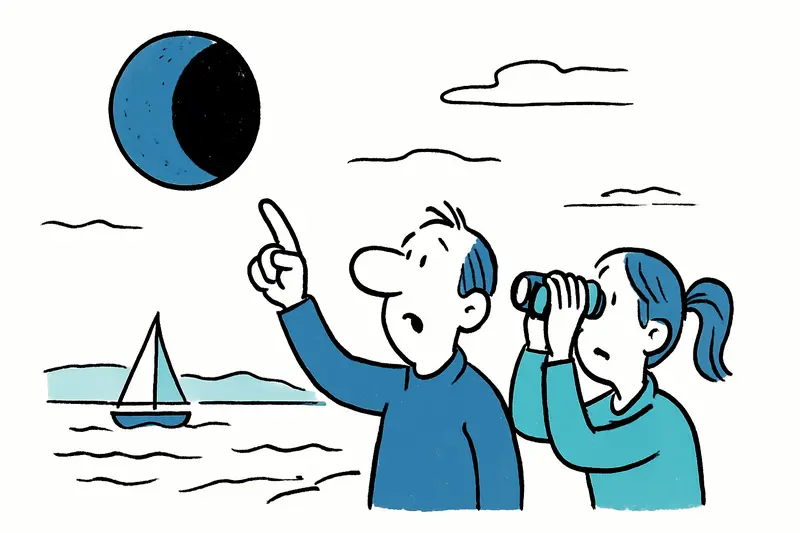
On Friday, 28 August, the sky issues an invitation to both late sleepers and early risers: already in the cool dawn the full moon will be partially covered by the Earth's shadow. The event starts inconspicuously, becomes clearly visible around 04:33 and reaches its most striking appearance in our latitudes shortly before sunrise.
Details: The moon begins to enter the Earth's weaker penumbra at approximately 03:23. This is hardly dramatic to the eye, more a gentle dimming. From about 04:33 the darker umbra then moves across the lunar disk — the partial phase has begun. The maximum of the eclipse occurs around 06:12; at that time the moon is already low on the west-southwest horizon and will soon disappear behind the sea or the coastline before the event fully ends.
This is a small peculiarity for the Balearics: we can see the most interesting phase, but not the complete end. For photographers this means planning short, concise time windows. For practical observing advice see Total Lunar Eclipse: Evening Tips for Observers on Mallorca.
Where to watch: In Palma, Passeig Marítim and the area around Portixol offer good unobstructed views to the west. If you prefer an elevated vantage point, head to Castell de Bellver — from there the moon sets particularly beautifully above the bay. Wide west-facing views that capture the moon sinking over the sea can also be found at Platja de Palma or along the Cala Mayor coast. In the countryside, for example in the west of the island near Banyalbufar or Andratx, you can find even quieter, almost meditative observation spots.
What to bring: Binoculars or a small telescope are nice but not essential. A tripod for your camera will steady shots; without a tripod you can still get decent phone photos with some exposure boosts. Mornings can be surprisingly cool — even in August — so bring a jacket. If you come in a small group, a thermos of coffee or tea is a real mood booster.
A typical local scene: It's 04:00 in Palma, the streetlights still cast yellow light on the Passeig, cleaners sweep up the last leaves, a few fishermen head out and the boats clink quietly at the quay. Above the strollers hangs the pale moon — and all of this gives the moment something familiar, almost cinematic. Such morning hours have their own magic on the island: calm, salt air, the distant lapping of waves and the gaze upward.
Why this is good for Mallorca: Events like this bring people together without the need for entry fees or organization. A small natural spectacle, live and free, that attracts residents and visitors alike. Local cafés and bakeries that open early benefit, photographers and astronomy enthusiasts find fellow observers, and for tourist spots these are great images — not a loud party but a quiet, sustainable kind of "event." They also remind us how much daily life here is shaped by natural rhythms: tides, wind and the moon's phases. For other sky events see Supermoon over Majorca: On November 5 it's worth looking up or Total Solar Eclipse 2026: Opportunities, Risks and How Mallorca Should Prepare.
A few final notes: Weather is the decisive factor — clouds on the western horizon can limit visibility. Checking the latest forecasts (AEMET or local apps) the evening before is worthwhile. Also pay attention to light sources: a darker spot on the beach or on a hill significantly improves the visibility of the shadow play.
In closing, without being sentimental: grab someone who is reasonably punctual, or get up alone, fix your gaze on the western sky and enjoy the quiet minutes in which our Moon plays a little hide-and-seek with the Earth. Such early morning hours are among the few moments when Mallorca feels particularly reflective and friendly at once.
For readers: If you take photos, feel free to post some pictures to your social channels and tag the location — we welcome local impressions of this morning sky show.
Frequently asked questions
When is the best time to visit Mallorca for nice weather and manageable crowds?
Is swimming possible in Mallorca year-round?
What should I pack for a Mallorca trip?
What are the best outdoor activities to try in Mallorca?
How should I plan transportation around Mallorca?
Are there family-friendly beaches in Mallorca?
What should I know about Mallorca's weather and clothing?
Which towns in Mallorca are worth visiting for a sense of local life?
Similar News

Demolition or Opportunity? The Casetas on the Costa des Teatre — What Palma Really Must Decide
The city plans to redesign Plaça Major — but the small wooden huts on the Costa des Teatre are at stake. An inventory wi...

Douglas scion shakes up Deià's short film festival — behind the camera
Dylan Douglas worked in Deià on a one-minute short film about the solar eclipse and handled the editing. For the island ...

He disappeared after a bike tour near Campos: A reality check on the case of Hans Peter Harke
Since 31 July there has been no trace of 72‑year‑old Hans Peter Harke. Drones and a helicopter searched unsuccessfully a...
Stones from the wall: Tourists damage dry-stone wall at Es Colomer — a reality check
A viral video shows a family at the Es Colomer viewpoint prising stones out of a dry-stone wall and throwing them into t...

Behind the Camera: Dylan Douglas Edits at the One-Minute Festival in Deia
At the small but refined One-Minute Festival in Deia, Dylan Douglas mixed with the audience — and this time he wasn't in...
More to explore
Discover more interesting content

Boat Tour with BBQ along Es Trenc Beach
Private transfer from Mallorca Airport (PMI) to Pollensa
