
When Paws Help: Joan March Clinic Brings Therapy Dogs for Older Patients
When Paws Help: Joan March Clinic Brings Therapy Dogs for Older Patients
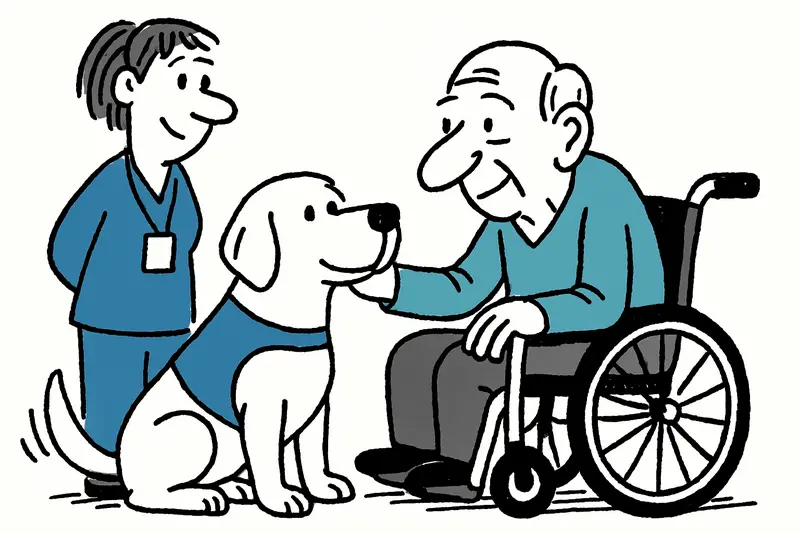
At Joan March Clinic, trained Labrador teams regularly visit older long-term patients. The program, funded by Fundació La Caixa and implemented by Fundació S'Hort Vell, aims to boost mood, mobility and social contact in everyday clinical life.
When Paws Help: Joan March Clinic Brings Therapy Dogs for Older Patients
A calm canine gaze as a complement to medical care
You often notice it in a small, accidental moment: a caregiver pauses in the corridor, an older patient lifts their head — and both smile as the Labrador walks in with a steady step. Such moments are now part of daily life at Joan March Clinic. A program of animal-assisted interventions has started there, specifically tailored to people with longer inpatient stays.
Funding comes from Fundació La Caixa; the practical implementation is handled by the specialist foundation Fundació S'Hort Vell. By doing so, the hospital supplements medical care with elements that address patients' emotional and social well-being. Several responsible health officials attended the presentation, including the regional health minister Manuela García.
Sessions take place in small groups. Trained animals and their teams bring simple activities: petting, small memory exercises, coordinated movement tasks, and sometimes reading aloud together. The aim is not to replace therapy or nursing; rather, these encounters are intended to make hospital time more humane, reduce anxiety and encourage more communication.
For older people such offers are doubly helpful. Hospital stays often mean routine, isolation and little variety — something familiar on Mallorca, especially during long winters when visitors are rarer. Contact with dogs can balance mood swings, improve concentration and gently stimulate physical activity without overstraining.
Scientific studies show that animal-assisted measures can reduce stress and trigger positive biological reactions, such as lower blood pressure or increased release of feel-good hormones. Joan March Clinic applies these findings in practice: not as a quick miracle cure, but as a complementary measure that softens everyday hospital life and focuses attention on the person behind the diagnosis.
What stands out when you walk through the hospital corridors is that it is not only the reaction of individual patients. Care staff report a more relaxed atmosphere after the visits, relatives sit at the bedside longer because conversations start more easily. On the forecourt the clatter of rolling suitcases, the smell of cafeteria coffee and the gentle panting of a Labrador mingle — a small breather for everyone involved, in a city that has recently promoted public outreach such as Palma launches campaign for clean streets and responsible dog ownership.
The participating foundation S'Hort Vell has prepared dogs specifically for assignments in healthcare environments, a role that differs from other local canine programmes such as Four Paws for Alcúdia: Ona and Tro Bring the Police Closer. They are trained to handle sensory stimuli, remain calm in restless moments and respond to clear hand signals. This reduces risks and ensures that encounters are planned and safe.
For Mallorca the project has an additional value: it brings a form of care to the fore that promotes social closeness and everyday perspectives — aspects island communities particularly appreciate. Especially in towns where family structures are changing and the number of elderly people is growing, such an offering can become a relief and enrichment; local animal-care debates are reflected in coverage like 30 Years of SOS Animal in Calvià: Between Birthday Cake and a Systemic Question.
What comes next: experiences will be documented, and accompanying professionals will observe effects on mood, mobility and communication behavior. If the start is successful, regional expansions are conceivable — other hospitals or care facilities could incorporate similar teams. Networking remains important: doctors, nurses, therapy teams and volunteers must work hand in hand.
For people who often only see windows and corridors, a dog day can become a small journey. Not every treatment is measured in numbers; sometimes an alert look, a warm paw and the feeling of being seen are enough. If Joan March Clinic brings a piece of normality back into everyday hospital life, it will be noticeable on a rainy afternoon in Palma as much as on a sunny morning in the mountains: it makes the day easier.
Simple outlook: if you walk through town attentively, you may soon hear of small successes — a patient who smiles more after a session, families who start conversations, or care staff who report that routine has become a little more human. This is not a grand promise but an invitation: more room for subtleties in daily clinical life, with four paws as allies.
Frequently asked questions
What are therapy dogs used for at Joan March Clinic in Mallorca?
Do therapy dogs really help older hospital patients feel better?
What happens during a therapy dog session in a hospital?
Is it safe to bring dogs into a hospital like Joan March Clinic?
Who funds the therapy dog programme at Joan March Clinic in Mallorca?
Why are therapy dog visits especially helpful for older people in Mallorca?
Will more hospitals in Mallorca offer therapy dog visits in the future?
Where in Mallorca is Joan March Clinic located?
Similar News

Fewer Airlines, Fewer Destinations: What Palma's Winter Flight Schedule Means for Mallorca
Analysis shows: Winter at Son Sant Joan Airport will be quieter, with significantly fewer airlines and destinations. Who...
German tourist dies in Sa Calobra – a reality check for emergencies on Mallorca's beaches
A 40-year-old tourist died at the Torrent de Pareis. The emergency call, a doctor who happened to be present, a defibril...
Deadly Tractor Accident in Bunyola: What Needs to Be Done Now
In a work accident on an estate near Bunyola, a roughly 40-year-old man lost his life. His wife and a small child were o...
Head-first dive into the shallow part of Cala Fonoll: An accident and the unresolved question of responsibility
A young tourist dove into Cala Fonoll and was seriously injured. Key question: Why are clear warning signs missing at da...

Mistaken identity with fatal consequences: Brutal assault in S'Aranjassa — what's missing in the follow-up?
At S'Aranjassa a visitor to a finca was tied up, beaten and thrown out of a van. Three men have been arrested, including...
More to explore
Discover more interesting content

Can Cap de Bou

Townhouse Lleo 72
