
When the Beach Smells: Posidonia, Rules and Everyday Life at Es Comú
When the Beach Smells: Posidonia, Rules and Everyday Life at Es Comú
At Playa Es Comú, washed-up Posidonia accumulates in large mats. Conservation law protects the plants — but bathers complain about the smell and limited access. How can this be managed in practice?
When the Beach Smells: Posidonia, Rules and Everyday Life at Es Comú
How do you combine nature protection with the demand for a clean beach?
Early in the morning, when fishermen sort their nets and the first families shuffle along the sandy path toward the water, a heavy smell lies over Playa Es Comú. Meter-long strips of brown seagrass pile up at the high-tide line; children step around them, older bathers look for step-by-step free access to the sea. It is a scene that is seen more often these days: washed-up Posidonia spreads out like carpets and makes swimming awkward to impossible.
The central question is simple and pressing: How can the legal protection of Posidonia — enshrined among others in Decree 25/2018 and in the management plan of the S'Albufera protected area — be reconciled with the needs of residents and visitors for accessible, low-odor beaches?
From a legal point of view the cards are clearer than in practice. In Natura and protected zones strict rules apply: washed-up plants may not be removed arbitrarily because they are part of a sensitive coastal ecosystem. Exceptions, for example in cases of concrete health or safety risks, must be authorized. This is important, protects the beach in the long term and prevents habitat destruction by excavators. At the same time, this caution leads in the short term to conflicts with bathers and businesses on the coast.
Critical analysis: The problem is less the existence of the rules than how they are handled locally. Approval procedures take time, responsibilities are divided (municipalities, Consell, Balearic government and conservation authorities) and communication about measures is often lacking. Public debate lacks a sober presentation of the risks, but also concrete, immediately applicable solutions. Many visitors think in categories of 'clean or dirty', not 'ecological benefit'. Authorities tend to be correct on paper — but on a windy morning, when the smell drives away sunbed users, that is a poor response.
Also missing in the discourse is a graduated approach that brings urgency and protection needs together. Transparent information on site is lacking (signs, notices in several languages, information at parking areas), clear indications of responsibility ('Responsible for beach maintenance: Ajuntament de Muro / Consell de Mallorca / Balearic government'), and a faster procedure for short-term, ecologically justifiable interventions when a health risk is plausible.
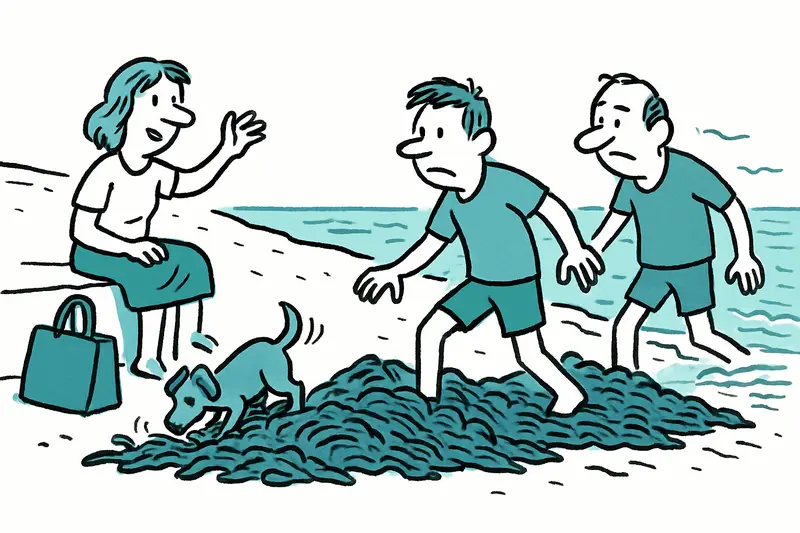
Everyday scene: On a Sunday afternoon a woman with a shopping bag sits on the low stone wall above the beach and waves to others who climb over sand covered in seagrass. A dog enthusiastically digs in a pile of seaweed, two teenagers trudge through brown stalks because access to the water in the usual cove is blocked. From the parking lot you can see signs of the natural park, but they are dusty and flaked by salt spray. The mood is uneasy: understanding for nature, but also anger about the smell and the restricted enjoyment of bathing.
Concrete solution approaches (practice-oriented):
1) Fast-track procedures for health cases: Local authorities should have a clearly defined, accelerated approval process for cases in which decomposition demonstrably poses hygiene risks. A short on-site assessment could be a prerequisite.
2) Temporary 'channels' to the sea: Instead of wide-scale removal, narrow access ways — barrier-free paths made of sand or wooden planks — could be created that leave the seagrass to the sides but enable bathing. This solution protects the ecosystem and provides short-term relief.
3) Designated collection zones outside the dunes: Where possible, washed-up biomass could be gathered at one end of the beach and disposed of ecologically from there. Important: never store in the dunes or on protected areas.
4) Public outreach on site: Clear notices at parking areas and access points should explain why Posidonia is important, when removal is permitted and who to contact. Transparency reduces frustration.
5) Seasonal arrangements: In peak months municipalities can plan moderate clearings in less strictly protected areas; in core zones protection remains the priority. This requires coordinated maps and prior agreements with conservation authorities.
6) Research-accompanied tests: Before mowing or mechanically removing on a large scale, pilot actions should be tested with environmental experts to avoid long-term damage.
Who should act? First the local municipality, together with the responsible conservation authority and the island council. Important is a low administrative threshold for decisions so that action is not delayed for weeks at a smelly beach.
Pointed conclusion: Posidonia is not 'rubbish' — see why dry 'seaweed' on Mallorca beaches isn't rubbish; it is a protective system of the coast. Those who say that in Palma or in Muro are right — and yet the situation at Es Comú is a failure of practice. Protection laws make sense; implementation and communication are not always adequate. A bit of pragmatism, transparent signs and temporary paths could reduce the anger without sacrificing the ecosystem. And honestly: anyone who expects a sea smell in the morning and still wants to go to the water should accept stepping over a little brown seagrass — but authorities should ensure that this does not become a permanent burden.
Frequently asked questions
Why does Es Comú beach in Mallorca sometimes smell bad?
Can Posidonia be removed from beaches in Mallorca?
Is it safe to swim at Es Comú when Posidonia is on the beach?
What should visitors to Mallorca pack for a beach day if Posidonia is likely on the sand?
Why is Posidonia protected in Mallorca?
Who is responsible for beach maintenance at Es Comú in Mallorca?
When is the best time to visit Es Comú beach in Mallorca?
Are there simple solutions for beach access at protected Mallorca beaches like Es Comú?
Similar News
Failed before the first flight: How Fischer Air's plans for Palma were ground down
Announced routes, repeated postponements and now apparent insolvency: Why the Fischer Air project for Mallorca is not me...

Seconds in the Water: 19-year-old Fights Her Way Out of Flooded Car in Palma
A 19-year-old managed to rescue herself from her half-submerged car after sliding under the Verge de Lluc underpass. Res...

Between Dream and Reality: Thorsten Legat and the Challenges of FC Germania Mallorca
The former Bundesliga pro has assembled a colorful squad in a short time. But how realistic is the grand plan for promot...

Arrest warrant at check-in: Why two travelers at Cologne/Bonn Airport suddenly had to pay
At Cologne/Bonn Airport, federal police in mid-September found two German passengers subject to enforcement measures. Bo...
Balearic Islands as a New Route: A Reality Check on Rising Boat Migration
For the first time the Balearic Islands are ahead of the Canary Islands in boat arrivals. What do the numbers really say...
More to explore
Discover more interesting content

Can Cap de Bou

Townhouse Lleo 72
