
Secret Superpowers Beneath the Water's Surface: Why Posidonia Is More Than Pretty Green
Secret Superpowers Beneath the Water's Surface: Why Posidonia Is More Than Pretty Green
New research from the Mediterranean shows: seagrass meadows store huge amounts of carbon — and are under pressure in Mallorca. A critical assessment and concrete proposals.
Secret Superpowers Beneath the Water's Surface: Why Posidonia Is More Than Pretty Green
A critical assessment: What the study really says and what is missing
Early in the morning on the Paseo Marítimo, when the garbage trucks are still rolling and the fishers are sorting their nets, you see none of the work happening beneath the water's surface. Off the waves in front of Mallorca, the seagrass species Posidonia oceanica spreads dense carpets that for a long time remained largely invisible — until a research team led by Nerea Piñeiro-Juncal (IMEDEA) systematically recorded the carbon storage of these meadows. (see Sea off Mallorca: When the Underwater Meadow Disappears)
The key finding of the investigation: the seagrass meadows and other coastal landscapes around the Iberian Peninsula together store enormous amounts of CO2 in plant biomass and in the first meter of sediment. The researchers quantify these stocks at about 95 teragrams of CO2 — that is 95 million tonnes — and estimate an annual increase of around 0.15 teragrams of carbon. For context: the stored amount corresponded during the study period to about a quarter of the annual CO2 emissions of Spain and Portugal in 2022; the yearly uptake, however, is only a small fraction of that.
This is remarkable because the Balearic Islands play an outstanding role for these ecosystems: the islands host a very high share of the seagrass meadows, a backbone for coastal stability, water quality and as a nursery for fish. (see How the Sea off Mallorca Is Heating Up Faster Than We Think — and What We Can Do About It)
And yet: the study is louder than policy. It names the usual threats — tourism pressure, anchoring of boats, pollution, coastal changes — but does not automatically show how to turn figures into concrete protection policy. Now comes the question we must ask here:
Key question: How can the scientifically documented climate and coastal protection potential of Posidonia be translated into binding local measures, instead of being used only as a nice argument for image campaigns?
From a critical perspective three gaps stand out. First: monitoring and comprehensive mapping exist in spots, but not always at a temporal resolution that would detect rapid interventions — for example, when new summer anchoring bans are ignored. Second: economic incentives are missing. When a municipality talks about the value of the meadow, that rarely makes it into budgets or tourism management. Third: the governance level is fragmented; responsibilities between municipalities, autonomous regions and state authorities overshadow concrete implementation plans.
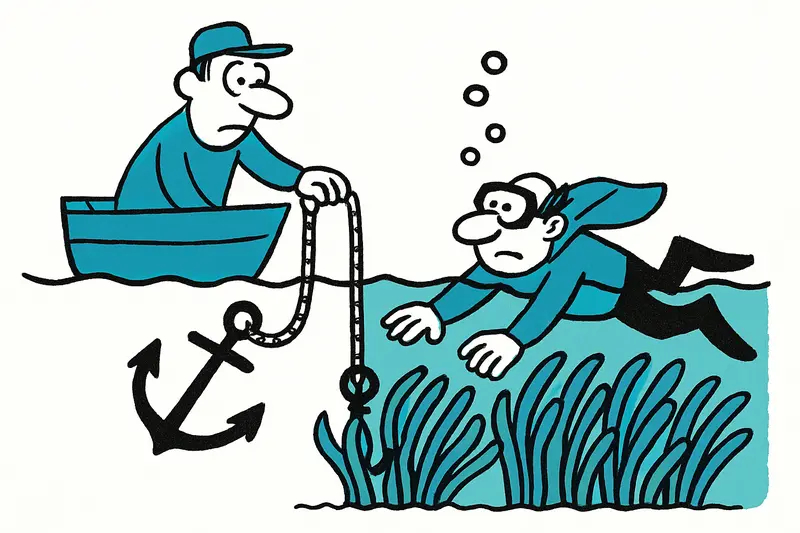
An everyday scene that makes this point: on a Saturday afternoon in Cala Major a powerboat drops anchor even though the meadow beneath might be protected. Bathers perceive it as annoying engine noise, not as an intrusion into a carbon-storing system that works over decades. For the seagrass mats the jerking and churning of the sediment is an injury; for us it is a momentary nuisance.
Concrete solution approaches that could work locally:
- Expansion of permanently installed mooring buoys in sensitive bays and strict sanctioning of illegal anchoring; this immediately reduces physical damage.
- Simple, visible information signs at beach accesses and in tourist brochures: short, local and multilingual so skippers and tourists understand that underwater meadows are not decoration.
- Financial valuation of so-called "blue carbon" in municipal budgets: those who develop the coast should internalize the costs of loss (beach loss, increased dune maintenance, fewer fish stocks).
- Regular satellite-supported and diver-based monitoring, linked to a map with current protected zones for skippers, available in harbor authority apps.
- Promotion of cooperative projects between hoteliers, dive schools, fishers and environmental networks: practical measures like controlled landing sites, waste reduction and citizen-science count more than moral appeals.
With all proposals it applies: Posidonia is not a magic wand that alone saves the climate. The large amount of long-term bound carbon is a valuable complement to emissions reductions on land. But we should stop treating seagrass meadows only as a "net plus" for the islands' image and start managing them as an infrastructural element — similar to roads, water pipes or garbage collection.
To conclude with a pointed summary: whoever wants to keep the beach clean must first protect the carpet beneath. Research now provides clear numbers; the challenge is political-administrative and practical-operational. Mallorca can and should show how to defend blue carbon — not as a PR gesture, but as solid coastal policy. Otherwise the superpowers of Posidonia will remain invisible — until they are gone.
Frequently asked questions
Why is Posidonia important for Mallorca’s beaches and water quality?
Can you swim over Posidonia seagrass in Mallorca?
What is the best time of year to see Posidonia in Mallorca?
What should I pack for a Mallorca beach day if Posidonia is present?
Why is anchoring harmful to Posidonia meadows in Mallorca?
Where can I see Posidonia meadows near Cala Major in Mallorca?
Are there protected areas for Posidonia in Mallorca?
How does Posidonia help Mallorca with climate protection?
Similar News

German tourist dies in Sa Calobra – a reality check for emergencies on Mallorca's beaches
A 40-year-old tourist died at the Torrent de Pareis. The emergency call, a doctor who happened to be present, a defibril...

Deadly Tractor Accident in Bunyola: What Needs to Be Done Now
In a work accident on an estate near Bunyola, a roughly 40-year-old man lost his life. His wife and a small child were o...
Head-first dive into the shallow part of Cala Fonoll: An accident and the unresolved question of responsibility
A young tourist dove into Cala Fonoll and was seriously injured. Key question: Why are clear warning signs missing at da...

Mistaken identity with fatal consequences: Brutal assault in S'Aranjassa — what's missing in the follow-up?
At S'Aranjassa a visitor to a finca was tied up, beaten and thrown out of a van. Three men have been arrested, including...

High heel slips, car accelerates: accident on Camí de Son Hugo
A woman lost a high-heeled shoe on the forecourt of the sports facility at Camí de Son Hugo. The car accelerated, mounte...
More to explore
Discover more interesting content

Can Cap de Bou

Townhouse Lleo 72
