
Poster row in Palma: Sparkasse removes airport advertisement
Poster row in Palma: Sparkasse removes airport advertisement
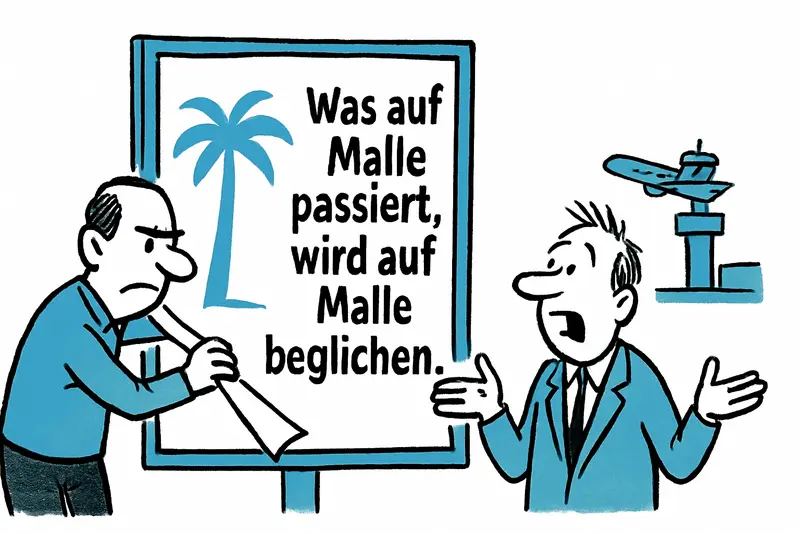
A poster bearing the sentence "What happens in Malle is settled in Malle" was removed at Palma airport. Who approved it — and why was action only taken after public pressure?
Poster row in Palma: Sparkasse removes airport advertisement
Key question: How could an advertising slogan with such provocative wording be placed at the island's arrival gate — and why was it removed only after public outcry?
Last night a large advertisement from the Sparkassen financial group disappeared from the areas near departures and arrivals at Palma airport. The motif read "What happens in Malle is settled in Malle", a formulation that quickly sparked criticism on the island. The Balearic government demanded its removal, the financial group apologized and announced it would continue the campaign with different wording. These are the confirmed facts.
The short version sounds like a clear result: mistake noticed, mistake corrected. But a closer look reveals a systemic failure. Airports are public spaces with high visibility. Advertising there is not only commercial; it shapes perceptions of the island — for tourists, for residents, for airport staff, cleaning crews and the police officers who walk the halls shift after shift, and with recent operational changes such as Digital Boarding in Mallorca: Ryanair Stops Paper Boarding Passes – Who Gets Left Behind?, staff attention is already stretched. That a formulation considered cynical or overly general by many passed the approval mechanisms at all raises questions.
One critical point is the ad review itself: who decides which messages are allowed? Do review bodies operate only formally, or do they also check for cultural sensitivity? Commercial slogans can quickly contribute to normalizing stereotypes — and the island government has every right to intervene; similar controversies have arisen, for example New posters from a party in Palma, Inca and on the islands are causing an uproar. At the same time the case shows that reactions are often reactive instead of preventive. The removal followed public pressure, not apparently an internal pre-check that could have spotted the problem.
Missing so far from the public debate is the perspective of the people who work at the airport every day. Cleaning and service staff who have to look at the poster content for hours; taxi drivers picking up passengers; parents arriving with children — all these everyday actors experience how such messages change the mood in a space. I stood at the taxi exit in the morning, heard different languages, a child laughed, an older woman shielded herself from the sun with her bag, and yet the poster hung over it all like a foreign body. These small scenes show: advertising has an immediate effect on everyday life, not just on marketing reports.
Concrete proposals to prevent a recurrence: first, clear guidelines for airport-relevant campaigns that assess cultural sensitivity and potential discriminatory effects. Second, a transparent approval chain: advertising in public spaces should undergo a short review by an independent local body — with participation from employee representatives and local communities. Third, binding deadlines for the removal of problematic messages and penalties for agencies or companies that repeatedly place offensive motifs. Fourth, awareness workshops for advertisers and airport operators on local particularities — a half-day briefing can prevent embarrassing mistakes.
It is not enough to say afterwards "It wasn't meant that way" and take the motif down. Responsibility must begin before the installation. Airports are windows to society: the first impression is formed here. If that impression confirms stereotypes or hurts parts of the population, it is not a minor mishap but a signal that communication processes need improvement.
The case also shows that public communication needs local anchoring. Advertising conceived in central German marketing departments does not automatically hit the right tone on site. A simple measure: every major campaign running in sensitive spaces should be locally tested in advance — a short panel with tourism professionals, local businesses and two randomly selected travellers can spare a lot of frustration.
Blunt conclusion: taking down the poster was right, but not enough. It must not end with an apology. Airports, authorities and advertisers must review their processes — and do so in a way that puts the people on site first, not least those who work daily among suitcases, coffees and boardings. Otherwise the scene will repeat itself someday — on another sign, with different words, and with the same bitterness on the faces of the island's residents.
Frequently asked questions
Why was the Sparkasse airport ad in Palma removed?
What happened with the advertisement at Palma airport in Mallorca?
How are ads reviewed at Mallorca airport?
Why did the ad cause so much criticism in Mallorca?
What does this ad row mean for travellers arriving in Mallorca?
How should problematic ads be handled at Palma airport?
What role do airport workers play in cases like this in Mallorca?
Can a company keep a campaign in Mallorca after removing a bad slogan?
Similar News

Nine-year-old rescued after cliff fall at Cala Murada — How safe are Mallorca's coastal paths?
A boy fell roughly five meters down the rocks near Cala Murada. The dusk rescue was elaborate; a helper also had to be r...

How safe are tourists in the luxury marinas? After arrests: a reality check
The Guardia Civil arrested two men in Calvià who are suspected of stealing luxury watches in Port d'Andratx and Puerto P...

Palma Chases Wealthy US Tourists — The Key Question: Who Should the City Actually Serve?
The city is investing more than €200,000 to attract high-paying visitors in several US cities. A good idea — but what is...

Enough swimming: Why Port de Pollenca is louder than the sea
More than 200 people formed a human chain in Port de Pollenca — not only as a protest but as a wake-up call. Guiding que...

Mysterious disappearance in Alcúdia: Where is 24-year-old Lisa B.?
Since August 3 there has been no trace of 24-year-old German Lisa B. The family has traveled to Mallorca and urgently re...
More to explore
Discover more interesting content

Boat Tour with BBQ along Es Trenc Beach

Private transfer from Mallorca Airport (PMI) to Pollensa
