
Poster Removed at the Airport — What the Action Really Reveals
Poster Removed at the Airport — What the Action Really Reveals
A promotional poster from the Sparkassen Financial Group in Palma was taken down. The scene raises questions about handling stereotypes, decision-making at the airport, and advertising oversight. A reality check from Palma.
Poster Removed at the Airport — What the Action Really Reveals
Key question: What does the swift removal of the Sparkassen poster at Palma airport reveal about responsibilities, advertising controls and how local sensitivities are handled?
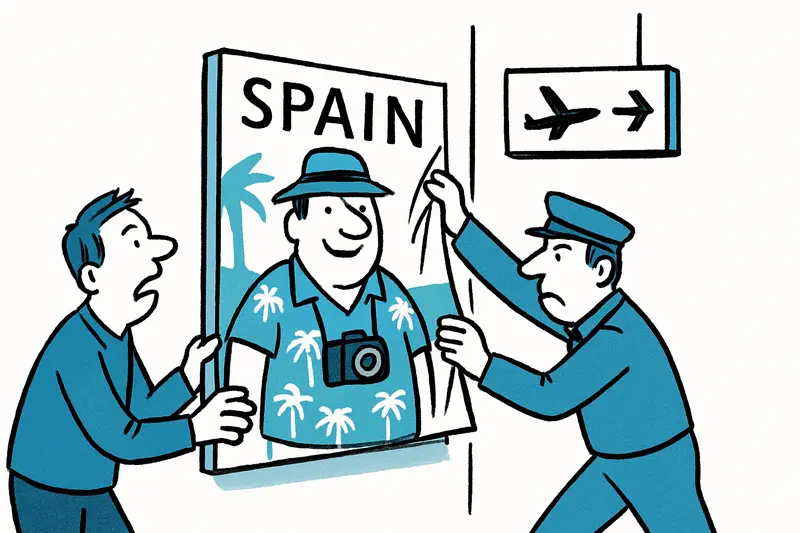
Last night a large advertising banner disappeared from the area in front of the gates in Terminal B at Palma airport. It was not a loud protest, not fireworks — rather the result of a short but intense public debate: a slogan from the German Sparkassen Financial Group had offended many people on the island. The Balearic government demanded the poster be removed, and the company complied and issued an apology. Similar controversies have recently played out elsewhere on the islands, for example in Poster Dispute in the Balearic Islands: How Much Provocation Can Public Space Tolerate?.
Viewed critically, the removal says more about processes than about the advertisement's motive itself. Who approves advertising spaces at the airport? Which control bodies check texts for cultural sensitivity? In Palma the distances are short: travellers with rolling suitcases, the beeping of check-in machines and security announcements form the backdrop in which advertising messages immediately find a response. If a slogan is nationally debated within an hour, something is wrong with the internal checks — or they are simply not taken seriously, as Posters, Provocation, Polarization: How Mallorca's Streets Become a Campaign Ground shows.
Public debate was largely framed as a moral question: ignorance or provocation? What is missing from the discourse is a sober analysis of responsibilities. Airport authorities, advertising agencies and clients share the power over visibility. What internal guidelines apply at Aena and the operators of the Mallorcan terminals? Is there a clear line against stereotypes that demean entire population groups? Such questions have been asked far too rarely so far.
A snapshot of everyday life in Mallorca makes this clear: on the Passeig d'es Born older residents sit, watch tourists and listen to the city breathe. Conversations quickly turn to concrete consequences: if locals do not feel respected, does the mood in the city affect their willingness to welcome visitors warmly? Small remarks in airport language can create bigger waves here — and this is not just a feeling, it is social reality; local incidents such as the Soller posters dispute illustrate how quickly posters can provoke strong reactions, see Soller hangs photos of suspected pickpockets — provocation or necessary wake-up call?.
Concrete solutions must remain practical. First: transparent approval procedures for airport advertising, with protocols recording who approved which text. Second: a locally reachable review body on the island — not a central call-center workflow from afar, but a local contact for sensitive campaigns. Third: pre-checks with local focus groups before slogans are displayed in large formats; this takes some time but prevents damage to an image. Fourth: a mandatory "sensitive wording" list for large-format ads in multilingual areas like Palma that automatically flags aggressive or demeaning expressions.
There also need to be rules for crisis communication: who apologizes for what, how quickly must a removal occur, and what documentation will be published? The current case ended with a withdrawal and an apology — that is good. But it is not enough to only see the result. Disclosing who approved the campaign would build trust. Transparency is not a luxury, it is part of good administrative practice at an airport through which millions of people pass each year.
In conclusion: advertising is attention-grabbing and effective — both positively and negatively. Airports are the shop windows of the island; they shape first impressions. If an advertising message triggers a political reaction, it shows: control was insufficient, sensitivity was lacking, and the mechanism for processing complaints is reactive rather than proactive. An island with so many voices needs rules that take those voices seriously.
Conclusion: Removing the poster was necessary, but not enough. It would be progress to now do more than argue about the line itself and to repair the system — clear rules for airport advertising, local review processes and transparent actions by those responsible. Then future slogans will less often become political repair work and more often a genuine invitation.
Frequently asked questions
Why was the poster removed at Palma airport?
How are airport advertisements approved in Mallorca?
What does the Palma airport poster controversy say about local sensitivities?
What should companies do before running ads at Mallorca airport?
What happens if an airport ad offends people in Mallorca?
Why is Palma airport such a sensitive place for advertising?
What kind of advertising rules could help prevent disputes in Mallorca?
What is the best way to handle a controversial ad at Palma airport?
Similar News

Who will clean up? Illegal rubbish heaps on the highway near Son Gual drive residents onto the streets
For months, construction debris and household waste have piled up along the highway between Palma and Manacor near Son G...

Amundi takes over Bikini Island & Mountain Port in Sóller – many questions remain open
The French asset manager Amundi has acquired the four-star Bikini Island & Mountain Port hotel in Sóller from an Austria...

Silvia was allowed to see the sea once more – a small farewell in Port de Soller
A team from the Balearic health service IB-Salut fulfilled a terminally ill woman's wish: one last trip to the water in ...

Magaluf: Imprisonment for Beach Club Employee after Theft of a Bag — What the Ruling Overlooks
A former dishwasher received a one-year prison sentence for stealing a Louis‑Vuitton bag. The appellate court upheld the...

Road collapse at Port de Valldemossa: Who will pay for the next wave of damage?
A section of the MA-1131 near Port de Valldemossa slipped after heavy rains from cold front "Adam". Residents are strand...
More to explore
Discover more interesting content

Can Cap de Bou

Townhouse Lleo 72
