
Digital Boarding in Mallorca: Ryanair Stops Paper Boarding Passes – Who Gets Left Behind?
From November 3, Ryanair at Palma airport will no longer accept printed boarding passes. What this means for travelers, who may run into problems and which solutions can help.
From November 3: Who benefits – and who is left out?
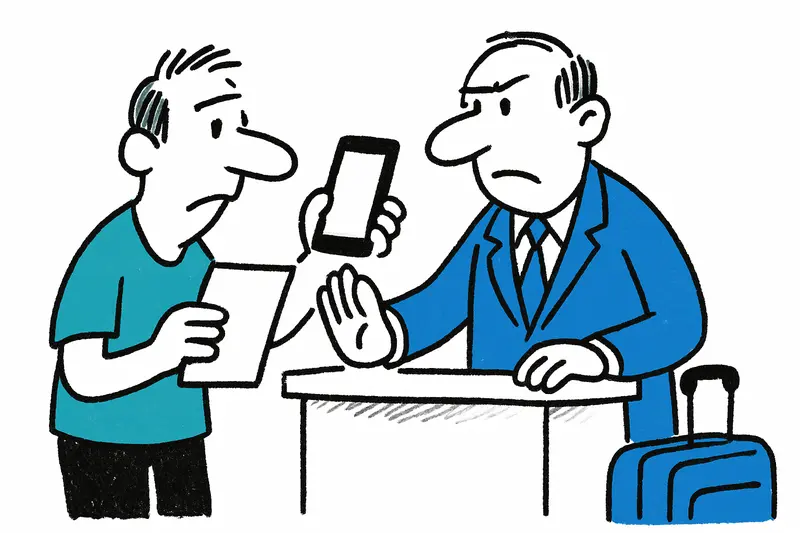
From 3 November, an era ends with Ryanair in Mallorca: paper boarding passes will no longer be accepted. That sounds modern and efficient at first, but the central question remains: who benefits from the digital shift — and who will be stuck at the gate because of a dead battery or lack of know-how? For timeline updates see Ryanair postpones phase-out of paper boarding passes — Is Mallorca really ready?.
The mood in the departure hall
At Palma Airport, between the walkway to security and the smell of coffee from the small bistros, I often hear the same things: announcements in Catalan, Spanish and English, the beeping of boarding-pass scanners and the murmur of travelers frantically searching for their phones. Early in the morning, especially between 6 and 9 a.m., when several planes depart at once, the queue at the gate grows faster than the sun rises over the Rampla. Some are informed, many are not.
Problems that rarely appear on paper
Ryanair's guidance on mobile boarding passes suggests that the booking passenger can download boarding passes for others and forward them via WhatsApp. Practical — until the shared image is blurry, the receiving device vibrates or the display stays dark. Less discussed are:
- Digital exclusion: Older travelers, people without smartphones or with limited data plans are at risk. Not everyone has a power bank ready or knows how to share a screenshot.
- Airport infrastructure: There are too few power outlets and charging stations in the waiting areas. Even if shops sell power banks — in the morning rush the queue for them is an extra time sink.
- Data protection and security: Sending boarding passes via WhatsApp is practical but not ideal. They contain personal data that is transmitted unencrypted via third-party services.
Concrete consequences for operations
In practice, longer waiting times at the gate can occur: staff will have to help digitally, check exceptions or, in the worst case, handle individual cases manually. For Palma this means: more stress in the departure hall, potential delays and frustrated guests who wanted to be in holiday mood.
What travelers can do right away
A few simple steps save time and trouble:
- Secure battery: Pack a power bank; a fully charged phone is a must.
- Offline backup: Save the boarding pass as a screenshot and place it in a separate folder in the gallery. Download PDF files beforehand and make them available offline.
- Second device: If possible, store boarding passes on a second smartphone — the family trip leader will be in demand.
- Print important info: Not the boarding pass, but print booking reference, flight number and the airline's contact details. That helps when contacting support.
- Arrive early: Get there earlier to have enough time at the gate in case digital troubleshooting is needed.
Solutions for the airport and the airline
The transition can succeed — if the airport and airline make improvements. Some pragmatic suggestions:
- More charging infrastructure: Power sockets, USB ports and small charging stations in waiting areas would be a simple investment with high benefit.
- Printing stations and kiosks: A few terminals that can print on demand for exceptions, where staff can quickly print passes, would prevent long queues at the gate.
- Staff training: Gate teams should be trained to quickly and securely handle digital problems — and to do so in multiple languages.
- Information campaigns: On Mallorca, flyers at car rental counters, beach hotspots and in hotels are conceivable — not every tourist reads their emails before flying. Local reporting in Spanish also discussed the timetable and implications: Ryanair pospone el fin de las tarjetas de embarque en papel: ¿está realmente preparada Mallorca?.
- Privacy-friendly options: Secure transmission methods and clear guidance on how boarding passes may be shared would reduce the risk.
A look at the baggage rules
Alongside the digitization, Ryanair has slightly adjusted the allowed size for free cabin baggage: the new dimensions are 40 × 30 × 20 cm instead of the previous 40 × 25 × 20 cm. New measuring frames are now in place at Palma Airport — a clear signal: those who promise too much must pay or repack. The sound of suitcase wheels on the tiled floor will at least be a little more orderly.
Conclusion: Digitalization with foresight
Digital instead of paper is, in many cases, a gain in comfort: fewer sheets, less check-in chaos, faster processes — if the network holds and the battery lasts. But in Mallorca, where the mix of holidaymakers, business travelers and older residents is particularly large, transition solutions are needed. A good compromise would be a clear communication strategy, more charging points at the airport and a few printed exceptions for vulnerable groups. Then the departure hall stays relaxed, the sun shines through the glass roof — and we don't have to ask whether life now really lives only on the screen.
Frequently asked questions
When will Ryanair stop accepting paper boarding passes in Mallorca?
What should I do if my phone battery dies before my Ryanair flight from Mallorca?
Can I use a screenshot of my boarding pass at Mallorca Airport?
Is Ryanair changing cabin baggage rules for flights from Mallorca?
How early should I arrive at Palma Airport for a Ryanair flight?
Does Palma Airport have enough charging points for travelers?
How can older travelers in Mallorca prepare for digital boarding?
Can Ryanair boarding passes be shared on WhatsApp for Mallorca flights?
Similar News
Release after bloody attack in Palma: Why the court's decision raises questions
An 18-year-old who allegedly inflicted a serious neck injury on a man at Plaza Gomila using a wristwatch wrapped around ...
Kidnappings in Inca: Three young men forced into car trunks and abused in the forest – a reality check
In Inca, three 18-year-old men were forced into car trunks by masked assailants at the Plaça des Bestiar, taken to a for...
Spreading Massification: The Brake That Still Has Much Work to Do
Marga Prohens announces limits on volume tourism. The measures sound harsh — but are they enough to save everyday life, ...

Through the Keyhole onto the Party Yacht: How Daniela Katzenberger Is Planning Her 40th on Mallorca
Daniela Katzenberger turns 40 and wants to celebrate it on the island — likely with a boat, cake and her mother. A relax...
By Boat Instead of the Road: Palma's Water Bus — a Reality Check
The 'Bus Nàutic' launches in two stages — but questions remain over interim operations, fares and environmental requirem...
More to explore
Discover more interesting content

Can Cap de Bou

Townhouse Lleo 72
