
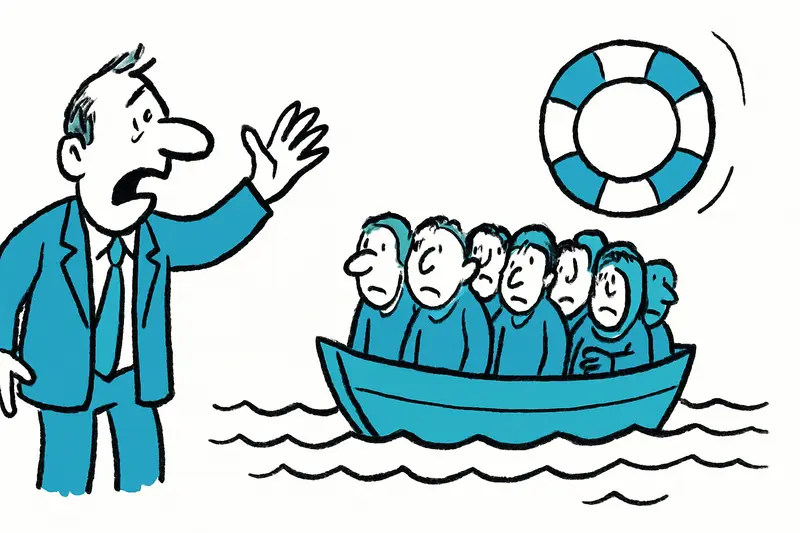
Rescue or Risk? 7,300 People in Boats on the Balearic Islands in 2025
Rescue or Risk? 7,300 People in Boats on the Balearic Islands in 2025
In 2025 around 7,300 people reached the Balearic Islands in about 400 boats — an increase of 24.5%. Many landed on Mallorca; numerous people went missing on the route from Algeria.
Rescue or Risk? 7,300 People in Boats on the Balearic Islands in 2025
Guiding question: How are Mallorca and the Balearic Islands practically handling a growing wave of boat arrivals — in a humane, safe and responsible way?
The bare numbers are stark: around 7,300 people arrived on the Balearic Islands in 2025, spread across roughly 400 boats — and recent reporting documents specific surges such as New surge of boat migrants: 122 people rescued in one day off the Balearic Islands. That is more than a quarter more than the previous year — an increase of 24.5 percent. According to official figures, about 4,000 people landed on Mallorca, a situation also discussed in More Boats, More Questions: Mallorca Under Pressure from Rising Boat Arrivals. Many apparently took the route from Algeria, a passage that aid workers and researchers describe as particularly dangerous. The organization Caminando Fronteras reports that more than 1,000 people disappeared on this route last year.
Does that sound abstract? On the streets of Palma the issue becomes tangible. The harbor smells of diesel, fishermen sort their nets, and tour groups stroll along the Passeig Marítim. At the same time, people with backpacks who are new to the island wait outside the social center. These contrasts show: boat arrivals are not a remote debate, they change everyday life, public spaces and administrative work.
Critical analysis: the figures raise questions with no easy answers. Humanitarian necessity, security responsibilities and migration-policy interests collide. There is a lack of clear coordination between sea rescue, health services, municipalities and central administration. Often local staff provide initial care — from registration to medical treatment — while higher-level strategies are still being debated; this dynamic is illustrated in acute incidents such as 336 People in One Day: Between Rescue, Improvisation and Strategy. The result: improvised procedures, overloaded reception facilities and insecurity for the people arriving.
What is too often missing from the public debate: first, the perspective of the arrivals themselves. Why do thousands choose the dangerous route? Second, the long-term costs and burdens for municipalities are not only financial: integration, school places, access to healthcare and housing are at stake. Third, the role of international cooperation — with countries of origin, NGOs and European institutions — is often treated only peripherally, although it would be decisive.
Everyday scene: on a grey morning in Port d'Alcúdia a fisherman brings coffee because volunteers need help unloading. On the promenade Català is spoken quietly, then Arabic, then Spanish — an acoustic patchwork. Such moments are not an alarm state, they are lived reality. The efforts of organizations, the decentralization of aid and small gestures from neighbors hold the system together.
Concrete solution approaches, practical and locally implementable: 1) Clear regional deployment plans: municipalities, rescue services and health authorities need binding procedures for initial reception and redistribution. 2) Expansion of sea and rescue capacities at critical points, combined with better data on route developments. 3) Temporary reception centers with standardized health checks, initial psychological care and rapid transitions into integration measures. 4) Stronger cooperation with NGOs and civil-society initiatives experienced in interpretation and trauma care. 5) Preventive dialogues with countries of origin — without false solutions; concrete agreements on readmission, but also on legal access routes and development projects that reduce root causes of flight. 6) Municipal support funds that specifically relieve schools, social services and housing projects.
Less useful would be pseudo-solutions: closure alone does not reduce the risk for people at sea; it only shifts the suffering. At the same time, naive humanitarianism without organization is fatal: landings without medical checks or reception capacity lead to chaos.
Punctuated conclusion: the Balearic Islands stand at a crossroads between humane care and administrative overload. The 2025 figures are a wake-up call. Pragmatic, local solutions are needed that are linked to regional and European policy. Small measures — clear procedures in the port, reliable emergency capacities, cooperation with proven helpers — would have an immediate effect. People who live on Mallorca know: when the wind changes, a little preparation can prevent a difficult situation from turning into a crisis. And: human destinies cannot be processed as mere statistics.
Frequently asked questions
Why are more people arriving by boat in Mallorca and the Balearic Islands?
How does Mallorca deal with boat arrivals when people are rescued at sea?
What happens to people who arrive by boat in Palma?
Are boat arrivals in Mallorca handled by local authorities or the central government?
Is it safe to swim or go boating in Mallorca if arrivals are happening nearby?
What should visitors in Mallorca know when they see a boat rescue?
Why is Port d'Alcúdia mentioned in stories about boat arrivals in Mallorca?
What local problems does Mallorca face when boat arrivals increase?
Similar News

Released with Conditions: The Plus Ultra Suspicion and a Mallorcan Finca as Residence
A Dutch entrepreneur, sought in connection with the Plus Ultra case, was extradited to Spain after his arrest in Germany...

Haute Nuit in Puerto Portals: Fashion, Art and Indulgence by the Water
On October 2 the Lobster Club in Puerto Portals will be transformed into a stage for curated fashion, art and culinary e...
Magaluf: Watchtower Alarm – Lifeguards Pull Unconscious Beachgoer from the Water
After a drama in the late afternoon, two lifeguards at Magaluf beach rescued an unconscious 44-year-old man. He was stab...

Turquoise in the City: How dangerous is the color play of the Sa Riera?
The Sa Riera in Palma suddenly turned turquoise — a pretty motif, but behind the effect lies a discharge of saline waste...

Jeckliner at Sunnesching: Cologne spirit sets sail from Palma
In September 2027 the Mein Schiff 2 briefly becomes a floating carnival stage: four days with Cologne bands, comedy and ...
More to explore
Discover more interesting content

Can Cap de Bou

Townhouse Lleo 72
