
Property purchases in Mallorca: Who benefits — who gets left behind?
Property purchases in Mallorca: Who benefits — who gets left behind?
In 2025 Germans top the list of foreign buyers in the Balearic Islands. What do 39 percent mean for tenants, young families and the character of towns? A critical look.
Property purchases in Mallorca: Who benefits — who gets left behind?
Key question: How sustainable is a market in which foreign buyers account for nearly a third of transactions and a large share of the money?
The raw figures from the 2025 yearbook of the Spanish notary chamber — reflected in reporting such as Almost every second property in the Balearic Islands in foreign hands – what does this mean for Mallorca? — sound like a wake-up call: Almost 40 percent of all foreign buyers in the Balearic Islands come from Germany, while the second-largest origin group — the United Kingdom — is far behind at just over nine percent. The archipelago still tops the list of autonomous regions where foreigners buy disproportionately many properties; almost 30 percent of all sales there go to buyers without a Spanish passport. Even more striking: for nearly half of these purchases the price exceeds €500,000 — and around 42 percent of foreign acquisitions surpass this threshold (70 percent of those buyers are from the EU, 30 percent from non-EU countries).
These numbers say two things: first, Mallorca remains attractive for investors and high earners. Second, the consequences for island society are tangible, not only in Palma but also in villages like Alaró or Banyalbufar: rising prices, a tightening rental market and noticeable shifts in the appearance of towns.
Critical analysis
When a single country of origin represents almost 40 percent of all foreign purchases, this is no longer a marginal phenomenon but a structural pattern. The concentration of purchasing power on certain segments — luxury flats on the Paseo Marítimo, villas in Puigpunyent, renovated townhouses in Santa Catalina — not only pushes prices up, it also changes how properties are used: second homes, short-term rentals and empty houses become more common. This drives local renters out of their neighborhoods and makes workers in hotels and restaurants reluctant to relocate: someone who works in Palma often cannot find affordable housing nearby and would have to accept long commutes.
The statistics also show a small but important cooling compared with 2024: nationwide the share of foreign purchases in 2025 was just under 29.8 percent (4,370 transactions), slightly below the previous year when it was 32.2 percent (4,515 transactions). This is not proof of the trend ending, but rather a shift: fewer transactions overall, but more money per deal, a clear sign of a market oriented toward luxury, as examined in Why so much property buying in Mallorca is paid in cash — and what that means for the island.
What is missing from the public discourse
The debate often runs along two tracks: economic success versus loss of quality of life. What gets too little attention are reliable answers to three points: first, a transparent breakdown of who exactly is buying (private individuals, companies, investment funds, trustees, as discussed in Real Estate and Inheritances in Mallorca: Act Smart Now Before Rules Change). Second, robust figures on vacancy and use — how many purchases lead to permanent use, how many to holiday rentals or second homes that sit empty for months? Third, the consequences for middle incomes: how many young families or employees lose the chance to buy a home each year in the communities where they work?
Everyday scene: in front of the estate agents' window
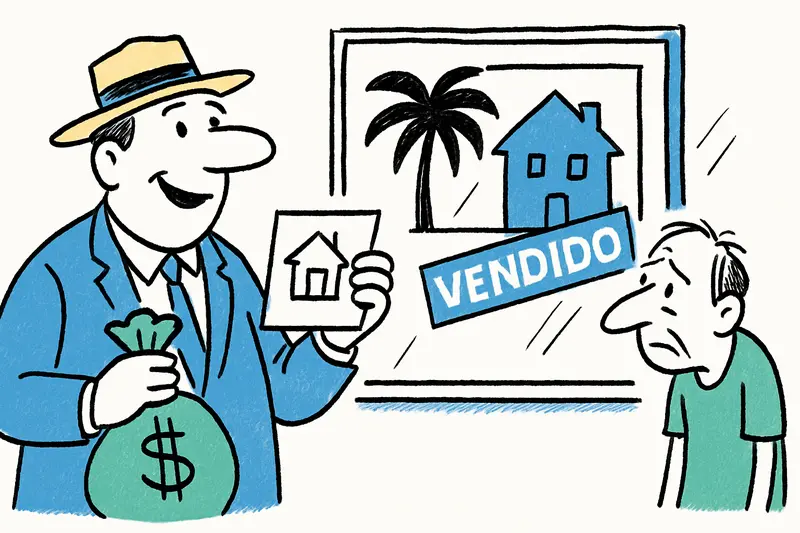
You don’t have to look far: early in the morning the shutters of the estate agents on Avinguda Jaume III go up. In the windows, photos of terraces with sea views shine, next to a note reading “Vendido” — sold. On Plaça de Cort an older woman sits feeding a pigeon; she says the neighboring flat was sold to foreign buyers two years ago and has been rarely occupied since. On the construction site in Portixol you can hear concrete mixers and craftsmen — a block of luxury apartments is being built here, mainly to be sold as holiday properties. These scenes repeat in smaller towns: an empty house in Felanitx, a renovation in Deià that will only attract seasonal residents.
Concrete approaches to solutions
If you want the island to remain vibrant and not become a museum, several levers must be turned. Proposals that could be implemented on Mallorca without legal fiction include:
1) More transparency: Mandatory disclosure of the beneficial owner in property purchases; regular publication of local data on acquisitions, vacancy and use.
2) Fiscal signals: A tiered property tax (IMI/IBI) for long-term vacant or only seasonally used properties; incentives for long-term letting to island residents.
3) Building for locals: Municipal rules requiring a percentage of new projects to be designated as social or subsidized housing; support for municipal housing companies.
4) Rules for short-term rentals: Stricter controls and proportionate sanctions against illegal holiday rentals; prioritization of residence permits for local families.
5) Community solutions: Models such as community land trusts or cooperative housing that remove properties from the speculation market and keep them affordable in the long term.
Conclusion
The 2025 figures are more than statistics; they reflect what is visible on streets, in cafés and at construction sites: a market where a lot of money meets a few locations. This is not a simple crisis that can be solved with a single law. But there are levers: more transparency, smart tax policy and targeted housing policy can separate the wheat from the chaff. The crucial question remains whether politicians in Mallorca and at the regional level will find the will to use those levers — before the next “Vendido” sign turns another neighboring flat into a seasonal listing.
Frequently asked questions
Why are property prices in Mallorca rising so quickly?
Is it still possible for locals to buy a home in Mallorca?
Who is buying the most property in Mallorca?
What does foreign property buying mean for Mallorca renters?
Which areas in Mallorca are most affected by luxury property demand?
Are there more empty homes in Mallorca because of property speculation?
What housing solutions are being discussed for Mallorca?
Is Mallorca becoming a second-home market instead of a place to live year-round?
Similar News

High heel slips, car accelerates: accident on Camí de Son Hugo
A woman lost a high-heeled shoe on the forecourt of the sports facility at Camí de Son Hugo. The car accelerated, mounte...

Phone Scam: How Two Hotel Employees at Playa de Palma Lost Thousands of Euros
One morning in September, two reception employees at Playa de Palma were pressured by alleged alarm-company staff — in t...

When the Wallet Becomes a Danger: Attack in Peguera and Lessons for Mallorca
In Peguera, two women are said to have stolen the wallet from a 75-year-old German couple. When the victim intervened, t...
Plata stays Plata: Young people take over, Llonguets remain
A small bar on Carrer de l'Argenteria will continue: Tolo Serra hands the place over to young Mallorcans at the end of t...

Unnoticed in the Luggage Compartment: How a Boy Traveled More Than 100 Kilometers in a Team Bus
A minor traveled in the undercarriage of a team bus for more than 100 kilometers until his cries for help were heard. A ...
More to explore
Discover more interesting content

Can Cap de Bou

Townhouse Lleo 72
