
Dispute over 17 Ombu Trees on Plaza Llorenç Villalonga: Who Decides on Urban Green?
Dispute over 17 Ombu Trees on Plaza Llorenç Villalonga: Who Decides on Urban Green?
Residents in Palma blocked the planned felling of 17 Ombu trees up to 80 years old. The city cites a technical report; the neighborhood demands more transparency and alternatives.
Dispute over 17 Ombu Trees on Plaza Llorenç Villalonga: Who Decides on Urban Green?
Key question: Is a technical report sufficient to remove decades-old trees in the middle of a neighborhood — or is more public participation needed?
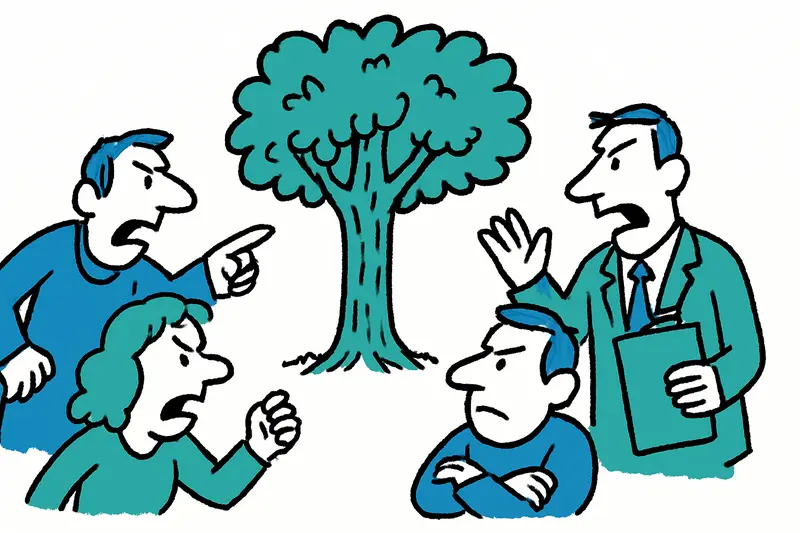
On the morning of December 11, more than 80 residents gathered at Plaza Llorenç Villalonga in Palma, according to a Mallorca Magic report on the protest. A human chain formed around the trunks, and a few people chained themselves to trees. The mood was tense: the clinking of coffee cups from the plaza's cafés mixed with quiet discussions and occasional chants. The city administration wants to fell 17 Ombu trees at this location, a move described in coverage of the planned felling. Technicians had previously identified decayed areas and an increased risk of branch breakage; the city insists the felling is necessary. The neighborhood does not accept the report uncritically and demands access, alternatives and a public debate.
Viewed critically, two perspectives are at odds here: the risk assessment of the experts on the one hand and the collective memory of a neighborhood on the other. Ombu trees that have stood in one place for many decades become landmarks — they shade plazas, retain humidity, dampen street noise and give children places to hide. For many residents the trunks are also part of everyday stories: the neighbor who walks his dog there every day; the old man on the bench who sweeps away chestnut leaves; the small bakery on the corner that has a queue in the mornings.
The submitted report is the central authority in this case. But a paper alone is not always enough to capture the social and ecological functions of trees. Technical assessments work with damage symptoms, measurements and risk categories; see International Society of Arboriculture guidance on tree risk assessment for common methodologies. Nevertheless, measurement errors, local peculiarities such as root competition, soil compaction from construction work or past pruning measures may be underrepresented in the report. At Plaza Llorenç Villalonga, the neighborhood is convinced that such factors were not sufficiently taken into account.
What is missing from the public discourse? First: comprehensible transparency. The residents' demand to inspect the report is not nitpicking but the basis of democratic oversight. Second: independent second opinions. When administration and citizens clash, a third report by an independent tree expert builds trust — or reveals justified objections. Third: a clear cost–benefit analysis for alternatives. Felling is final; measures such as crown securing, partial pruning, root rehabilitation or a staged observation period cost money but preserve ecological and social values; the practical techniques and maintenance options are explained by the Arboricultural Association's guidance on pruning and tree care.
An everyday scene from Palma: in the mornings, when the sun is low, neighbors sit on the plaza and watch the ivy climb the trunks. Children ride scooters around the bare spots that have appeared in recent years. A municipal sticker on a trunk recalls an earlier maintenance measure. Such details explain why people react emotionally — it is not just about wood, but about familiar places.
Concrete approaches that could be implemented immediately: 1) Publish the original report with an explanatory summary for laypeople; 2) Commission an independent, certified tree assessor and compare findings; 3) Establish a time-limited observation protocol (e.g. six months) to document stability, crown condition and crack patterns; 4) Examine securing measures such as crown bracing, targeted pruning or soil rehabilitation; 5) Hold a citizens' assembly with moderated discussion, free participation and a clear decision-making architecture.
Practically, the city could also offer a pilot solution: instead of removing all 17 trees at once, the most acute cases could be reduced initially while less affected trees are preserved and monitored. This way the plaza would not be left bare overnight, and the administration could demonstrate that it takes safety concerns seriously without immediately sacrificing the familiar urban landscape.
Who bears responsibility? Legally the decision often lies with the municipality, which is responsible for traffic safety and public spaces. Politically and socially, however, it faces pressure when residents take to the streets, as shown in local coverage of the neighborhood's opposition. Transparency, independent expertise and genuine involvement of local people would be steps to strengthen trust — and at the same time clarify liability questions.
My conclusion: The felling of trees is more than a technical measure. In Palma this is about urban identity and decisions that people feel daily. The administration has the right to avert dangers; the residents have the right to information and participation. Before 17 Ombu trees disappear, the city should examine all scientifically reasonable alternatives and publish the results. A controlled, gradual approach would do more justice to the plaza, its people and the trees themselves than an abrupt clearing action.
On the evening of the protest, fresh footprints remained on the paving, a plastic bag with flyers lay next to a bench, and the lights of the café terraces cast a warm glow on the trunks — an image that leaves open how Palma will deal with its living witnesses of urban history.
Frequently asked questions
Why are the Ombu trees on Plaza Llorenç Villalonga in Palma being considered for removal?
Can a municipality in Mallorca remove a street tree based only on a technical report?
What alternatives to tree felling are usually considered in Palma?
Why do residents in Mallorca object so strongly when old trees are cut down?
What is happening on Plaza Llorenç Villalonga in Palma?
Who decides whether trees can be removed from a public plaza in Palma?
What should a good tree risk assessment include in Mallorca?
How can Palma residents get more transparency on planned tree felling?
Similar News
When coercive fines aren't enough: Could holiday rental owners soon face prosecution?
The island administration is stepping up action against unauthorized holiday rentals: high daily coercive fines up to €5...
Palma Airport on an Expansion Course — Who Decides How Much Growth the Island Needs?
Aena and Madrid are planning multi-million euro investments for Son Sant Joan and project higher capacities. Concern is ...
Who Gets Left Out? Why Overbookings Will Hit Many Mallorca Travelers This Summer
On hot check-in days at Son Sant Joan, frustrated travelers pile up. New figures from Reclamador.es show that a large sh...
When the Handyman Came: How an Engagement Ring Disappeared in Mallorca and What It Says About Trust
During a repair in Andratx a highly personal engagement ring went missing — a case that calls not only for punishment bu...
How Burglars Test Fincas in Mallorca — and What You Can Do About It
The Spanish National Police warn of a simple but effective trick: small markings on doors reveal whether a finca is occu...
More to explore
Discover more interesting content

Can Cap de Bou

Townhouse Lleo 72
