
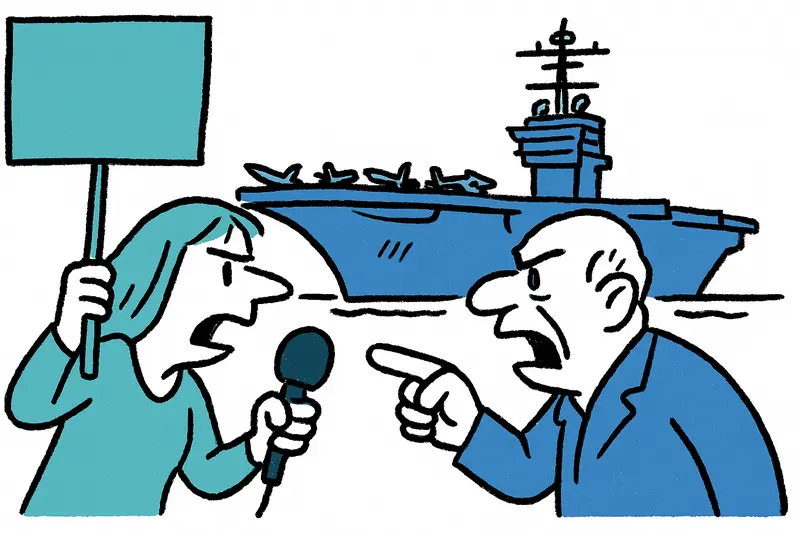
USS Gerald R. Ford off Palma: Why the island is now divided
A 337-meter aircraft carrier will lie off Palma in early October — and is dividing the island. Protests, business interests, security concerns and environmental worries collide.
A giant in the bay and the guiding question: Do we want to make Palma a stage for military power?
The sight is unusual: on October 3 the the USS Gerald R. Ford off Palma is scheduled to arrive off Palma — 337 meters of steel hull, nearly 90 aircraft on board, accompanied by other warships. On the Paseo Marítimo ice-cream conversations mingle with political debates about the carrier. Terns screech, taxis honk, and activists at the harbor rehearse their speeches at the same time.
Between protest signs and everyday sounds
Left-regionalist groups have registered demonstrations. Their message is clear: Palma must not become a backdrop for foreign policy power displays. During a walk through Portixol I met a woman who smoothed her banner once more, while an older man with his café con leche dryly remarked: 'If they bring money, the mood is different.'
This mixture of indignation and pragmatism runs through the city. Tourists continue to lick their ice cream in front of the cathedral while banners fluttering on the quay mark the contrasts. It is a scene we will see more often in the coming days: protest, commerce and the stoic rhythm of everyday port life.
What is rarely discussed
The public debate often remains stuck on the poles of 'for' or 'against'. Less visible are three questions that the discussion urgently needs: What concrete costs and revenues does such a port visit bring? What environmental risks — noise, air pollutants, changes in marine life — are to be expected? And how transparent was the authorities' decision-making?
Port visits can bring income: provisioning, shore leave, supplies for the ship. At the same time, burdens arise: increased police presence, traffic restrictions, potential disturbances for residents. That these trade-offs are rarely communicated in real time is one reason for many citizens' unease.
Strategy, history, symbolism
The Balearic Islands are not a group of islands in a vacuum — their location in the western Mediterranean has repeatedly attracted fleet movements. But symbolism plays a role: a modern aircraft carrier sends signals far beyond its physical presence. Experts point out that the timing is geopolitically charged. For many residents, therefore, it is not only about the ship but about the meaning and message of this visit.
Practical consequences for Palma
For business owners along the port such a visit can mean more customers in the short term: restaurants, taxi drivers and souvenir shops benefit. But the profit is not evenly distributed. Residents complain about noise and restrictions; doctors and emergency services must plan for possible security situations. The question is: who pays the price for the economic benefits?
Concrete steps that are often missing
The debate would be less charged if the administration and port operators informed early and transparently. Practical proposals that could be implemented here:
1. Public information forums: Pre-events where residents, business owners and civil society can review figures, routes and security concepts.
2. Environmental monitoring: Publish measurements of noise, air and water quality before and after the visit.
3. Economic disclosure: A clear breakdown of what fees the port receives and how much flows to local service providers.
4. Rules for shore leave: Agreements that military ceremonies do not take place in central tourist streets to avoid tensions.
5. Accompanying programs: Instead of purely military PR, cultural exchange formats could be created: talks with schools, port tours under civilian leadership, joint environmental actions.
Opportunities for a more productive approach
Conflicts are never just a nuisance. They can be an occasion for better communication. If the city administration takes the criticism seriously and at the same time offers pragmatic solutions, the polarization could be eased. An open dialogue could also lead to clearer rules for future visits — to the benefit of residents, tourism and security authorities.
A concluding view
In the coming days Palma will experience a strange coexistence: protests on the quay, joggers on the waterfront promenade, tourists taking photos, and above it all the silhouette of the largest US aircraft carrier moored in the Bay of Palma. Those who observe the events should not only count the slogans but ask: Who decides how our port is used? And how can we ensure that such events are transparent, accountable and as gentle as possible on the city?
Whether one approves of the visit or not — one thing is clear: this time the island will not only be a holiday backdrop but the site of a public confrontation about security, politics and identity.
Frequently asked questions
Why is the USS Gerald R. Ford in Palma causing protests?
What does a warship visit mean for Mallorca’s local economy?
Will the USS Gerald R. Ford visit affect daily life in Palma?
What environmental concerns come with a large warship visit in Mallorca?
Why do some people in Palma see the carrier visit as symbolic?
Where are the protests against the USS Gerald R. Ford in Mallorca taking place?
What should residents expect from a major naval visit in Palma Bay?
How transparent are decisions about military ship visits to Mallorca?
Similar News
Palma under the microscope: 87 arrests over forged passports – what now?
The National Police stopped 87 people at Palma airport this year with allegedly forged documents. Why are controls alone...

When a Taxi Fare Dispute in Magaluf Turned Bloody: How Safe Are Passengers and Drivers?
In Magaluf a dispute over the fare escalated: a tourist, now 18, is accused of having seriously injured a taxi driver in...

Why Mallorca Has Become So Terribly Expensive — A Reality Check
Rents are exploding, staple food prices are rising, wages are lagging behind. A look at the causes, what is missing from...

When Paradise Becomes Unaffordable
Hotel rooms, paella and the weekly grocery shop: Mallorca is becoming more expensive for many. Who pays the bill — guest...

End at Ballermann: What Is Lost with the Dino Mini Golf at Playa de Palma
On October 25 the dinosaur mini-golf course at Playa de Palma will close after more than 30 years. Why the city is recla...
More to explore
Discover more interesting content

Can Cap de Bou

Townhouse Lleo 72
