
Virtual Reality at Hospital d'Inca: Small Headset, Big Questions
At Hospital d'Inca, doctors and nurses are testing virtual reality headsets during chemotherapy. Early relief is noticeable — but technical, ethical and clinical questions remain.
A small room, big impact — and a few unanswered questions
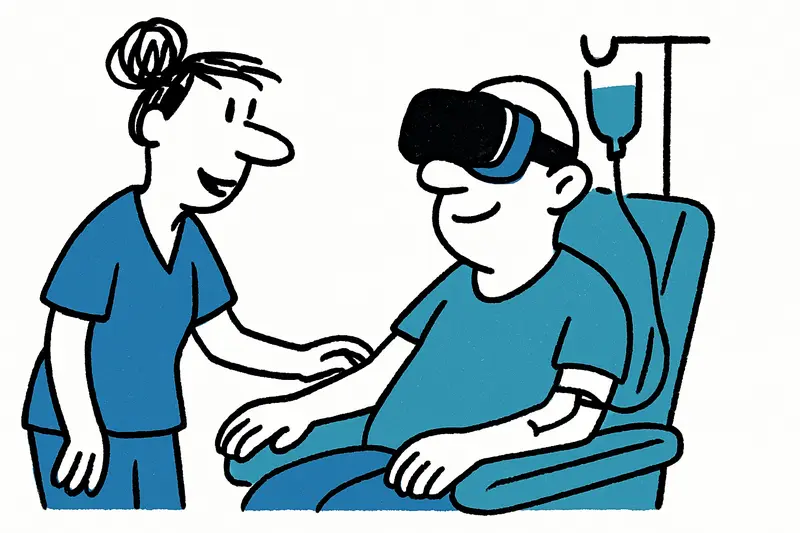
The smell of freshly brewed coffee hangs in the air outside the treatment room at Hospital d'Inca, featured recently in Inca hospital in 'hotel mode': More comfort — but at what price?; occasionally a taxi horn blares outside and the sun beats down on the cobblestones. Inside, patients sit with IV drips, some leafing through magazines, others staring at the ceiling. Recently, a box of virtual reality headsets became part of this scene. For 30 minutes, participants see beaches, whale songs or forest trails and are meant to experience relaxation instead of anxiety.
How is the VR complement to chemo handled in practice?
At check-in the nurse routinely asks about nausea or dizziness, then adjusts the headset, places headphones and starts the session alongside the infusion. Toni, one of the nurses, watches and laughs: "You immediately notice how the tension eases. Some patients suddenly smile, even though they were very quiet before." The duration: usually exactly 30 minutes. Staff documents positive reactions as well as cases of discomfort and stops the session if necessary.
Initial observations — hopeful, but preliminary
The preliminary impressions are optimistic: many report less anxiety, and some say the time on the drip passed faster. Dr. Clara Gómez, who is overseeing the project, is clear: "It is a supportive measure, not a replacement for pain medication or psychological care." The team sees VR as an additional tool that can make daily treatment more pleasant — provided side effects like dizziness are recognized immediately.
The central question: Is VR effective long-term and for whom?
Here it becomes critical: Do 30 minutes of a virtual beach really help against long-term therapy fear, or is it just short-term comfort? The clinic records reactions but also plans longer studies. Important points that have received little attention so far include selection criteria (who benefits, who does not), objective measures of stress reduction and whether VR can influence medication administration or psychological follow-up.
Risks, documentation and ethics
A non-negligible part are side effects: motion sickness, dizziness, occasional nausea. If everyone receives the headset, the risk of incidents increases. The team therefore documents meticulously who watches which scenes, for how long and which reactions occur. Data protection also plays a role: which data do the devices store? Who has access to the session logs? Such questions must be resolved before the approach is expanded.
Funding, training and scaling
The devices were purchased thanks to a local foundation. That's nice — but not every clinic in Mallorca has such support; other local initiatives like Virtual Sea Coves: How VR Calms Children in Son Llàtzer's Pediatric Emergency show different uses. Real expansion requires a clear cost plan: acquisition, maintenance, hygiene, software licenses. Equally important is training nursing staff. Half an hour of instruction is enough for the technology, but not for the clinical assessment of side effects or integration into psychosocial services.
Concrete proposals for next steps
From the team's perspective and with an eye to best practice, the next steps would be: standardized inclusion and exclusion criteria (e.g. known motion sickness), uniform documentation forms, involving psychologists in content selection and randomized studies with control groups. Also useful: multilingual content for the international patient population and clear hygiene protocols for the devices.
Simple comfort — and a realistic look ahead
In the end there is a simple observation: in a bare treatment room a 30-minute dream of the sea or forest can provide some normality. A patient who wished to remain anonymous says: "I feel like the needles are no longer the center of my day." That is valuable. At the same time the project in Inca challenges us to think not only about feel-good effects but also about scientific evidence, clear protocols and fair funding.
Important: Virtual reality is a supplement — not a panacea. If you have questions, you can contact the patient admissions at Hospital d'Inca or speak to the team at the next treatment.
Frequently asked questions
Can virtual reality help chemotherapy patients in Mallorca feel less anxious?
How does the virtual reality session work at Hospital d'Inca?
Are there side effects from using VR during cancer treatment in Mallorca?
Is virtual reality a replacement for pain medication or psychological support?
Who might benefit most from VR at Hospital d'Inca?
Why is Hospital d'Inca testing VR for patients in Mallorca?
Does VR at Hospital d'Inca raise privacy concerns?
Could VR be introduced in other hospitals in Mallorca?
Similar News

"Expensive chaos" and many open questions: What clients can do when a lawyer suddenly stops responding
Several clients complain that a well-known German lawyer in Mallorca has been unreachable for months. Key question: What...
TV tip: 'The Last Problem' — Mallorca as the setting of a classic crime
A classic whodunit on Mallorca: A new miniseries set in spring 1959 brings storm, an isolated hotel and a dense web of s...

Nipping Sea Creatures: Why Bathers in Cala Major and Elsewhere Should Be Cautious
In Cala Major, bathers have reported being nipped by small fish. What is behind it, how can problems be avoided — and wh...
Forced eviction in Santa Catalina: When a 65-year-old slept in her car and showered on the beach — a question of responsibility
The story of Pilar López from Santa Catalina represents a problem affecting many Mallorcans: How can an island with a bo...
New traffic rules from October 1: What Mallorca visitors and locals need to know
From October 1, 2026, Spain will implement far-reaching changes to traffic regulations. Important for Mallorca: greater ...
More to explore
Discover more interesting content

Can Cap de Bou

Townhouse Lleo 72
