
Reality Check at Palma Airport: What the Sparkasse Poster Really Reveals
Reality Check at Palma Airport: What the Sparkasse Poster Really Reveals
The red poster debacle on the airport facade is more than a faux pas. A guiding question, an analysis and concrete proposals for handling advertising formats in Palma.
Reality Check at Palma Airport: What the Sparkasse Poster Really Reveals
Guiding question: How can advertising at the airport be designed without disregarding local sensitivities?
On a late Sunday afternoon, when the city's heat was still steaming from the walls and 27ºC blinked on the displays at Palma Airport, passengers rolled their suitcases over the orange-tiled strip toward the exit. The trolley wheels squeaked, voices blended with announcements – and a huge red banner hung from the parking garage facade that visibly angered many on the island. Shortly afterwards the responsible spokesperson for Sparkasse, Stefan Marotzke, announced that they had decided to have the motif removed. That is the starting point, not the end of the debate.
The case does not concern only the two or three slogans seen at the airport: the provocative phrase that used the word "Malle", a football-like contrast of "Fair Play" and "Fair Pay", and a poppy party line with references to well-known fan chants. Together these advertising motifs raise several questions: Who decides which cultural codes are permitted at an international hub? How can an advertiser better gauge local sentiment? And why was the regional government's reaction so clear – is a quick removal a sufficient response?
Critical analysis: The advertising shows how far marketing campaigns can miss the local reality. A bank is promoting a pan-European payment system (Wero) with humorous, linguistically coloured slogans. Humor depends on the country; a line that seems funny in one market can be perceived as patronising or trivialising in another. Airport space is also a symbolic place: locals, seasonal workers, tourists and decision-makers come together in close proximity. This multiplicity of uses has been visible in previous reporting, for example Flash shoot at Palma Airport: When the terminal briefly becomes a film set — and who should pay. A message that trivialises excess culture is therefore noticed more strongly than it would be at a bus stop in a small German town.
What is missing from the public discourse: three levels are rarely discussed. First, the responsibility of outdoor advertisers and the airport's marketing partners: What review mechanisms exist before large-format motifs are published? Similar concerns about signage review emerged in Tiny Symbols, Big Confusion: Ryanair Pictograms at the Gate in Palma. Second, the role of local stakeholders in approval processes – hotels, municipality, tourism experts and trade unions have an interest there. Third: preventive checks for cultural sensitivity. These points are often only raised once outrage erupts; preventive processes, however, would reduce conflicts.
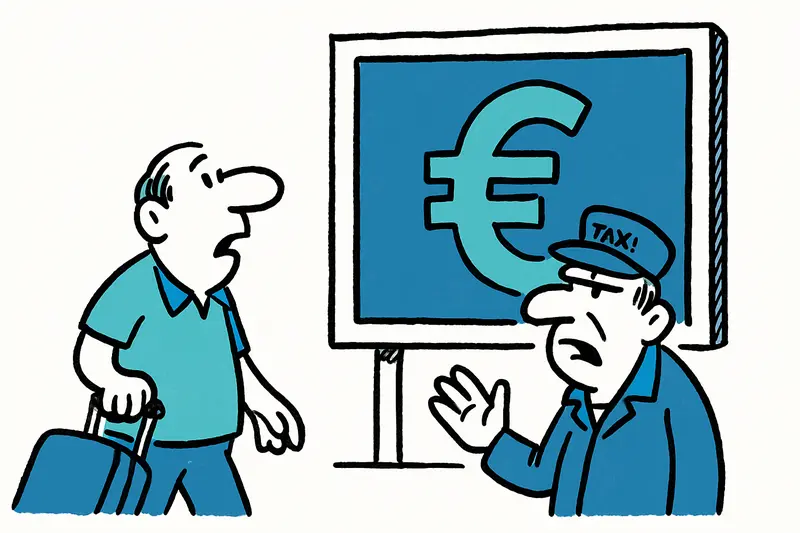
An everyday scene to illustrate: A taxi driver at the exit, waiting for passengers, says he has several times this week seen families talking about the banner. "People shake their heads, some laugh, others are offended," he says. A hotel receptionist finishing her shift adds: "For us it's not a joke – such images end up in chats, are shared, and the mood tips." Such conversations on site show that advertising is not abstract but part of the everyday feeling.
Concrete approaches: First, a binding assessment scale for airport advertising that evaluates cultural sensitivity, seasonal particularities and potential polarization. Second, the establishment of a local advisory board that must be consulted for large-format campaigns – with representatives from tourism, business, administration and civil society. Third, mandatory test runs: show digital campaigns locally in a smaller format first, evaluate reactions and only scale up nationally or internationally if feedback is unproblematic. Fourth: clearer labelling of campaign messages – if humour is used, provide context, not blanket provocation.
Why this matters: Palma lives from the island's reputation. Amateurish outdoor advertising can create an image in minutes that the city, businesses and locals will chew over for days. Removing a poster is a short-term bandage; more sustainable is a process that prevents missteps in the future and enables dialogue. Similar discussions about airport management have arisen elsewhere, as in Seven Hours of Waiting at BER: What the Mallorca Weekend Taught Us.
Conclusion: Sparkasse's quick response – withdrawing the ads and apologising – was necessary. Yet the real question remains: Do we want to keep just reacting, or do we want to establish mechanisms that prevent such irritations? Mallorca does not need censorship forms, but it does need clearer communication between advertisers, airport operators and island society. Otherwise, in the end there will only be an exchange of press releases while tourists and taxi drivers in Palma keep rolling their trolleys over the same tiles and debating what "respectful" should actually mean.
Frequently asked questions
Why did the Sparkasse poster at Palma Airport cause so much criticism?
How should airport advertising in Mallorca be reviewed before it goes public?
What makes humour in advertising risky in Mallorca?
Is Palma Airport a sensitive place for public advertising campaigns?
What should companies consider before running a campaign in Mallorca?
How do locals in Palma usually react to controversial airport ads?
What is the best way to avoid cultural mistakes in Mallorca advertising?
What does the Sparkasse case say about Mallorca’s public image?
Similar News
Three-ton llaut salvaged in Puerto Portals – volunteers clear microplastics from the harbor
During the weekend operation in Puerto Portals, divers pulled an approximately three-ton llaut from the harbor. Associat...
Naked Pillar in Bunyola: Why a Climbing Prank Is More Than an Accident
During the Sant‑Mateu verbena a 20‑year‑old fell at a protected wayside cross in Bunyola and pulled the stone cross off ...
Towel on It, Chair Gone? How Hotels Can Regulate Reservations of Sun Loungers
After a deadly dispute in Greece, the question has resurfaced in Mallorca: Are hotels allowed to ban or sanction the pra...
Illetas: Police Officer and Two Lifeguards Rescue Two Female Tourists from the Sea
Late on Friday afternoon emergency responders entered the water off the coast of Illetas: a local police officer and two...
Inca: Severely injured female dog found in garbage bags in a container – who has seen anything?
In Inca, a severely injured female dog was discovered wrapped in two garbage bags inside a container on Avenida Rei Jaum...
More to explore
Discover more interesting content

Can Cap de Bou

Townhouse Lleo 72
