
Robbery in Palma's Old Town: Luxury Watch Stolen — How Safe Are Evening Walks?
A man loses a luxury watch worth around €56,000 in a stairwell in Palma's Old Town. An arrest in Barcelona shows investigative success — but questions about prevention, civil courage and asset recovery remain open.
Robbery in the stairwell — a scene that used to be rarer here
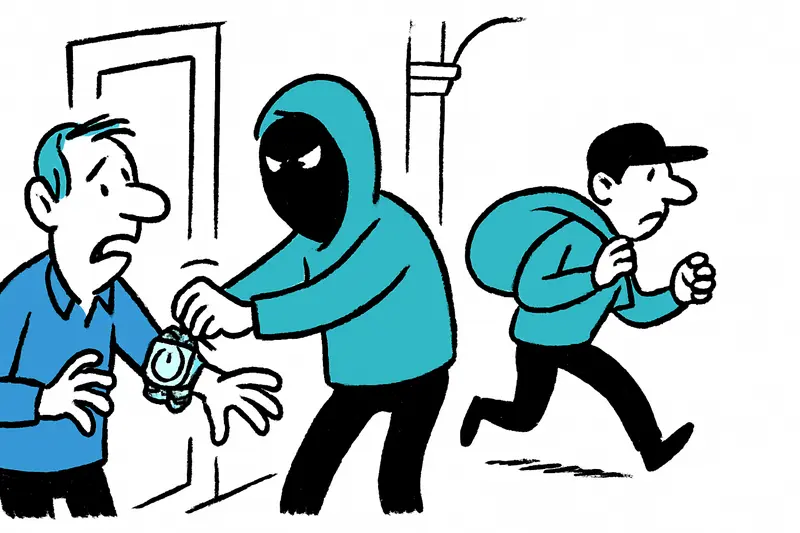
At the end of September, around 8 p.m., in a narrow alley of the Old Town: the evening chimes of the cathedral mix with the distant hum of the street. A man enters a building, stops in the stairwell — and within seconds a teenager tears the watch from his wrist. Then a sprint, a waiting accomplice, and the two are already gone into the darkness. The watch: estimated at €56,000.
What looks like a short, almost cinematic move is bitter reality for the victim and the residents. In Palma, where narrow stairwells, mild evenings and groups of tourists come together, opportunities arise that thieves exploit. The National Police investigated and, following leads, were able to arrest a suspect in Barcelona after the watch robbery — he had left the island. The second perpetrator and the watch remain at large.
The central question: Why are arrests alone not enough?
Arrests are important — but they do not answer the systemic question: How do thieves repeatedly manage to turn high-end watches quickly into cash or untraceable hands? And how can the city ensure that residents and visitors do not have to be constantly on guard in the evenings?
The investigations reveal a familiar pattern: observation, sneaking up, distraction, a quick handoff on the street. Such patterns suggest the acts are planned rather than purely opportunistic. For the police this is useful — patterns can be followed. For residents it means distrust has become a temporary protective mechanism.
Aspects often missing from the public debate
First: the value chain behind luxury watches. These timepieces are small, valuable and sought after worldwide — they can be moved, partially dismantled or resold through opaque channels. Without stricter controls at pawnshops, second‑hand stores and online platforms, a large market remains.
Second: spatial factors. Narrow courtyards, poorly lit staircases and little-used exits create “blind spots.” In Palma's Old Town, where streets like the Carrers are winding, such spots are numerous — charming by day, vulnerable at night.
Third: social factors and tourism pressure. When many people are only briefly in the city, the number of visible valuables increases and so does the likelihood that perpetrators will deliberately choose victims who are distracted or misjudge their surroundings.
Concrete proposals — what could help now
Prevention is more than appeals:
1. More visible presence — more foot patrols by the police in the evening hours, especially at access points to residential buildings.
2. Better lighting and 'watch-the-courtyard' initiatives — simple lanterns, better-lit stairwells and neighborhood networks that quickly share suspicious movements.
3. Tighter trade rules — stricter checks on buying and selling luxury watches, mandatory checks of serial numbers and better international cooperation so stolen pieces can be identified more quickly.
4. Information campaigns — targeted advice for residents and visitors: wear your watch under the sleeve, keep bags closed, avoid displaying conspicuous jewelry in busy areas.
What residents say — small observations with big impact
An elderly neighbor speaks of footsteps in the stairwell that were not heard before. A restaurant owner increasingly hears guests say they pull their jacket over their watch in the evenings. These small adjustments reflect a change in habits: the city is still lively, but the certainty of earlier times has become more fragile.
Investigative success, but questions remain
The arrest in Barcelona linked to the watch theft in Palma's Old Town proves that the investigative chain between the island and the mainland works. Still, the watch is missing and an accomplice remains free. As long as the trade in such items is not transparent and returns to criminal networks are possible, repetition is a risk.
For everyone walking through Palma's lanes in the evening: the bell chimes are still beautiful, the olive trees still smell of summer at night — but a quick glance at your wrist won't hurt. And anyone who saw something should report it. Sometimes small tips make the second step of the investigation possible.
Frequently asked questions
Is it safe to walk through Palma's Old Town in the evening?
Are luxury watches a target for theft in Mallorca?
What should I do if my watch or jewelry is stolen in Palma?
Why are narrow streets and stairwells in Palma's Old Town a concern at night?
How can tourists avoid becoming a target in Palma?
Are there more police patrols in Palma's Old Town at night?
Can stolen watches in Mallorca be resold easily?
What can residents do to make Palma's Old Town safer?
Similar News

Meager Industry in Mallorca: How the Island Can Be More Than Just Tourism
The industrial sector in Mallorca is shrinking, productivity is falling and firms remain tiny. The key question: can the...
Pre-Nit de l'Art: Galerie Mensing invites to a special evening with Tom Boston
Before the big art night, Galerie Mensing opens its doors: pop art, champagne, a DJ and a hand-signed print by Tom Bosto...

Sea view and more seats: Cappuccino Grand Café reopens in Port d'Andratx
After a long renovation, the Cappuccino Grand Café on the Port d'Andratx harbor promenade has quietly reopened. Larger t...

Enric Mas wins the Vuelta – a triumph that resonates in Mallorca
Mallorcan Enric Mas has won the 82nd Vuelta — the first Spanish overall victory since 2014. Cyclists and neighbors on Ma...

Body at the Llevant Market: A Death That Raises Questions About Care for the Homeless
A man was found dead near the Llevant Market. Authorities describe it as a natural death; a companion had reported feeli...
More to explore
Discover more interesting content

Can Cap de Bou

Townhouse Lleo 72
