
Dangerous Steps: How risky are Ryanair's retractable 737 stairs?
Dangerous Steps: How risky are Ryanair's retractable 737 stairs?
Numbers from an investigation show: the integrated, extendable stairs on Boeing 737s are narrower and steeper than normal airport steps — and lead to more falls. What does this mean for passengers in Mallorca and who must act?
Dangerous Steps: How risky are Ryanair's retractable 737 stairs?
Key question
Key question: Are the retractable stairs on Boeing 737s an avoidable safety risk — and who in Mallorca bears responsibility to ensure passengers board safely?
Brief analysis
A recent investigation by the competent flight safety authority documents that since 2021 several hundred passengers were injured on the metal steps of internal aircraft stairs. In Italy alone, more than a hundred reported fall cases were recorded for 2023–2025. The figures indicate that the risk with retractable stairs is noticeably higher than with conventional airport steps — in the evaluated datasets at least twice as high. For context on operational safety incidents, see Back after takeoff: What a 'toilet problem' reveals about flight safety.
Technically, these stairs are built compactly: twelve steps, just under 61 centimetres wide, step height about 20 centimetres, incline around 35 degrees. The standard for fixed airport boarding stairs normally requires significantly more width (at least 100 centimetres), shallower steps and larger tread surfaces. Notably: the top step at the aircraft is trapezoidal — due to the shape of the fuselage — and therefore differs from the rest of the staircase, which makes the transition unfamiliar.
What public discourse often omits
There is a lot of discussion about prices and punctuality, and less about specific operational decisions that affect safety. Three points are often missing from the debate: first, clear responsibilities between the airline, the airport operator and the manufacturer; second, a concrete assessment of risk groups (older travellers, families with small children, people with mobility impairments); and third, practical guidelines for airports with heavy holiday traffic — like Son Sant Joan in Mallorca, as reported in Ryanair Hand Luggage Checks: Between Efficiency and Frustration at Palma Airport — so that the cheaper solution does not automatically become the riskier one.
A typical Mallorca scenario
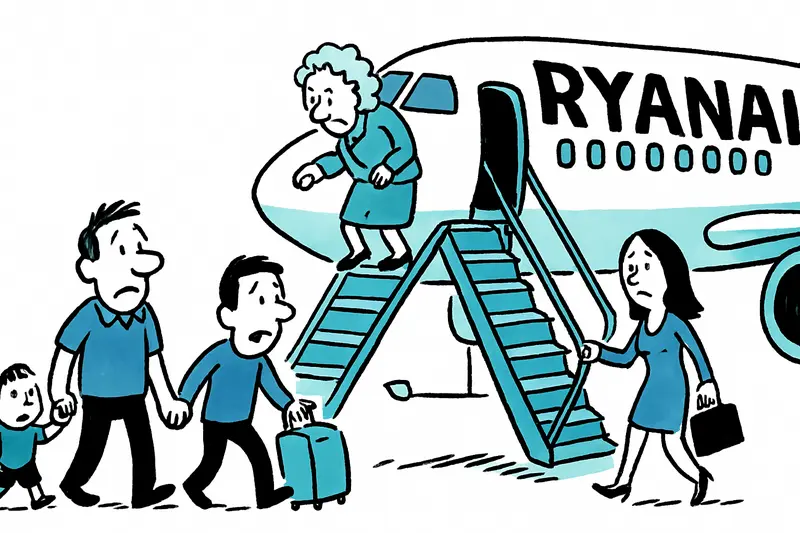
Imagine this: early morning in Palma, Terminal B. A bus pulls up, oversized luggage rattles, the sun is already shining through the terminal glass. Older holidaymakers with wheeled suitcases, a father holding two children by the hand, a woman travelling alone in high heels — all are supposed to use the aircraft's folded-out stairs. The steps are narrow, the stair run is short, the pace is high because boarding must proceed quickly. Such moments are typical and explain why accidents happen here.
Concrete solutions
No miracles are needed, but three practical changes would help: (1) Clear operating rules: when an aircraft can use available ground-level stairs or a jet bridge, the safer option should be preferred — especially on flights with many seniors or families. (2) Technical improvements: non-slip coverings, clearer markings on the trapezoidal top step and, where possible, a slight reduction in step height could reduce missteps. (3) Human assistance: deploy ground staff specifically where needed; make short PA announcements and visible indicators for who needs help; and provide training for quick, safe assistance during boarding and disembarkation.
Who should take action?
Responsibility is shared: manufacturers provide the option, airlines decide on its use, airports organise the ground handling. Authorities can set binding minimum requirements or issue recommendations — for example on width, incline or on prioritising safer ground stairs at busy holiday destinations, as underlined by incidents such as Frightening Seconds over Palma: Two Flight Attendants Injured.
Conclusion
The facts are clear enough: compact, steep, narrow stairs carry a measurable risk. In Mallorca, where people of all ages travel daily, the motto should be: practical safety over saving time. A few manageable changes are enough to prevent some falls. Not a big drama, but action is needed — and now.
Frequently asked questions
Are Ryanair's retractable stairs on Boeing 737s a safety risk for Mallorca-bound passengers?
Who is responsible for safe boarding with retractable stairs in Mallorca airports?
Which travellers are most at risk from retractable stairs?
What practical steps could improve boarding safety with retractable stairs at Mallorca airports?
What might a typical Mallorca boarding scene look like with retractable stairs?
What concrete safety improvements have been proposed for retractable stairs?
Are there guidelines on ground stairs for busy Mallorca destinations?
Should travelers seek assistance during Mallorca boarding when retractable stairs are used?
Similar News
Up to €9,000 Fine in Inca: Why Wet Wipes Can Blow Up the Sewers — and What We Should Really Do
The municipality of Inca warns of blockages caused by wet wipes — fines of €300 to €9,000 are possible. A reality check:...

World Cup Trophy in Palma: Two Days Up Close
The World Cup trophy is coming to Palma at the end of October: two days on display at City Hall, and on 31 October photo...

End of October: Can you still swim in the sea in Mallorca?
The late-autumn sun still warms the air and the sea has retained its summer heat—many people don't pack away their swimw...
Years of abuse in Costa de la Calma – Neighbor calls Guardia Civil
In a villa in Costa de la Calma a neighbor alerted the Guardia Civil: a 19-year-old woman reported years of violence by ...

Schauinsland Takes Over Management of the Morito in Cala Millor – a Reality Check
From March 2027 the German tour operator Schauinsland will manage the Morito hotel in Cala Millor. The Batle Erikson fam...
More to explore
Discover more interesting content

Can Cap de Bou

Townhouse Lleo 72
