
Sant Elm: Car slides down the embankment — Driving without a license and insurance raises questions
In Sant Elm a car rolled more than three meters down the slope. The young driver had no license, the vehicle was deregistered and apparently uninsured. The case has rekindled the debate in Mallorca over foreign vehicles and inspections.
Small bang, big question mark: What went wrong in Sant Elm?
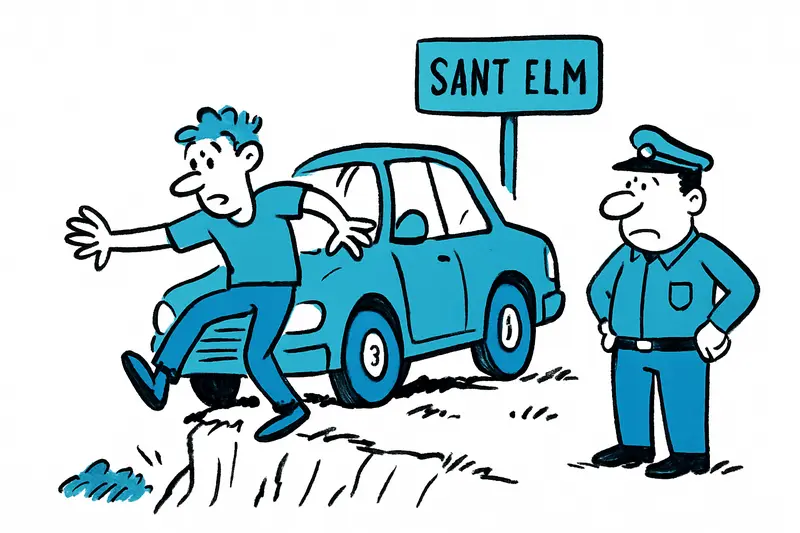
On Tuesday afternoon, as seagulls circled above the small harbor and the Tramuntana sent only a light breeze, the usual calm in Sant Elm was torn apart for a moment. On the parking area above the beach a car lost control and rolled over the edge — more than three meters down, until the sheet metal came to rest in the bushes. Bathers and walkers who had heard the crash alerted emergency services and the police, as reported in Sant Elm: Family car rolls down embankment – 18-year-old without a driving license at the wheel.
An ambulance and patrols of the Policía Local from Andratx arrived quickly. The driver, a 20-year-old, suffered minor injuries and received outpatient treatment, details appear in Accidente en Sant Elm: joven de 20 años hace caer un coche por un talud — sin licencia ni seguro. Luck was on the side of those present: neither passers-by nor other vehicles were hit. But the end of the immediate incident was only the beginning of the questions.
Main question: How could a vehicle without a license, insurance and with foreign documents park here freely?
During the check, officers noticed several things: the car had German license plates, was officially deregistered according to the records and was apparently travelling without valid motor insurance. The young man could not produce a driving license and said the vehicle belonged to his stepmother. Whether that is true and how a deregistered vehicle ended up on a public parking area at all must be clarified by the investigations, as also covered in Coche familiar cae por un talud en Sant Elm: joven de 18 años conducía sin licencia ni seguro.
The combination of foreign registration, deregistration and missing insurance makes immediate clarification difficult: a look at the windshield is not enough here, the official data are held by authorities on both sides of the border. This creates a vacuum that causes annoyance in everyday life — and in the worst case endangers people.
More than an isolated case: Systemic gaps become visible
On Mallorca such cases are not just a footnote. Residents repeatedly report improperly registered vehicles that travel here for long periods without local registration. This leads to several problems: lack of insurance coverage in accidents, unclear responsibilities for parking offenses or traffic violations and limited control options for the local police.
Especially in summer, when parking spaces are scarce and the roads are busy, improperly registered vehicles can quickly become hotspots. A café owner in Sant Elm said he had heard the crash and ran outside immediately: "You don't see this every day here. Fortunately nobody was seriously injured." Such voices show how close everyday life skirts the risk.
What authorities can do — and what we should call for
Investigations for driving without a license and on suspicion of missing insurance are underway. But beyond that, measures are needed that address the causes: more cooperation between local police forces, the Guardia Civil traffic information and foreign authorities would be a start. Digital interfaces that allow registration and insurance data to be queried across borders would ease controls.
Practical measures on site are equally important: clearly visible no-parking signs at exposed parking spots, increased checks in sensitive zones such as cliff-edge parking areas, and awareness campaigns for rental agencies and families who bring vehicles from abroad for extended periods. Clear communication of fines and consequences can also have a deterrent effect.
Concrete opportunities: Digitization and neighborhood watch
One opportunity lies in digitization: if local police departments had direct access to EU-wide vehicle data, cases like the one in Sant Elm could be resolved more quickly. That requires political work at the level of the Balearic Islands and Madrid, and improved links with national systems such as the Dirección General de Tráfico (DGT) services, but small steps like standardized reporting forms for municipalities or central hotlines for suspected cases could be implemented immediately.
The neighborhood can also help: anyone who notices noise, unusual movements or a vehicle without a license plate should secure photographic evidence and inform the Policía Local. Every piece of information helps investigators, and sometimes a tip prevents worse outcomes.
Conclusion: Lucky — but not a free pass
Sant Elm got off lightly this time. But the incident is more than a locally told anecdote about a fender-bender: it reflects structural problems in dealing with foreign vehicles on Mallorca. If politicians, authorities and citizens do not work together, the island remains vulnerable to a quartet of issues: deregistered cars, missing insurance, legal grey zones and overburdened controls.
In short: Police and the public prosecutor's office are now examining responsibilities. Officers continue to ask for witnesses — every photo, every observation can help to finally clarify the sequence of events.
Frequently asked questions
What should I do if I see a car crash near a beach parking area in Mallorca?
Can you drive a car in Mallorca without a valid driving licence or insurance?
How can foreign-registered cars become a problem on Mallorca?
Is it safe to park near the edge of a slope or embankment in Sant Elm?
What does police check after a car accident in Mallorca?
Why are parking problems in Sant Elm worse in summer?
How can residents help report a suspicious vehicle in Mallorca?
What can Mallorca authorities do about cars with unclear registration or insurance?
Similar News

Who will clean up? Illegal rubbish heaps on the highway near Son Gual drive residents onto the streets
For months, construction debris and household waste have piled up along the highway between Palma and Manacor near Son G...

Amundi takes over Bikini Island & Mountain Port in Sóller – many questions remain open
The French asset manager Amundi has acquired the four-star Bikini Island & Mountain Port hotel in Sóller from an Austria...

Silvia was allowed to see the sea once more – a small farewell in Port de Soller
A team from the Balearic health service IB-Salut fulfilled a terminally ill woman's wish: one last trip to the water in ...
Magaluf: Imprisonment for Beach Club Employee after Theft of a Bag — What the Ruling Overlooks
A former dishwasher received a one-year prison sentence for stealing a Louis‑Vuitton bag. The appellate court upheld the...

Road collapse at Port de Valldemossa: Who will pay for the next wave of damage?
A section of the MA-1131 near Port de Valldemossa slipped after heavy rains from cold front "Adam". Residents are strand...
More to explore
Discover more interesting content

Can Cap de Bou

Townhouse Lleo 72
