
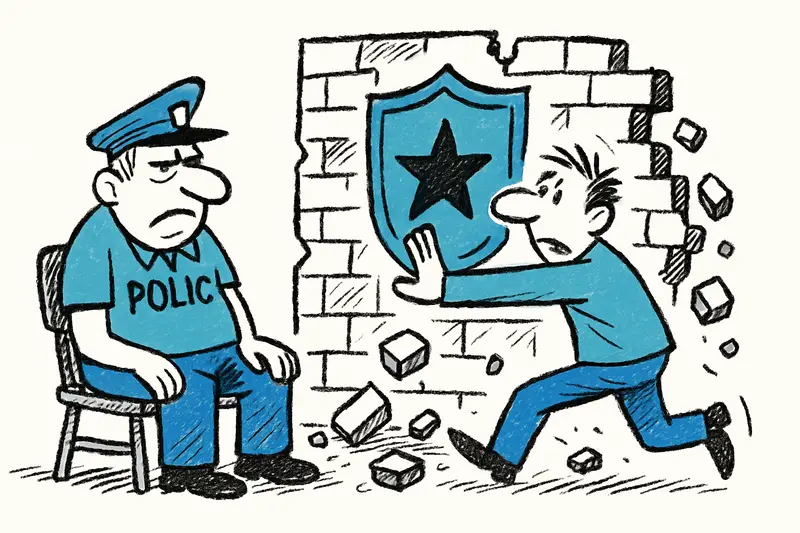
Santa Margalida: When the police's protective walls are crumbling
Santa Margalida: When the police's protective walls are crumbling
Officers in Santa Margalida complain about staff shortages, exhaustion and rigid surveillance. Can the municipality ensure safety under these conditions — and what is missing from the debate?
Santa Margalida: When the police's protective walls are crumbling
Lead question: Can a municipality like Santa Margalida, with understaffed, demotivated local police and a climate of constant surveillance, still reliably ensure public safety?
Critical assessment
On paper the local police of Santa Margalida have 23 officers, 15 of whom work in shifts. On the ground you hear different numbers: officers who say this staffing is hardly enough to sensibly cover the municipality's three locations – Santa Margalida, Can Picafort and Son Serra. In fact, colleagues say 35 to 50 officers would be necessary to reliably run patrols, prevention and rapid responses. With fewer staff the burden on those who remain increases. Exhaustion, longer response times and an increased risk of accidents and errors are not abstract terms but everyday reality. Recent incidents such as Burglary Spree on the MA-12: How Safe Do Santa Margalida and Muro Still Feel? have amplified residents' concerns.
What the debate oversimplifies
Public discussion mainly revolves around numbers. What has been missing so far is a sober analysis: How are deployments distributed over time and space? Which tasks could be regionalized or delegated to the Guardia Civil and Policía Nacional? How large is the budget for new hires? Who is responsible for training and duty planning? These gaps are rarely named, which is why demands remain vague and solutions non-binding. The Guardia Civil's interventions in other hotspots, for example Mirador d'es Colomer: Three Arrests — How Safe Are Mallorca's Viewpoints Really?, illustrate coordination challenges.
Morale and the view of colleagues
Between the market stalls in Can Picafort, when the wind from the sea carries the smells of roasted almonds and wet asphalt, police speak more quietly. It's not just about overtime, but about a leadership style that sows distrust: cameras in the station, GPS monitoring of vehicles even outside duty hours, the feeling of being constantly watched. In such situations team climate crumbles. Colleagues become more cautious, less willing to take responsibility — exactly the opposite of what a civilian protection force needs. At the same time, broader moves to increase surveillance, like those described in Palma Tightens Controls: More Security — or a New Punitive Culture?, fuel the debate about effectiveness versus punitive culture.
Analysis: Why this is problematic
Staff shortages alone do not explain everything. What matters is how the available resources are organized and how personnel are treated. Strict control without clear agreements with staff councils leads to frustration. Lack of psychological support and hardly regulated breaks increase the risk of errors and of absences due to illness. And when service vehicles are monitored by GPS, a pressure to justify actions arises that turns preventive presence into purely reactive service operations.
Concrete: Measures that would help
- Short term: Inter-municipal agreements to reinforce resources during peak times; temporary secondments from neighboring municipalities or regional reserve units.
- Medium term: A transparent personnel plan with clear target numbers, accompanied by recruitment and training programs as well as premiums for difficult shifts.
- Leadership culture: Service agreements on surveillance (cameras, GPS) in consultation with staff representatives; mandatory training for leaders on staff management and stress management.
- Health: Access to psychological support, mandatory rest periods, programs against burnout.
- Citizen participation: Public safety day(s) with concrete performance goals and measurable indicators so that politicians and the public know what to expect.
What must happen now
The administration in Santa Margalida has a duty to respond transparently. Talks between the mayor's office, police leadership and the workforce must deliver binding interim steps: a personnel plan, short-term reinforcements, written rules on surveillance. Without visible measures the risk grows that the already scarce police service will deteriorate further — with consequences for everyone who lives and works here. Calls for social responses are echoed by analyses such as After Arrest in s'Arenal: Police Are Not Enough — Social Solutions Needed.
Conclusion: Security is more than statistics. It depends on reliable services, fair leadership and the trust of those who stand outside day and night. Ignoring this is irresponsible toward a small municipality where the sound of a night siren is still the strongest alarm signal.
Frequently asked questions
Is Santa Margalida on Mallorca dealing with a police staffing problem?
How many local police officers does Santa Margalida have on Mallorca?
Why are residents in Santa Margalida worried about public safety?
What is the situation with policing in Can Picafort, Santa Margalida?
How are local police monitored in Santa Margalida?
What would help improve police coverage in Santa Margalida?
Does Santa Margalida need more coordination with the Guardia Civil?
What are the main challenges for police work in small Mallorca municipalities like Santa Margalida?
Similar News
Palma, Palma de Mallorca, Palma‑Mallorca: What is it really about?
The debate over the city's name is more than grammar: it concerns identity, law and branding policy. A sober reality che...
Warning to Bathers: Nipping Fish in Cala Major and Other Coves — a Reality Check
In Cala Major and several beaches around Mallorca, bathers report painful “nips”. Who are the animals, why are they gett...

Rental Car Theft in El Arenal: What This Incident Reveals About Our Gaps
A teenager steals a running rental car in El Arenal, flees on foot, climbs over walls and is caught by the Guardia Civil...
Red Rope in Palma's Library: What Helps Against Selfie Tourism — and What's Missing
Palma's city library cordoned off an area with a red rope to keep selfie tourism away from reading and working activitie...

Fort San Carlos: Museum, Harbor Dispute — and a Conflict That Demands Answers
The military museum at Fort San Carlos sits right on Palma's harbor, with unexpectedly quiet rooms filled with cannons a...
More to explore
Discover more interesting content

Can Cap de Bou

Townhouse Lleo 72
