
Ses Salines Celebrates Art: ArtinSal Turns the Village into a Gallery
More than 70 artists, open houses, music on the Plaça Sant Bartomeu and the Església Vella as an exhibition space: ArtinSal transformed Ses Salines into a lively meeting place for art and community in one evening.
Ses Salines Celebrates Art: ArtinSal Turns the Village into a Gallery
How streets, churches and private homes opened everyday life for one evening
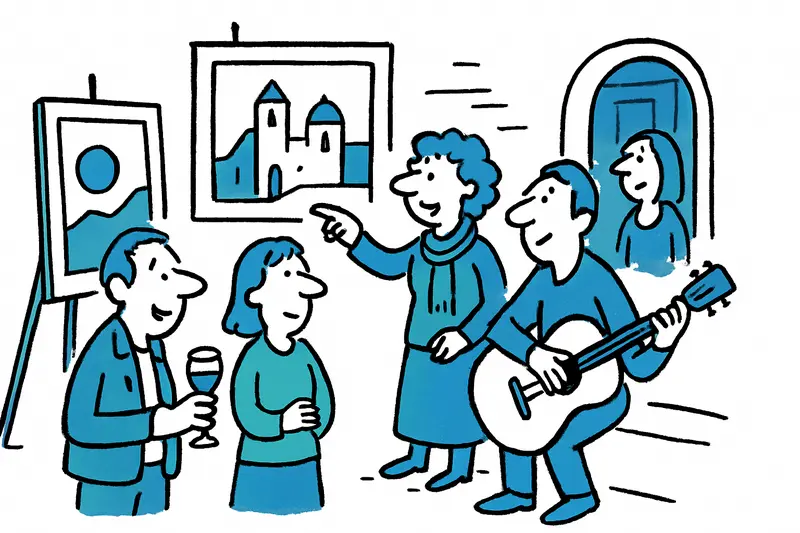
On Saturday evening there was something special in the air in Ses Salines: not a routine exhibition marathon, but a joyful coming and lingering. The Plaça Sant Bartomeu buzzed—not with cars, but with voices, guitar sounds and the clinking of wine glasses. People walked along the Carrer Major, stopped in front of a painting, looked up, exchanged a comment and moved on to Carrer Sitjar or Carrer Batle Andreu Burguera Mut. Over everything hung the slight uncertainty of the weather forecast — and the relief when it stayed dry.
ArtinSal brought together over seventy artists in this edition. What was remarkable was less the number than the way the works were shown: not in a closed space, but spread across the whole center. The Església Vella opened its doors as an exhibition venue, private homes, some with curved staircases and thick wooden doors, became galleries for an evening. In front of a house that used to be the town hall, visitors declared the landing a resting area; there stood people you wouldn't normally see at an opening — neighbors with shopping bags, tourists with cameras, young people with colorful scarves.
The town council of Ses Salines supported the night organizationally and visibly watched how encounters unfolded. Mayor Guillem Mas Bonet and the councilor for Culture, Tourism and Heritage, Sebastiana Gomila Amengual, stood alongside curator Inmaculada Bianchi when the edition was presented. Inma Bianchi could be found everywhere that evening: she arranged final details, greeted artists and answered questions with a mix of pragmatism and warmth rarely experienced so closely.
I had hung my own paintings in a private house — a place with history. Where the village's first town hall once stood, acrylic and oil paintings now hung on the walls. The owners had opened their doors not as mere stage dressing but as a gift to the place. People went up and down the stairs, paused in small groups, and sometimes one almost forgot why one had come: not only to see artworks, but to share a piece of community.
Live music mixed with conversations from time to time. An accordion here, a DJ set there, a performance in front of the church — the chill of the early autumn night was more of a motif than an obstacle. Children ran barefoot across the square, an older man nodded along on a bench, and at the edge volunteers handed out programs and explained where which artists could be found. These scenes showed how easy it is to make culture accessible when infrastructure and people cooperate.
What struck me most: it was not just about seeing. Visitors asked about techniques, had the path of a painting explained to them, talked about material costs and inspiration. Artists stood ready, explained, laughed, maybe even negotiated a sale — but mostly you heard genuine interest. It's a small but important sign: that evening art was not treated as an elitist good, but as a basis for conversation.
Evenings like this do the island good. They connect generations, give old buildings new purpose and show that culture is not a luxury, but part of daily life. For Ses Salines this means a stronger identity that appeals to both locals and visitors. That the municipality, the curator and private hosts worked hand in hand is a model other places in Mallorca could adopt.
What remains is the memory of a village that opened its windows for one night. The paintings were taken down, the music boxes switched off, but the conversations lingered long after: ideas, contacts, invitations. ArtinSal was not just an art night — it was a promise that culture here does not remain confined to rigid rooms, but grows on streets, in churches and in homes.
A look ahead: if municipalities continue to support such formats and neighbors are willing to share their living rooms, lasting networks will form. The next edition of ArtinSal can then grow not only in numbers but in depth — with workshops, school projects and stable collaborations between artists and public bodies. Until then remains the image of a summer night in early autumn: people talking, a bit of wine, an open door and the good feeling of having been part of something together.
Frequently asked questions
What is ArtinSal and how did it transform Ses Salines into a village gallery?
When does ArtinSal happen and how does the weather affect it?
How were private homes involved in ArtinSal?
What role did Església Vella play in ArtinSal?
What was the atmosphere around Plaça Sant Bartomeu during ArtinSal?
How did ArtinSal affect community and cultural life in Mallorca?
What could help formats like ArtinSal grow across Mallorca?
What lasting takeaway does ArtinSal offer for Ses Salines and similar towns?
Similar News

After Accident in the Tramuntana: Mourning — and the Question of Rally Safety
The death of Klaus Rader at the Rally 550 Challenge Mallorca has shaken island residents and participants. His wife aske...
Does Pedro Sánchez Have Better Odds in New Elections? A Reality Check from Mallorca
Sánchez weathers setbacks, forms tactical coalitions — but is that enough in new elections? A critical look with an ever...
More than five tons of waste from the sea: Who cleans up when plastic keeps washing ashore?
In September, response boats in the Balearics recovered over 5.3 tons of waste from the sea and coasts — almost half of ...

Loose dog on the MA-19: Rescue — and an uncomfortable question
A large dog ran across the carriageway of the MA-19 near exit 12 on Sunday morning. The Local Police captured the animal...
Cala Rajada: Why the "Sharky's" Keeps Closing — a Reality Check
The "Sharky's" at Cala Agulla is vacant again. High takeover price, expensive rent and a damaged reputation: What is rea...
More to explore
Discover more interesting content

Can Cap de Bou

Townhouse Lleo 72
