
Several Days of Rain Approaching: How Well Is Mallorca Prepared?
Several Days of Rain Approaching: How Well Is Mallorca Prepared?
Aemet says: rain from Thursday until at least Tuesday, especially heavy on Monday. Temperatures remain mild. A reality check for roads, barrancos and people on the island — and practical tips on how to get through the coming week safely.
Several Days of Rain Approaching: How Well Is Mallorca Prepared?
Key question: Are the precautions and information on the island sufficient when Aemet forecasts several days of precipitation — and what can each neighborhood still do now?
Aemet has predicted a phase of persistent rain for Mallorca: the sky is expected to thicken already on Thursday, with initial showers possible, and recurring precipitation is forecast until at least next Tuesday; the service reports significantly heavier rainfall on Monday. Temperatures will drop only moderately: daytime highs from around 32 °C to about 27 °C by Tuesday, while nights remain comparatively warm with values above 19 °C. A striking point in the recent measurement mosaic: in the past days thermometers still climbed locally above 31 °C (Muro 31.6 °C, Pollença 31 °C, Porreres 30.8 °C, Sa Pobla 30.2 °C, Colònia de Sant Pere 30.1 °C) — the air is heavy and humidity is high.
At first glance this sounds like an inconvenient week: rethinking beach plans, postponing garden work, drying wet towels. But the real question is less whether one needs an umbrella and more whether our infrastructure, settlements on slopes and the often narrow roads can withstand the stresses.
Critical analysis: Aemet predicts prolonged rain and individual episodes of heavier precipitation. In this situation small streets can quickly turn into streams and barrancos (torrent beds) can become raging waterways within a very short time. In Palma, during heavy rain the Plaça Major or the pedestrian areas near Passeig Mallorca can very quickly become obstacle courses for pedestrians and cyclists. Drainage systems are in some places outdated or clogged; leaves, sand and construction debris reduce the capacity of drains. With longer, but not extremely cool nights the air remains humid — this burden is felt especially by older people in city apartments who lack air conditioning to remove moisture.
What is missing in public discourse: There is currently too little focus on three things at once: small-scale infrastructure (cleaning street drains and barrancos), concrete behavioral guidance for everyday situations (which streets to avoid? where are assembly points for help?) and locally tailored warning communication. General weather warnings get through, but often lack the street- or neighborhood-level specification: the neighborhood at Torrent de sa Riera is not the same as Alcúdia’s old town.
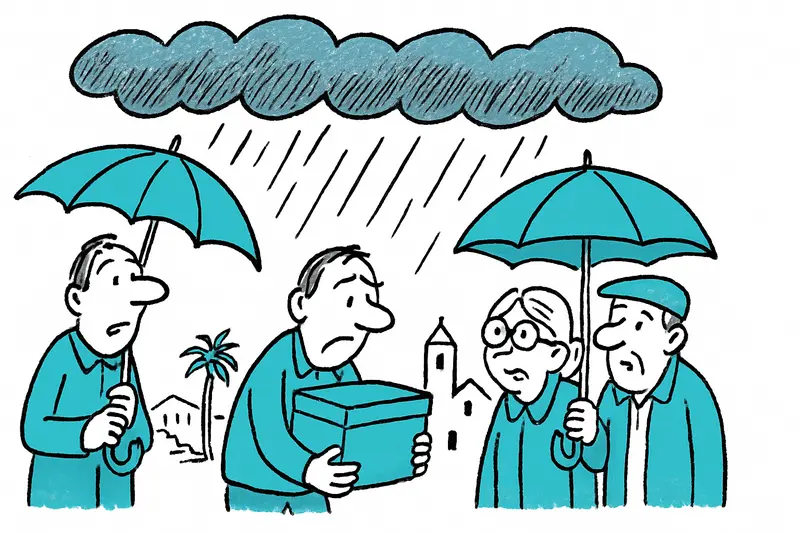
Everyday scene: A short walk through Palma in the early evening hints at the pattern to come: on the Passeig des Born restaurant owners are already folding in awnings, a delivery driver moves through the alleys trying to protect his plastic boxes, and at the Plaça de la Porta de Santa Catalina a group of seniors under umbrellas discuss whether the Friday market should even open. In the eastern suburbs fishermen check their racks and covers in the harbor, while in the Tramuntana people cast their first glances toward the clouds — tour guides pack their bags, beach towel renters begin to secure benches.
Concrete approaches: Some measures are short-term and locally implementable: 1) Municipal services should prioritize inspecting and, where necessary, clearing drains, street inlets and known barrancos. 2) Neighborhood groups can compile lists of particularly vulnerable residents (elderly, people with mobility limitations) and organize help with shopping or emergencies. 3) Homeowners on slopes and near torrents should secure balcony doors and cellar openings, fasten garden furniture and empty or secure rain barrels now. 4) Drivers: never drive through standing water; reduce speed and increase distance. 5) Small businesses and beach rental operators: store goods and electrical cables at height, check boats on land. 6) Municipal websites and social channels should be fed with precise, neighborhood-specific guidance — not only general yellow/orange/red alerts.
Technically feasible but not immediately implementable are better coordinated local early-warning systems: SMS lists for registered residents, targeted maps showing flood risk by street, or mobile sirens for particularly low-lying zones. Such measures require planning — for the present situation simple, coordinated neighborhood actions help the most.
Conclusion: The coming rainy spell is no reason for panic, but it is a prompt to abandon old routines. Those who secure their shutters on Thursday, check garage thresholds and avoid disposing of waste into street drains have in many cases already prevented the worst outcomes. Keep an eye on Aemet, avoid low streets on Monday during heavy rain and maintain phone contact with neighbors who might need support. The island is experienced with weather changes — a bit of preparation from all of us significantly reduces hassle and risk.
Frequently asked questions
What’s the best time of year to visit Mallorca for outdoor activities?
What should I pack for a trip to Mallorca?
Are there family-friendly beaches in Mallorca?
How can I get around Mallorca without a car?
Is it safe to swim in Mallorca’s sea?
What are some must-see experiences in Mallorca?
What are easy day trips from Palma?
Do I need to speak Spanish or Mallorquin to visit Mallorca?
Similar News
Nervous Reaction at a Traffic Stop: Why Campos Is Not Just a Sniffer-Dog Problem
At a traffic stop in Campos a 37-year-old German was arrested with a bag full of drugs. Our reality check explains why s...
Cameras Against Illegal Dumping: Porto Cristo Monitors Problem Areas – a Reality Check
Manacor has installed four surveillance cameras at particularly problematic waste spots in Porto Cristo. A local check a...
Reality check: Palma's "white" torrent — harmless salt or neglected warning sign?
White crusts on the Torrent de Sa Riera are causing a stir. Emaya describes them as salt deposits. Our reality check: wh...
When Ryanair's fleet grows: What Mallorca's travelers should know
Ryanair will soon receive 737 Max 10 jets. The larger aircraft offer potential savings — but also new risks for flight o...
Rising fuel and housing costs: Why Mallorca's overland buses are suddenly overcrowded
More and more people are leaving Palma — and boarding TIB buses: Between January and August 2026, the network recorded o...
More to explore
Discover more interesting content

Can Cap de Bou

Townhouse Lleo 72
