
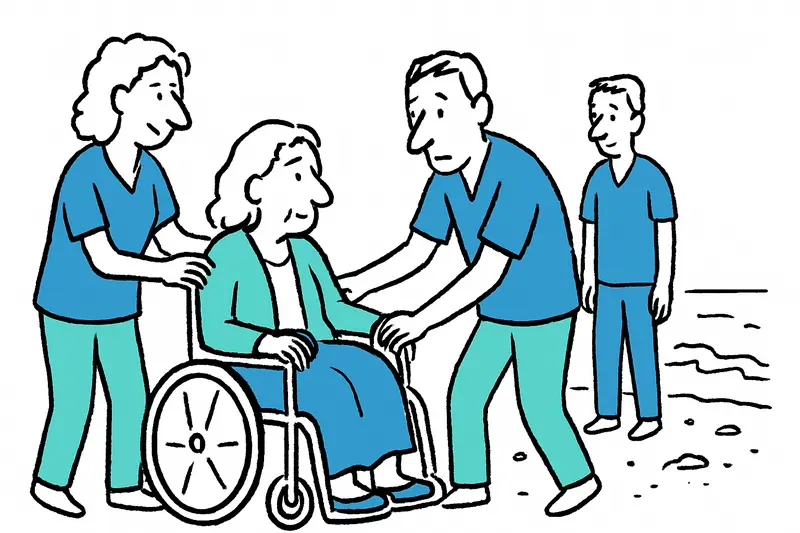
Silvia was allowed to see the sea once more – a small farewell in Port de Soller
Silvia was allowed to see the sea once more – a small farewell in Port de Soller
A team from the Balearic health service IB-Salut fulfilled a terminally ill woman's wish: one last trip to the water in Port de Soller. A quiet moment that shows how care can go beyond medicine.
Silvia was allowed to see the sea once more – a small farewell in Port de Soller
A simple gesture that remains in memory: nurses and carers accompanied a dying patient to the coast
No big words are needed when the waves brush the pebbles and the air smells of salt. Last week a team from the Balearic health service IB-Salut brought the patient Silvia to the beach in Port de Soller. The outing didn't last long, but it was meaningful for everyone involved.
When the small convoy arrived at the harbor, the clatter of the tram tracks mixed with the calls of the seagulls. A few fishermen sat on their crates mending nets, the promenade was quieter than in summer, and the wind carried the familiar blend of sea and pines. Silvia was gently lifted from the vehicle; the helpers spoke softly, step by step. No one protested the silence — it belonged to that moment.
IB-Salut documented the event in a short video to show how care can extend beyond medical treatment. It's about listening, about eye contact, about taking wishes seriously when time is short. The nurses and carers who accompanied Silvia were visibly moved afterward; tears mixed with the salty scent of the sea air. Such scenes stick with people — with relatives, with staff, and with neighbors who watched the little procession to the beach.
For the island this is not merely an anecdote. In an area that depends on tourism and often seems fast-paced, these quiet moments are a reminder: public health services can also be places of humanity. When people in their last weeks or days want something serious and personal — a look at the sea, a favourite song in the distance, a hand to hold — arranging these small wishes can significantly improve quality of life.
On site several practical details made the outing possible: flexible team schedules, short transport routes from the clinic to the coast, and the willingness to care for medical equipment on the move. Such procedures can also be used in other parts of Mallorca. A thought for municipalities and health institutions: small kits for outside appointments, training for emotional support and clearly regulated transport routes — it costs little but has great impact.
The scene in Port de Soller is also an invitation to the neighbourhood: listen, ask about wishes, offer help when someone needs it. Sometimes a walk to the harbour, a borrowed wheelchair or a phone call is enough. Volunteer groups, church communities and local associations could cooperate more closely with care services so that more people can experience such final moments.
At the end of the day the convoy drove back and the promenade slowly emptied again. For Silvia it was a moment at the sea, for the carers an experience that connects work and humanity. Such stories do not make a big fuss; they are quiet and familiar — just like the sea that continued to roar behind them. In Mallorca it remains comforting to know: medicine can relieve pain, but sometimes it most of all gives dignity and closeness.
What you can do: Ask your family about last wishes, talk openly about palliative options, offer help with transports or get in touch with local support groups to find out how you can assist care teams. Small gestures create moments that remain.
Frequently asked questions
How can hospitals in Mallorca arrange small outdoor outings for patients?
How should families talk about end-of-life wishes in Mallorca?
What made the Port de Sóller moment special?
How can communities support palliative care in Mallorca?
What practical steps enable outdoor medical visits in Mallorca?
Where can I learn about palliative care options and support groups in Mallorca?
Do Mallorca health services document compassionate care moments?
What should I consider packing for an outdoor visit with a patient in Mallorca?
Similar News
Magaluf: Imprisonment for Beach Club Employee after Theft of a Bag — What the Ruling Overlooks
A former dishwasher received a one-year prison sentence for stealing a Louis‑Vuitton bag. The appellate court upheld the...

Road collapse at Port de Valldemossa: Who will pay for the next wave of damage?
A section of the MA-1131 near Port de Valldemossa slipped after heavy rains from cold front "Adam". Residents are strand...

Pollença manages Cala Molins itself: Who pays — and what will it look like in the end?
Pollença town hall takes over planning for a coastal plot in Cala Sant Vicenç that has been used informally. The area is...
Storm 'Adam' paralyzes flight operations – and what Mallorca must learn
Heavy rain from low 'Adam' caused dozens of delays, numerous diversions and cancellations at Palma airport. Why does suc...

Local Imbalances: Why Some Places on Mallorca Flood While Others Stay Nearly Dry
Heavy showers were distributed extremely unevenly across the island on Monday: Lluc recorded 53.2 l/m², Binissalem 46.2,...
More to explore
Discover more interesting content

Can Cap de Bou

Townhouse Lleo 72
