

Local Imbalances: Why Some Places on Mallorca Flood While Others Stay Nearly Dry
Local Imbalances: Why Some Places on Mallorca Flood While Others Stay Nearly Dry
Heavy showers were distributed extremely unevenly across the island on Monday: Lluc recorded 53.2 l/m², Binissalem 46.2, while Porreres saw only 0.2 l. A reality check for infrastructure, warning chains and everyday life.
Local imbalances: Why some places on Mallorca flood while others barely get wet
Key question: How well is the island prepared for such spatially extreme rainfall?
On Monday nature showed one of its capricious sides: in the mountains of the Serra de Tramuntana, at the sanctuary of Lluc, 53.2 liters per square meter fell. Other spots on the island were hit with similar force: Binissalem reported 46.2 l/m², Calvià 45.2 l, Palma's west pier 39.2 l and the Balearic University 36.4 l. Campos (34 l) and Port de Pollença (32.6 l) also drew attention. At the same time, other places stayed almost dry: Porreres measured just 0.2 l, Sineu 1.2 l, Capdepera lighthouse 1.9 l and Muro 5.8 l.
Sounds contradictory? It is. Mallorca is small and the landscape very varied, and that creates these local extremes, as shown in Two Mallorcas in One Day: Why Heavy Rain Affects Us More Than We Think.
But meteorology alone must not be the only explanation. The remaining question is: are our roads, villages and fields prepared for these clustered showers, a question explored in Restless week in Mallorca: How well is the island prepared for heavy rain??
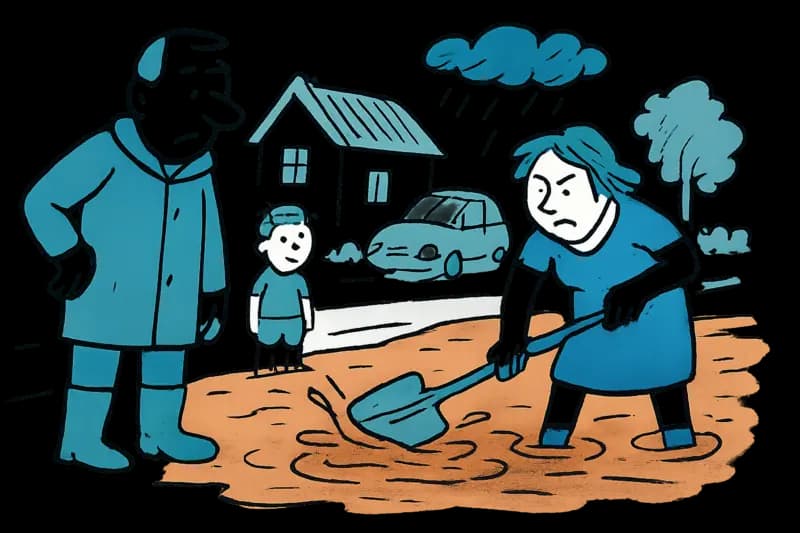
In the Plaça Major in Binissalem water slammed against old house walls, a woman swept water out of a shop, branches still roll into a culvert on the road toward Sa Calobra, and in Palma tires groaned loudly on a mix of rain and old paving, details echoed in After the Thunderstorm: Flooded Streets, Mudslides and the Big Question About Mallorca's Preparedness. Such everyday scenes repeat because drain covers clog, barrancos carry mud and debris, and urban retention areas are often missing.
Critical analysis: much of what is overlooked in reporting is not just a natural event but an interplay of location, maintenance and planning. Many drainage systems date from decades with different land use intensity. Narrower streets, more sealed surfaces and less biologically active soil increase runoff. Where streams once spread water over gravel beds and allowed infiltration, today concrete channels speed water toward the coast – and into the settlements below.
What is missing from the public debate? Three points stand out: first, regular inventories and visible cleaning schedules for sewers and barrancos; second, comprehensive, easily accessible rainfall data and warning levels for municipalities (not only for airports); third, concrete investment plans for retention and infiltration areas at critical points. It is not about panic but routine: cleaning gullies more often reduces acute damage, problems that were laid bare during the Orange alert in Mallorca: Why the rain exposes our weaknesses.
Concrete solutions: municipalities should urgently create priority maps— which roads to close first, which schools are in flood zones, where critical supply lines run. Technically sensible are combined measures: decentralized retention basins in mountain villages, more green roofs in Palma, larger culverts in barrancos, targeted reforestation of steep slopes and keeping floodplain areas free. Practically feasible are neighborhood municipal depots with materials (sandbags, pumps) and short training routines for emergency services so that on the next rainy morning not everyone has to improvise.
A small everyday example: in Port de Pollença a fisherman secured his boat though the sun was still half out; in Binissalem people stood ready with brooms; near Lluc some access roads were temporarily passable only with four-wheel-drive vehicles. Such local reactions help temporarily – but in the long term planning and money are needed.
Conclusion: the measurements are clear: some places received two to three times as much rain as others – this is not just weather, it is a system. Less surprising than the inequality of rainfall is the astonishment that streets sink again, cellars fill up and some municipalities must improvise. Mallorca can cope better with such episodes if rain is seen not only as a force of nature but as a recurring challenge. A bit of planning, brooms and, above all, structured measures would already make a big difference.
Anyone who knows the island from the car knows: after a shower the air smells different, it's cleaner, but the damage remains. The task in the coming months is to turn the measurements (Lluc 53.2 l/m², Binissalem 46.2 l/m², Calvià 45.2 l/m², Palma west pier 39.2 l/m², Balearic University 36.4 l/m², Campos 34 l/m², Port de Pollença 32.6 l/m²; Porreres 0.2 l/m², Sineu 1.2 l/m², Capdepera 1.9 l/m², Muro 5.8 l/m²) into concrete to-do lists—before the next locally concentrated cloud strikes.
Frequently asked questions
When is the best time to visit Mallorca for beach weather?
What should I pack for a trip to Mallorca?
Is it safe to swim in Mallorca and what should I know about beaches?
How can I get around Mallorca without renting a car?
What family-friendly activities does Mallorca offer?
Which outdoor experiences are popular in Mallorca?
Is Palma a good base for exploring Mallorca?
What makes the Serra de Tramuntana region a highlight of Mallorca?
Similar News

Pollença manages Cala Molins itself: Who pays — and what will it look like in the end?
Pollença town hall takes over planning for a coastal plot in Cala Sant Vicenç that has been used informally. The area is...
Storm 'Adam' paralyzes flight operations – and what Mallorca must learn
Heavy rain from low 'Adam' caused dozens of delays, numerous diversions and cancellations at Palma airport. Why does suc...
Nightmare 'Dana/Adam': Why the brown water at Cala Llamp is only a symptom
Heavy downpours turned Cala Llamp's water brown and flooded streets. Key question: How well is Mallorca prepared for suc...
Dana "Adam" paralyzes airports: What the many cancellations mean for Mallorca
Storm "Adam" caused 64 canceled flights and 16 diversions on Mallorca and Ibiza. An analysis of what lies behind the num...

Formentor Lighthouse Accessible by Car Again – A Small Relief for Holiday Days
Since October 18, private cars are allowed again to drive to the lighthouse at Cap Formentor. For holidaymakers this mea...
More to explore
Discover more interesting content

Can Cap de Bou

Townhouse Lleo 72
