
Magaluf: Imprisonment for Beach Club Employee after Theft of a Bag — What the Ruling Overlooks
Magaluf: Imprisonment for Beach Club Employee after Theft of a Bag — What the Ruling Overlooks
A former dishwasher received a one-year prison sentence for stealing a Louis‑Vuitton bag. The appellate court upheld the sentence but significantly reduced the compensation for the victim. What does this say about safety and responsibility in Magaluf's beach establishments?
Magaluf: Imprisonment for Beach Club Employee after Theft of a Bag — What the Ruling Overlooks
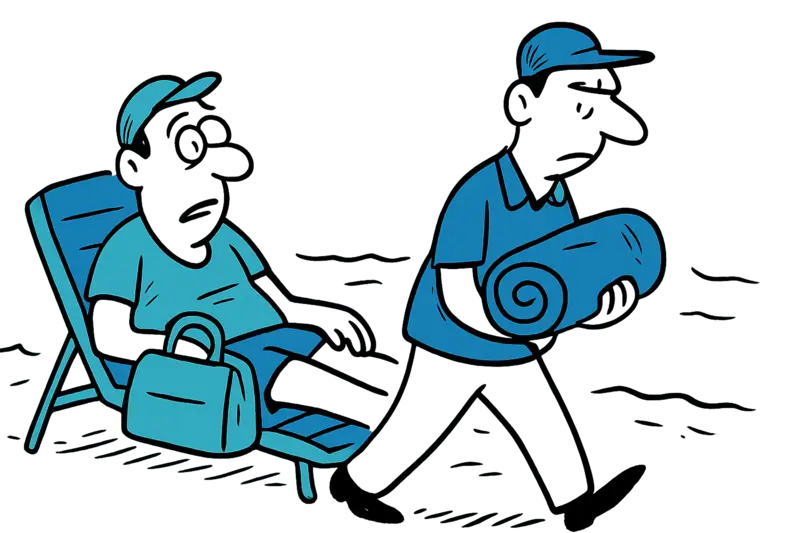
On a hot day in August 2022, somewhere between rows of setup sunbeds, the constant hum of kitchen air conditioners and the cries of seagulls above Magaluf's promenade, a designer bag disappeared from a sunbed. Cameras later recorded how an employee wrapped it in a blue towel and left the sunbathing area. It has now been confirmed: the man, employed at the time as a dishwasher, was sentenced to one year in prison. The appellate court upheld the custodial sentence but reduced the civil compensation for the victim from the initially stated €10,000 to €2,000.
Key question: How can a holiday region like Magaluf prevent individual crimes from becoming a symptom of a larger problem — without descending into hysteria?
Court ruling and sequence of events
The criminal assessment was clear: surveillance footage showed the employee's path with the item wrapped in a towel. The bag was later found nearby, the cash was missing. In the appeal proceedings, the judges maintained the prison term of one year but adjusted the amount of the initially claimed damages. Their reasoning: the extent of the alleged financial loss was not sufficiently proven. The plaintiff's demands for significantly higher compensation remained unsubstantiated.
What is often missing in the public debate
It is not enough to look at the individual case alone. In the everyday life around Magaluf's beachfront venues, precarious working conditions, heavy foot traffic and poorly controlled access areas come together. Beyond the headlines, there is rarely discussion about how much cash circulates in beach businesses, how staff areas are separated from guest areas, or how employers respond to reports of misconduct. There is also a lack of systematic examination of whether staff screening, fair wages and clear work procedures could help reduce opportunistic crime, as discussed in Magaluf: Hidden in a wardrobe with a knife — what does this say about safety and protective measures?.
On site you see it every day: the clatter of plates in the kitchen, delivery vans at the entrance, holidaymakers switching sunbeds when the band starts its evening set. In this confusion, small opportunities are quickly exploited — if nobody is watching.
Critical analysis
The cameras provided the decisive evidence, but video surveillance alone is not a cure-all. It shows what happened but does not automatically prevent the act. The reduction in compensation highlights how difficult it is in court to prove concrete financial losses — especially when cash is involved and witnesses are transient. It also leaves open the question of what role the beach club operator must play: courts confirm subsidiary liability, but how consistently are employers in the region required to implement internal prevention measures? Cases such as Court Convicts Tourist After Assault in Llucmajor: How Safe Are Hotel Employees Really? have raised similar questions about employer responsibility.
Concrete solutions
1. Clearly separate staff areas: define kitchen, storage and guest areas; provide staff changing rooms and lockers that prevent access to guest zones.
2. More transparent cash management: less cash, more electronic payment systems on the beach; daily cash reconciliations to spot irregularities more quickly.
3. More careful hiring and training: background checks for new hires, regular training on labor law and handling found items — coupled with decent wages to reduce economic pressure.
4. Reporting channels for suspected incidents: low-threshold, anonymous reporting channels for staff and guests as well as clear internal sanctions that ensure fairness.
5. Operator inspections by authorities: spot checks on site by local authorities or tourism associations that examine not only security but also working conditions.
What the island administration and operators should consider
A ruling like this is a warning to all involved: police and justice set boundaries, operators can prevent a lot through organization and prevention. For the reputation of seaside resorts, it is crucial that preventive measures become visible — not as panic-mongering, but as reliable standards. That also means public bodies should consider whether binding minimum requirements for handling cash and access to guest areas are necessary.
At the same time, it should be noted that punishments alone do not solve social problems if there is no prospect for those affected. Rehabilitation offers, career counseling and clear reintegration paths are needed so that a convicted person does not fall back into poverty and crime. Sentencing debates such as Palmanova verdict: Two years in prison — and what Mallorca must learn now underscore the need for reintegration measures.
Concise conclusion
The court punished a theft and assessed the evidence. The reduced compensation, however, underlines how hard it is to quantify individual losses when cash is missing. Magaluf should take away this lesson: surveillance helps to clarify incidents, prevention prevents crimes. If operators, authorities and the local community work together seriously — with clear rules, better working conditions and practicable controls — such incidents can become less frequent. Until then, the beach remains everyday life: the clinking of glasses, the rumble of kitchen trolleys and the worry that an unobserved minute is enough to destroy trust. Similar controversial verdicts on damages and sentences have sparked debate, for example Palma: Suspended sentence after €35,000 fraud – was that enough?.
Frequently asked questions
When is the best time to visit Mallorca for outdoor activities?
What should I pack for a trip to Mallorca?
Are there beaches in Mallorca with calm waters suitable for swimming?
How can I get around Mallorca without a car?
What are must-see natural areas in Mallorca?
Is it safe to swim in Mallorca's sea and what should I know about currents?
How does the weather vary across Mallorca's coast?
What are family-friendly activities to do in Mallorca?
Similar News

Road collapse at Port de Valldemossa: Who will pay for the next wave of damage?
A section of the MA-1131 near Port de Valldemossa slipped after heavy rains from cold front "Adam". Residents are strand...

Pollença manages Cala Molins itself: Who pays — and what will it look like in the end?
Pollença town hall takes over planning for a coastal plot in Cala Sant Vicenç that has been used informally. The area is...
Storm 'Adam' paralyzes flight operations – and what Mallorca must learn
Heavy rain from low 'Adam' caused dozens of delays, numerous diversions and cancellations at Palma airport. Why does suc...

Local Imbalances: Why Some Places on Mallorca Flood While Others Stay Nearly Dry
Heavy showers were distributed extremely unevenly across the island on Monday: Lluc recorded 53.2 l/m², Binissalem 46.2,...
Nightmare 'Dana/Adam': Why the brown water at Cala Llamp is only a symptom
Heavy downpours turned Cala Llamp's water brown and flooded streets. Key question: How well is Mallorca prepared for suc...
More to explore
Discover more interesting content

Can Cap de Bou

Townhouse Lleo 72
