
Smoke over Avenida Argentina: High-rise fire raises unanswered safety questions
On Saturday afternoon an apartment on Avenida Argentina in Palma caught fire. A building was evacuated and a neighbor suffered a minor smoke inhalation. The incident draws attention to cramped, legally disputed housing arrangements and the question of oversight and prevention.
Smoke over Avenida Argentina: A fire, many unanswered questions
Evacuation, one injured, and the search for those responsible
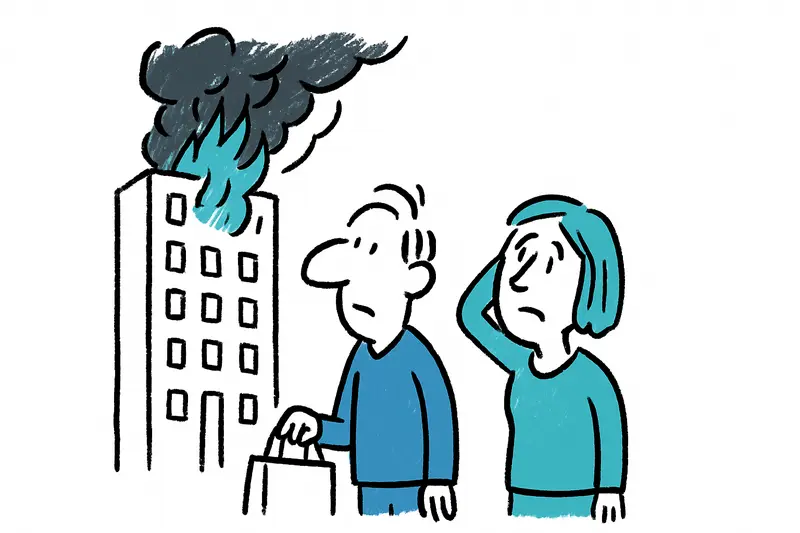
On late Saturday afternoon a fire spread in a third-floor apartment on Avenida Argentina in Palma. Residents alerted emergency services; firefighters, the Guardia Civil and the local Policía Local responded, the building was evacuated, and a woman received medical treatment for minor smoke inhalation. A visible consequence was a thick plume of smoke that could be seen from several kilometers away.
Key question: Who is responsible for safety in buildings where many people live in cramped conditions — and how can a similar incident be prevented from becoming a tragedy? This question arises because neighbors had been complaining about the affected flat for months: according to local residents, it was a heavily occupied unit, popularly referred to as a "patera apartment", where several food delivery workers are said to have lived together. However, concrete publicly accessible information — such as the number of occupants, ownership status or any ongoing administrative procedures — is lacking.
Critical analysis: Fire risk arises from several factors. Tight spaces, improvised cooking arrangements, poor smoke extraction and missing escape routes increase the danger. Added to this: when addresses change frequently, tenants lack formal rental contracts or employers have only loose ties to their employees' places of residence, preventive inspections become difficult to carry out. Routine inspections by the fire brigade usually focus on commercial properties and larger residential complexes; individual flats in private multi-family buildings are checked less systematically unless a complaint is filed.
What's missing in the public debate: numbers. How many flats on Mallorca are similarly overcrowded? How often does that lead to emergency responses? There is no transparency about what the Palma city council (Ajuntament) and the Balearic government can — and do — do in such cases. Also little discussed is how working conditions in the delivery sector influence housing choices and density. Many delivery riders work long hours, earn little and then share cramped spaces to save on rent. This is a social hotspot that translates into safety concerns.
An everyday scene: You stand at the bus stop on Passeig Mallorca, hear the siren, smell the smoke. Cafés briefly close their windows, a neighbour with a shopping bag stops and shakes his head: "That house again," he says, pointing toward the short, shady avenue. That is not what prevention looks like — it feels more like waiting for a more serious accident to happen if nothing changes.
Concrete solutions that must be discussed now: First, a targeted inspection campaign for older multi-family buildings in central locations, focusing on fire protection, escape routes and electrical systems. Second, clear reporting and enforcement channels: owners must be identified and held liable if they tolerate unsafe mass occupancy. Third, short-term protective measures for residents: smoke detectors, fire extinguishers and informational campaigns in multiple languages so people in precarious housing know how to react in a fire. Fourth, involve social and labor authorities: offer support to workers in the delivery sector, for example by helping them access affordable housing or temporary accommodations so that precarious living arrangements are not the only option.
Practically, this also means: police and fire services should be able to pass on anonymized indications of overcrowding during operations so that social services can act. And the municipal administration should maintain a register of particularly vulnerable buildings — not to stigmatize, but as a basis for targeted prevention.
What should happen now: a public briefing by the responsible city departments that names the facts (number of residents, ownership status, ongoing procedures) and announces clear measures. Without facts, the incident remains another item in a long list of reports instead of becoming a trigger for sustainable improvements.
Conclusion: The fire on Avenida Argentina was lucky not to have had worse consequences. The visible plume of smoke was a warning sign for the whole city: it is not enough to simply put out fires. Anyone who wants to live, work or sell cakes in Palma needs safe housing. If authorities, landlords and the labor market do not cooperate, the next siren will not be long in coming.
On site, between the murmur of people on the street and the distant crash of a delivery scooter, there remains a simple hope: that lessons are learned quickly and unmistakably.
Frequently asked questions
How common are overcrowded flats in Palma and what fire risks do they pose?
What concrete steps are proposed to improve safety in Mallorca's multi-family buildings after a fire?
If I live in a crowded apartment block in Mallorca, what should I do to stay safe?
Who is responsible for safety in private multi-family buildings in Mallorca and how can residents report concerns?
What happened on Avenida Argentina in Palma, and what does it reveal about housing safety in central Palma?
What’s Mallorca’s typical weather like for outdoor activities, and what should I pack?
Are inspections of older multi-family buildings common in Palma, and what triggers them?
How should Palma authorities communicate after a fire to ensure lessons are learned?
Similar News

When Farewells on Mallorca Run a Little Differently: Between Urn Chaos and Sea Singalongs
All Saints' Day on the island brings more than candles and flowers: stories of swapped urns, cremated scarves and sea bu...
Up for a Scare: Why Mallorca Enjoys a Little Fright
Pumpkins on the windowsill, children's voices on the Passeig Marítim and a warm autumn evening — Halloween on the island...

Wrong-way driving on the Ma-15: Head-on crash at Xorrigo and the questions that remain
In the early morning hours, a seven-seater vehicle traveling in the opposite direction collided with a delivery van at t...
When a Backpack Loudspeaker Becomes a Stress Test: Season's End at Ballermann and Loud Disregard
At the end of the tourist season, groups played extremely loud music through the streets in the Playa de Palma area. Res...
Iris Berben opens the Evolution Film Festival in Palma – 15 years of cinema on the island
At the 15th Evolution Mallorca Film Festival Iris Berben was honored for her life's work. The evening at the Palau de Co...
More to explore
Discover more interesting content

Can Cap de Bou

Townhouse Lleo 72
