
Solar Eclipse on August 12: Why Early Hotel Transfers on Mallorca Can Become a Problem
Solar Eclipse on August 12: Why Early Hotel Transfers on Mallorca Can Become a Problem
Because of the total solar eclipse on August 12, major tour operators are moving hotel transfers two to three hours earlier. For guests this can mean up to five hours of waiting at the airport. What this means for travelers and the island — and how it could be organized better.
Solar Eclipse on August 12: Why Early Hotel Transfers on Mallorca Can Become a Problem
When counters, shuttles and patience are put to the test
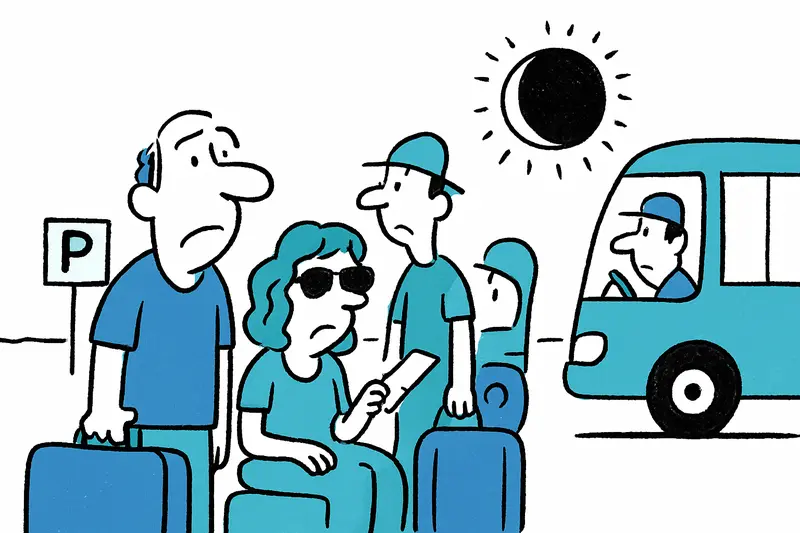
The Total Solar Eclipse 2026: Opportunities, Risks and How Mallorca Should Prepare announced for Wednesday, August 12, is prompting unusual organizational measures: major tour operators have announced they will move their hotel transfers to Palma airport two to three hours earlier. The Association of Balearic Travel Agencies (Aviba) has confirmed that guests could therefore arrive at the airport significantly earlier — in individual cases up to five hours before the scheduled departure.
At the same time private transfer companies are preparing additional vehicles; the airport operator Aena signals that flight operations should run without restrictions. On the island's roads, however, traffic restrictions are already planned, which can limit mobility services in the hours before the eclipse. The hotel association (FEHM) assesses the preparations as sufficient; hotels are used to coordinating many guests, and hotels in Sóller are already around 80% occupied.
Key question
Is it wise to move transfers forward because of an astronomical event — or are we creating a new logistical problem that causes many travelers unnecessary waiting time and additional stress?
Critical analysis
At first glance, moving the shuttles forward sounds like a pragmatic precaution: safety comes first, and less traffic in front of the airport reduces the risk of missed flights. On closer inspection, however, several questions arise. If large parts of the fleet depart several hours earlier at the same time, traffic is shifted and thus increases peak load at the terminal accesses and check-in. The consequence: full forecourts, long queues at baggage drop-off and overloaded waiting areas.
Less obvious is the social dimension: travelers with connecting flights, older people and families with small children spend more time in the air-conditioned but noisy departure halls; people with reduced mobility need dedicated spaces and care that cannot simply be solved "by an earlier bus." For employees in hotels, transfer companies and at the airport, the measure means longer shifts and logistics that have to be reconfigured at short notice.
What is missing in the public debate
So far the debate has focused on precaution only. Little discussed is who will bear the additional costs — hotels, tour operators or the guests? Concrete plans for waiting facilities are also missing: Are there extended seating areas, additional toilets, free drinks for long waiting times or additional signage in multiple languages? And: How will travelers with late check-ins or late commitments be prioritized?
Everyday scene in Mallorca
Imagine: It is early morning on Passeig Mallorca, the smell of freshly brewed coffee is in the air, taxis are still dropping guests at small cafés while white shuttle buses are already waiting in the sun before 6 a.m. for their clearance. At the entrance to Son Sant Joan airport queues form, suitcases crowd at the taxi rank. The loudspeakers make announcements in Spanish, English and German — and yet people with sunglasses and passports stand bewildered because their usual departure time suddenly no longer applies.
Concrete solutions
1) Staggered pick-up windows: Instead of moving all transfers forward at once, tour operators should bundle fixed time slots per region and flight. This relieves access roads and check-in counters. 2) Comfort zones and service vouchers: Hotels could provide free refreshments or transition rooms for guests who arrive significantly earlier. 3) Prioritized processing: Airlines and Aena should agree with tour operators which passengers are prioritized through check-in and security (e.g. families, people with reduced mobility). 4) Real-time information: A joint platform or a WhatsApp channel run by operators with live updates on waiting times and shuttle departures would reduce uncertainty. 5) Public transport as a supplement: Special buses and additional EMT lines could absorb rushes and reduce private vehicle traffic.
Conclusion
Mallorca has experience with massive visitor flows — this shows in hotels and transfer providers. But the decision to move group transfers two to three hours earlier only solves the problem on paper. Without staggered pick-up times, targeted support for vulnerable groups and clear, multilingual information, long waits and frustration at the airport are likely. Those leaving on August 12 should contact their tour operator, check the new pick-up time early and allow enough buffer time. The island can handle this organizationally — if we now clarify the small, practical details instead of leaving them in the crowded waiting halls.
Frequently asked questions
When is the best time to visit Mallorca for sunshine and fewer crowds?
Is it safe to swim at Mallorca's beaches?
What should I pack for a Mallorca trip?
What are the best ways to get around Mallorca without a car?
What should I know about visiting Palma de Mallorca?
What nature activities are good for a Mallorca day trip?
How warm is the sea and air in Mallorca across the seasons?
Where can I explore Mallorca's markets and sample local foods?
Similar News
Finally Home: Mike and Leyla Heiter Buy Villa with Sea View in Mallorca
The reality TV couple Mike and Leyla Heiter have bought a house in Mallorca with a roof terrace and sea view. An Instagr...

Arrest after series in Palma: Who protects apartments from repeat offenders?
The National Police arrested a man in Palma who investigators say may have broken into several apartments. In one incide...
How a Teenager Without a Driver's License Stole a Rental Car — and What It Means for El Arenal
In El Arenal a minor took advantage of an unattended rental car with its engine running. Flight, climbing over walls and...
Three-ton llaut salvaged in Puerto Portals – volunteers clear microplastics from the harbor
During the weekend operation in Puerto Portals, divers pulled an approximately three-ton llaut from the harbor. Associat...

Naked Pillar in Bunyola: Why a Climbing Prank Is More Than an Accident
During the Sant‑Mateu verbena a 20‑year‑old fell at a protected wayside cross in Bunyola and pulled the stone cross off ...
More to explore
Discover more interesting content

Can Cap de Bou

Townhouse Lleo 72
