
Son Gotleu 2.0: Opportunities, Gaps and the Question of Who Really Wins
Son Gotleu 2.0: Opportunities, Gaps and the Question of Who Really Wins
The regional government and city have announced a large-scale renewal plan for Son Gotleu. Good news — but many questions remain: financing, participation and the potential for displacement.
Son Gotleu 2.0: Opportunities, Gaps and the Question of Who Really Wins
Key question: Can the planned large-scale renovation strengthen the neighborhood without losing its residents?
At Plaça de Miquel Dolç, between clotheslines and small shops, you can see people with shopping bags in the morning, children playing on the curb, and the street cleaners collecting trash since sunrise. It is at this crossroads that the regional government and the city recently launched a joint program to redesign Son Gotleu: renovation of residential buildings, investments in schools, better street lighting, new squares — and an underground train station that will connect the area with the campus, Parc Bit, the airport and hospitals. Construction is scheduled to start in 2028, and the line is expected to be operational in 2032.
That sounds like a historic opportunity. At the same time, clear answers are missing where decisions change everyday life: What are the total costs? Which parts will be covered by the autonomous government, which by the city, and which by EU funds? How will it be prevented that rising rents and new offerings displace long-established households?
Critical analysis: Much is ambition, little is concrete. A cooperation protocol is a start — but without reliable figures and clear guarantees much remains vague. The announced measures touch almost every area of life: housing, education, mobility, public spaces. Yet neither a detailed catalog of measures nor a financial plan has been presented so far. That opens the door to hopes but also to risks: delays in infrastructure projects can mean long-lasting construction sites, renovation without protection mechanisms can fuel gentrification, and short-term upgrades without long-term maintenance lead to new problems.
What is missing in public discourse: residents' perspectives. Authorities announce meetings with neighbors — that is right. But simply informing is not enough. Crucial questions must be bindingly included in the process from the start: Will households have the right to return to renovated apartments? Are there rent protection or social housing quotas? How will local businesses be protected? And not least: what compensation is planned for forced relocations? Media coverage has also highlighted recent security actions, for example Why so many police officers in Son Gotleu? A look behind the controls and Major operation in Son Gotleu: 60 police officers, many questions.
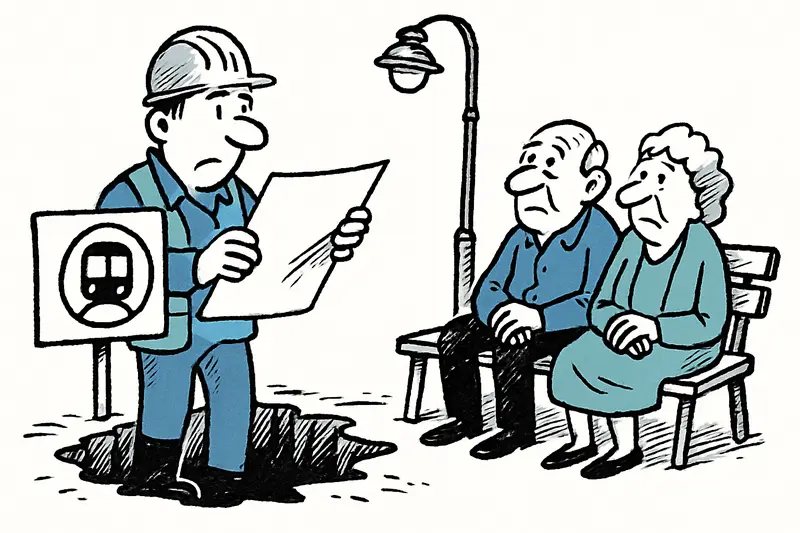
An everyday scene from Son Gotleu: an elderly couple on a bench in the afternoon, speaking quietly about the broken streetlight in front of their house. A small kiosk owner mentally adding up his accounts, wondering whether the renovation will bring new customers or push him out because of rent. These voices must carry more weight than attractive visualizations.
Concrete solutions the administration should examine immediately: 1) A binding social protection plan: fixed quotas for social housing in every upgrade and guaranteed return rights for temporarily relocated residents. 2) Transparency portal: an easily accessible online platform with costs, timelines, contracts and contact persons. 3) Local employment clauses in construction contracts so that trades and jobs remain in the neighborhood. 4) Pilot projects for public spaces and green areas funded by a municipal renewal fund and accompanied by resident groups. 5) Rent stabilization mechanisms and support packages for small businesses. 6) A permanent maintenance budget for infrastructure that does not disappear after the project ends.
On transport infrastructure: the planned underground stop at the plaza is a real benefit for mobility — but it must be planned together with first- and last-mile services: secure bicycle parking, accessible entrances, feeder buses and targeted noise protection measures during construction. Integrating the city's bike-sharing system must be done technically and spatially sensibly, including safe parking options for users.
Another point: financing from EU funds is possible, but not automatic. Funding programs have strict criteria; project sponsors must credibly demonstrate social sustainability and participation. For this reason, the administration and the region should jointly prepare a robust application dossier that lists social indicators and fairly distributed benefits.
Pithy conclusion: The plans for Son Gotleu have the potential to bring real improvements. Whether this becomes a gain for local people or a shiny project that ultimately attracts outside investors and displaces residents depends on details — on transparency, participation and binding social protection mechanisms. The upcoming meetings with neighborhood representatives are the chance to define those details. If the city and the region are serious, they must now deliver not only plans but also guarantees.
Frequently asked questions
What is planned for Son Gotleu in Mallorca?
When will construction for the Son Gotleu project start in Mallorca?
Will the Son Gotleu renovation in Mallorca make rents go up?
What protections are needed for residents during the Son Gotleu works in Mallorca?
How could the new Son Gotleu underground station affect Mallorca?
Where in Son Gotleu is the redevelopment focus in Mallorca?
Will local businesses in Son Gotleu, Mallorca, be protected during the renovation?
How much information has Mallorca’s government shared about the Son Gotleu project?
Similar News
Mini-tsunamis in Mallorca: Harmless natural phenomenon — or an underestimated danger?
Two harbor towns in Mallorca recorded unusual water level fluctuations. An analysis: How rissagas form, who is at risk —...
Stinging jellyfish in Cala Banyalbufar: Why everyone suddenly fled the water
In Cala Banyalbufar, Pelagia noctiluca washed up in droves. A personal account of why this is no coincidence, what is of...
New low-pressure trough brings rain — and the heat remains: What's missing in Mallorca?
A short, intense window of showers hit Mallorca, yet the air remained muggy and warm. Key question: Why does rain hardly...

Klaus-Michael Kühne has died: The entrepreneur who gave Mallorca a second home
He first arrived on the island at 60; later the holiday house became Castell Son Claret – a hotel, a music venue and an ...
Buying Instead of Moving Away? Why Every Fourth Property Owned by Balearic Residents Isn't Located Here
Almost a quarter of the apartments purchased by Balearic residents are located on the Spanish mainland. A concise analys...
More to explore
Discover more interesting content

Boat Tour with BBQ along Es Trenc Beach

Private transfer from Mallorca Airport (PMI) to Pollensa
