
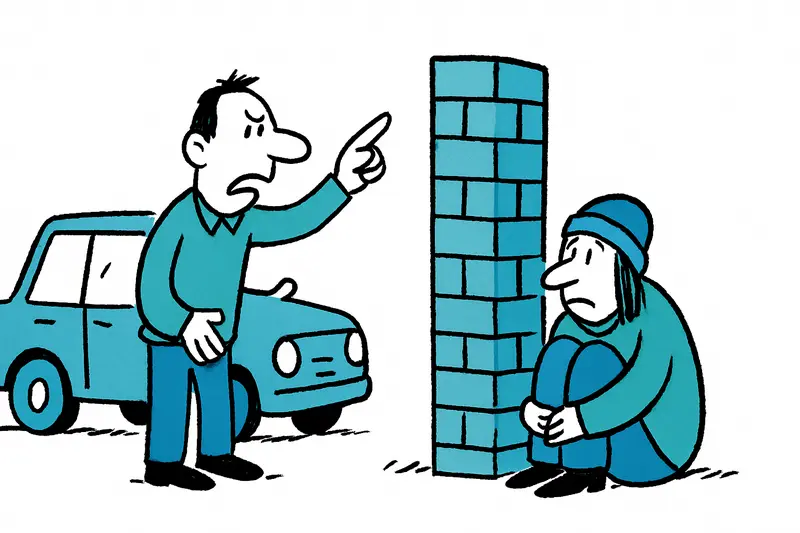
Son Hugo in Palma: A Wall Organises the Car Park—but Does It Solve the Problem?
A physical barrier can regulate access. But it does not answer where people go when a vehicle is also their home.
The key question in Son Hugo is not just where cars are allowed to park
For city officials, a wall is a straightforward solution: it separates areas, directs traffic and can be neatly drawn on a plan. Everyday life is less tidy. Around the car park by the Son Hugo swimming pools, two interests meet: visitors need space and reliable access; people living in motorhomes or other vehicles need somewhere they can stay. Can a physical barrier resolve this conflict—or does it simply shift it a few streets away?
That is the reality check every such measure needs. Cities have good reason to organise public spaces. A car park is not an unlimited housing facility, and the use of municipal land cannot depend solely on who got there first. At the same time, putting up a barrier does not solve a person’s hardship. If a vehicle is someone’s place to sleep, making access more difficult does not simply mean moving to another, more convenient parking spot.
Order is not the same as safety
A clear separation can prevent vehicles from entering areas that need to remain free for swimming pool operations or other public uses. It can also make responsibilities clearer. But a wall does not address questions about sanitation, rubbish, electricity, water or access to help. Nor does it tell us whether people can actually move elsewhere without ending up in an even more precarious situation.
This is where public discussion often falls short. People quickly talk about “free parking spaces” or “illegal living”, as if that were the whole story. The specific consequences are less visible: Is there an accessible point of contact? Are those affected consulted before a change is made? What rules apply to vehicle access and pedestrian routes? Is there a deadline, clear information and a way to report individual hardships? Without answers, the measure remains mostly a piece of construction—and a rather loud symbol.
A morning between the swimming pool and the asphalt
Anyone out and about in Palma on a chilly morning knows how the sounds change: somewhere, a bus rattles over a road joint, a shopping bag rustles at the roadside, and a car door slams in a car park. For visitors, a parking space is often just the short stretch between the car and the entrance. For someone sleeping in a vehicle, that same asphalt can be where the day begins and ends. These are two different uses of the same public space. Neither disappears just because a line is drawn or a wall is built.
That does not mean every space has to remain open to every vehicle indefinitely. It means the city should state its aims clearly. Is the goal to free up parking spaces at certain times? To address fire safety and access? To make a lasting change to how the area is used? The more precise the purpose, the easier it is to assess whether the chosen measure is appropriate. Otherwise, residents and users are left to suspect that the visible solution matters more than its consequences.
What Palma could do in practice
A workable plan would bring several steps together. First, explain the rules on site in clear, multilingual language, including hours, access routes and a point of contact. Second, speak with people who regularly use the area, distinguishing between parked vehicles and vehicles that are actually someone’s home. Third, check which legal alternatives or social support services are available before increasing pressure on a single location. This does not have to mean promising a parking space to everyone. But directing people to the responsible service is better than quietly pushing them away.
Practical details matter too: pedestrian entrances and exits, emergency routes, lighting and access for emergency services must not be treated as afterthoughts. After making a change, the city should check whether it has achieved its intended goal—and whether problems have simply moved to other neighbourhoods. This does not require a major campaign, just clear responsibilities and publicly accountable follow-up.
Son Hugo is about more than a parking dispute. It is about how Palma manages scarce public space without making people in difficult circumstances invisible. A wall can mark a boundary. But it cannot decide who has somewhere else to go. If the city only regulates access, it manages the conflict. If it also organises alternatives, social support and fair rules, it begins to solve it.
Frequently asked questions
What is the wall at the Son Hugo swimming pools in Palma meant to achieve?
Does a parking barrier solve the problem of people living in vehicles in Palma?
What should visitors check before parking at the Son Hugo pools in Palma?
Why do cities in Mallorca set rules for public car parks?
What information should Palma provide when it changes car park access?
How can Palma manage a car park used by both visitors and people living in vehicles?
How can Palma tell whether a new parking barrier is working?
Are parking rules enough to make a public space safe in Mallorca?
Similar News
When Motorhomes Become Homes: Palma’s Difficult Parking Question
A public car park must remain accessible to everyone. But people living in campers do not simply disappear when an entra...

A Shipwreck from the Islamic Period off Mallorca: Protection Comes Before Curiosity About Its Location
A member of the public alerted the Island Council to a shipwreck from the Islamic period. Ceramic fragments and deer ant...
Luxury Hotels near Banyalbufar: What’s Still Missing on Paper
New upscale hotels are being discussed around Banyalbufar. What matters is not the glamour of the plans, but what they m...

Calvià in Step with the World: What a Dance World Championship Brings to the Island
When international Latin dance couples compete in Calvià, there is more at stake than medals. The real question is wheth...

Albastar grounded: Employees are now bearing the cost of unpaid wages
Albastar has suspended flight operations and filed for insolvency. Around 230 employees are waiting for their wages. The...
More to explore
Discover more interesting content

Can Cap de Bou

Townhouse Lleo 72
