
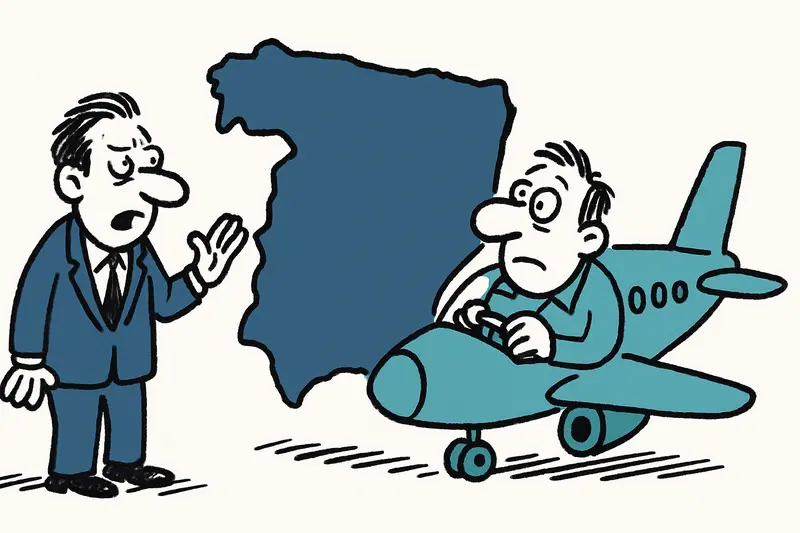
Spain closes airspace to aircraft involved in Iran operation: a reality check
Spain closes airspace to aircraft involved in Iran operation: a reality check
Madrid has closed its airspace to aircraft that are said to be involved in the offensive against Iran. What legal, military and local consequences does this have — and what is missing from the debate?
Spain closes airspace to aircraft involved in Iran operation: a reality check
What does the ban mean for Rota, Morón, NATO and for us in Mallorca?
Key question: Has Madrid, by prohibiting aircraft that are involved in the offensive against Iran from flying, primarily sent a foreign policy signal — or does the government thereby risk tangible operational and diplomatic problems?
The decision to close one’s own airspace is formally simple: sovereignty and control lie with each state. In practice, however, it is more complicated. By this move Spain is clearly saying no to certain operations. For Mallorca this concretely means: fewer overflights of military aircraft across our islands, potentially different routes for troop transports and logistical flights, and noticeable tensions in discussions between Madrid and its allies.
From a military point of view the measure raises questions. How far does the definition “involved in the offensive” extend? Does it affect only combat aircraft or also tankers, AWACS, aerial refuelling and transport planes? If overflights by third countries — for example originating in the UK or France — are affected, that changes routes, refuelling stops and timetables. That disrupts operations that rely on minute coordination.
The opening of bases such as Rota and Morón to US units is based on agreements. An overflight ban for involved units is not a breach of contracts per se, but it is a political signal. It forces the alliance to show a stance: will operational needs be placed above bilateral relations — or vice versa?
What is often missing in the public debate is legal granularity. There is international and national airspace and air traffic law, reporting obligations, and NATO procedures. Who decides whether a flight is “involved”? What evidence is required? Without clear criteria subsidiary questions remain open and there is room for misunderstandings.
Another blind spot: the consequences for civil aviation and for daily life in Mallorca. The island lives off traffic — not only tourist flights, but also cargo, training and private flights (training and private flights, and even scheduled events, can lead to short shutdowns covered in Two-hour shutdown at Son Sant Joan: Military show causes a stir). Diversions increase costs and flight times. On the Passeig Marítimo this morning you can hear the port cranes but fewer jets; that is a small, tangible effect (local reporting such as Drone over Son Sant Joan: Investigations, Gaps and the Question of Effective Prevention documents instances when operations were halted).
Politically the situation is charged. An open conflict with Washington is conceivable if Washington interprets the measure as a restriction on its operations. The debate often lacks a view on long-term options: how will European partners react? Will they seek compensatory solutions, or will Spain remain isolated in its stance?
Concrete approaches Madrid could use to strike a balance: first, publish transparent criteria that explain exactly whom the ban affects and why. Second, intensify coordination with NATO bodies and EU partners so operational gaps are closed early. Third, inform civil airlines and local authorities about expected diversions and schedules to limit economic damage.
On a practical level technical measures can also be taken: temporary corridors for humanitarian flights, clear alternative routes for civil aviation and emergency plans for Mallorca’s ports and airports (cases like Emergency Landing at Son Sant Joan: Questions Over Arrests and Procedures underline the need for clear protocols). That reduces panic and keeps the island operational if military movements shift.
What has been missing in discussions so far: the perspective of local people. In central Palma, at the café on Plaça España, locals do not talk about grand geopolitical theories but ask whether holidays will be cancelled, whether cargo will become more expensive and whether the local economy will suffer. This is not trivial; for many businesses such effects are existential.
A possible medium-term path would be a multilateral framework within the EU: common standards on how and when member states may impose overflight bans in the context of third-country operations, plus compensation mechanisms for affected partners. Such instruments would create transparency and cushion political burdens.
Conclusion: Madrid has sent a political signal and at the same time created a complex logistical problem. Sovereignty does not automatically guarantee smooth implementation. If Spain now combines clear rules, coordinated diplomacy and local protective measures, the risk of escalation can be reduced — and Mallorca can remain operational instead of being squeezed between great powers.
Frequently asked questions
What does Spain’s airspace ban mean for Mallorca flights?
Could Mallorca see more flight delays because of Spain’s military airspace restrictions?
How does Spain decide which aircraft are affected by the ban?
Does the airspace ban affect Mallorca tourism or just military flights?
What are Rota and Morón, and why do they matter in this dispute?
Could civil aviation in Mallorca be affected by military overflight bans?
What should travellers to Mallorca expect if airspace rules change again?
Why is Spain’s airspace decision causing tension with NATO partners?
Similar News
Bomb threat on board? Why the Tenerife incident concerns us in Mallorca
A passenger on a Jet2 flight from Tenerife to London triggered an evacuation and intensive security checks. The result: ...

More Electric Cars in the Balearic Islands: Sales Rise Sharply
Between January and August, 14,185 vehicles without petrol or diesel propulsion were sold — an increase of more than 40 ...
Autumn in Mallorca: What Truly Remains of Summer
The days grow shorter, the evenings cool — and yet more of summer lingers than you might think: sounds, recipes, people,...
Rescue operation at Tolleric: Why nighttime cliff parties become dangerous
A British holidaymaker fell about ten meters at the cliffs of Tolleric during the night, later climbed back up and was r...
Car accident on the MA-1: Mother and daughter on a bicycle struck by a fellow countryman – Who protects cyclists here?
On the MA-1 between Portopí and the Cala Major exit, a mother and her daughter on a bicycle were struck by a car. A para...
More to explore
Discover more interesting content

Can Cap de Bou

Townhouse Lleo 72
