
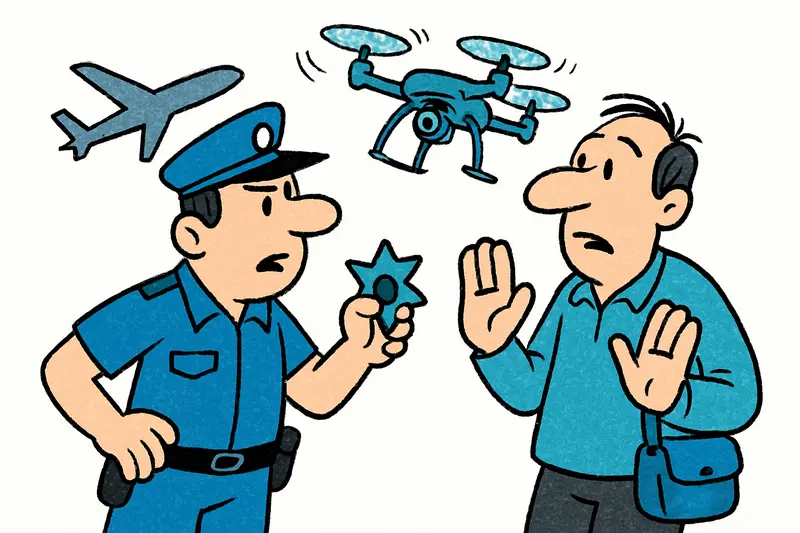
Drone over Son Sant Joan: Investigations, Gaps and the Question of Effective Prevention
On Sunday evening an unknown aircraft halted operations at Palma airport for 35 minutes. PEGASO is investigating — but the case reveals where clarification and deterrence are lacking.
Flight operations interrupted: one evening, many questions
It was Sunday, around 8:15 p.m., Son Sant Joan breathed the typical mix of travel fatigue and holiday cheer. Announcements in Spanish, Catalan and English came from the departure hall, cicadas were still chirping outside — until staff at Terminal A spotted a small, unfamiliar aircraft over the runway. For about 35 minutes operations stood still. Some flights were diverted, connecting passengers lost valuable minutes, taxi drivers on the access road watched in confusion; the episode is described in Drone over Palma Airport: Guardia Civil Investigates – How Safe Is Our Airspace?.
PEGASO on the trail — what is known so far
The Guardia Civil has called in the aviation security unit PEGASO. Investigators are now working with a classic toolkit: review of CCTV footage, comparison with radar and ADS‑B data, analysis of possible telemetry and questioning of eyewitnesses. Airport staff, passengers, even bus drivers are considered potential sources of information. Authorities make clear they want to act quickly but carefully in such cases: not every unknown object is automatically malicious, but every risk must be taken seriously. For context on regulations and operational rules for drones see EASA rules for civil drones.
What is often missing in the public debate
The headline “drone at the airport” is easy to write. Slower is the discussion about systemic gaps: how good is the cooperation between airport security, mobile network operators and drone manufacturers? Why did the device reach the immediate restricted zone — despite geofencing features on many modern models? And what responsibility do rental companies or event organizers who lure tourists with camera flights carry? A similar incident is recounted in Invisible Boundaries: Why a Drone over the Almudaina Is Dangerous.
Technology helps — but not everywhere
Radar and ADS‑B provide data, telemetry can give clues for well-configured devices. But many consumer drones send hardly any usable signals. Devices can also be manipulated or flown so they are only briefly visible. That means the trace search can take days. Further analysis is in Drone in the Sky over Palma: Why 35 Minutes of Chaos Aren't the Whole Story. In the meantime, only increased security presence on the ground, more checks at access roads and an appeal to the public remain — which is costly and socially burdensome.
Specific problem areas and solutions
A sober look at the incident reveals several approaches:
Better deterrence: Higher fines help, but only if the probability of being caught increases. Visible controls and rapid prosecution are necessary.
Mandatory technical building blocks: Geofencing, mandatory telemetry beacons or a nationally unified drone registration would make investigations easier — and increase the risk for pilots of going unnoticed.
Responsibility of rental companies: Those who rent drones to holidaymakers must inform them about restricted zones and be able to lock the devices accordingly.
Public reporting points: A simple app or hotline through which witnesses can quickly send photos or location data could significantly shorten investigation times.
Legal side and message to pilots
Drones are legally aircraft. That means flying in restricted zones is not a trivial offense. In addition to fines, criminal investigations can follow; see the earlier report Drone over Palma's Old Town: Report after No-Fly Zone Violation. Investigators are currently evaluating camera footage, mobile phone data and coordinating with mobile network providers. The urgent appeal is: rules are not recommendations — they protect lives and flight operations.
A practical outlook for Mallorca
The situation that evening was uncomfortable but controlled. Nevertheless, Son Sant Joan is an important hub for the island. A comparable incident during the high season, at night or in poor visibility, can quickly become more serious. The island therefore needs not only case-by-case investigations but clear, practical prevention steps — from information campaigns in rental shops to minimum technical requirements for drones rented on Mallorca.
If you saw anything at the airport on Sunday evening or have recordings: contact the Guardia Civil. Even small details can help prevent such disruptions in the future.
Frequently asked questions
Why do drones cause such serious disruption at Palma Airport?
What happens when a drone is spotted over Son Sant Joan?
Are drones legal to fly in Mallorca?
How do investigators trace a drone after an incident at Palma Airport?
What can Mallorca drone rental companies do to prevent problems?
Could better geofencing stop drones from reaching Palma Airport?
What should you do if you see a drone near Palma Airport?
Is drone flying in Mallorca a bigger issue during the busy season?
Similar News

Caro Robens: 15 kilograms lighter — and again in the crossfire of online comments
Bodybuilder Caro Robens, who lives in Mallorca, has lost 15 kilograms. Her success on Instagram was met with applause — ...

Meager Industry in Mallorca: How the Island Can Be More Than Just Tourism
The industrial sector in Mallorca is shrinking, productivity is falling and firms remain tiny. The key question: can the...
Pre-Nit de l'Art: Galerie Mensing invites to a special evening with Tom Boston
Before the big art night, Galerie Mensing opens its doors: pop art, champagne, a DJ and a hand-signed print by Tom Bosto...

Sea view and more seats: Cappuccino Grand Café reopens in Port d'Andratx
After a long renovation, the Cappuccino Grand Café on the Port d'Andratx harbor promenade has quietly reopened. Larger t...

Enric Mas wins the Vuelta – a triumph that resonates in Mallorca
Mallorcan Enric Mas has won the 82nd Vuelta — the first Spanish overall victory since 2014. Cyclists and neighbors on Ma...
More to explore
Discover more interesting content

Can Cap de Bou

Townhouse Lleo 72
