
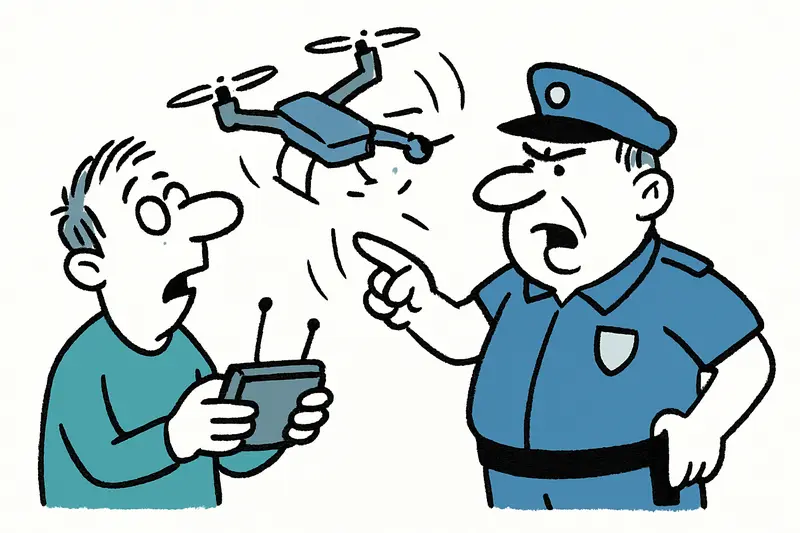
Invisible Boundaries: Why a Drone over the Almudaina Is Dangerous
A drone flight over Passeig de la Seu ended abruptly: the Guardia Civil brought a device down above the Almudaina Palace. Was it ignorance or risk? A look at rules, technology and possible solutions for Palma.
Invisible Boundaries: Drone over Almudaina — a matter of safety and consideration
Sunday afternoon, the air over Passeig de la Seu smelled of sea salt and fried fish, the church bells rang softly, and the promenade was full of walkers, children with ice cream and a school class taking notes. Then a buzzing that did not fit the cathedral: a drone hovered directly above the Almudaina Palace. The Guardia Civil intervened, the PEGASO unit switched off the device — and the flight ended abruptly on the forecourt.
The key question: ignorance or intent?
The pilot, according to the police a Serbian national, was checked and charged; the device was seized, as described in a report after launching a drone next to the Almudaina. The immediate reaction: relief among passersby. The deeper question, however, remains: was it a short-sighted snapshot born of tourist curiosity — or was a boundary deliberately crossed?
This question is not only moral. It determines how we will handle Palma's sensitive airspace in the future: do we need tougher penalties, better information, technical blocks — or all of the above, as suggested in an analysis of why a small device makes our airport vulnerable?
What is less loudly discussed in Palma
The public debate often stays on the surface: bans here, fines there. Less highlighted is how easily tourists and hobby pilots can be misled. Not everyone knows that drones are legally considered aircraft and that areas around state buildings and representative sites are practically permanently subject to stricter rules.
Also missing is the focus on technology: modern anti-drone systems like those used by the PEGASO unit can exploit radio shadows, jam signals or force a device to land. That sounds like magic — but in reality it is delicate technology that also carries risks: incorrect shutdowns, unexpectedly falling parts, or interference near other electronic equipment.
Dangers we do not want to see
A falling propeller blade is enough to injure a passerby. Even more serious would be a collision with a helicopter or airplane during takeoff or landing — in Palma, where government guests are received, that is not a theoretical risk, as shown by a report on a drone flight that interrupted operations at Palma Airport. Added to that is the protection of privacy: high-resolution cameras can reveal more than a holiday selfie.
The episode at the Almudaina shows: security interests, tourist curiosity and device technology collide directly here — amid ice cream vendors and dog leashes.
Concrete solutions for Palma
No general drone destruction plan is needed, but pragmatic measures are:
Clearer signage and information points: On Passeig de la Seu there is a lack of widely visible notices in several languages. A small sign and a QR code with a map view of no-fly zones would prevent many misunderstandings.
Mandatory information for rental companies: Those who rent drones to tourists — a business model that now exists on the island — should be required to inform customers about local flight rules and provide a brief briefing.
Geofencing and technology obligations: Manufacturers could be more strongly obliged to block no-fly zones via firmware. This would make pilot error a rarer exception.
Transparent use of anti-drone technology: Authorities should explain how and when systems like PEGASO are deployed — this increases trust and reduces fear of arbitrary shutdowns.
Citizen-focused prevention: Short information campaigns at tourist spots, collaboration with hotels and tour guide associations, local apps with push notifications during heightened security risks (visits by delegations, etc.).
An appeal to pilots — and to the city
For drone enthusiasts: pause for a moment, observe the surroundings, and when in doubt do not take off. For the city: simpler rules, visible notices and dialogue with the tourism sector. Palma is lively, open and sometimes a little chaotic — that is part of its charm. But where state guests are received, invisible boundaries must be respected.
In the end there was a charge and a seized device. Investigations continue. One Sunday walk less calm, one more debate about safety and digital consideration.
Frequently asked questions
Can you fly a drone over the Almudaina in Palma?
What should tourists know before flying a drone in Mallorca?
Why are drones considered dangerous near Palma Airport?
How do authorities stop illegal drone flights in Palma?
What are the risks of using anti-drone technology in Palma?
Do drone rental companies in Mallorca have to explain the rules?
What can Palma do to make drone restrictions easier to understand?
What should a drone pilot do if they are unsure about flying in Palma?
Similar News
Release after bloody attack in Palma: Why the court's decision raises questions
An 18-year-old who allegedly inflicted a serious neck injury on a man at Plaza Gomila using a wristwatch wrapped around ...
Kidnappings in Inca: Three young men forced into car trunks and abused in the forest – a reality check
In Inca, three 18-year-old men were forced into car trunks by masked assailants at the Plaça des Bestiar, taken to a for...
Spreading Massification: The Brake That Still Has Much Work to Do
Marga Prohens announces limits on volume tourism. The measures sound harsh — but are they enough to save everyday life, ...

Through the Keyhole onto the Party Yacht: How Daniela Katzenberger Is Planning Her 40th on Mallorca
Daniela Katzenberger turns 40 and wants to celebrate it on the island — likely with a boat, cake and her mother. A relax...
By Boat Instead of the Road: Palma's Water Bus — a Reality Check
The 'Bus Nàutic' launches in two stages — but questions remain over interim operations, fares and environmental requirem...
More to explore
Discover more interesting content

Can Cap de Bou

Townhouse Lleo 72
