
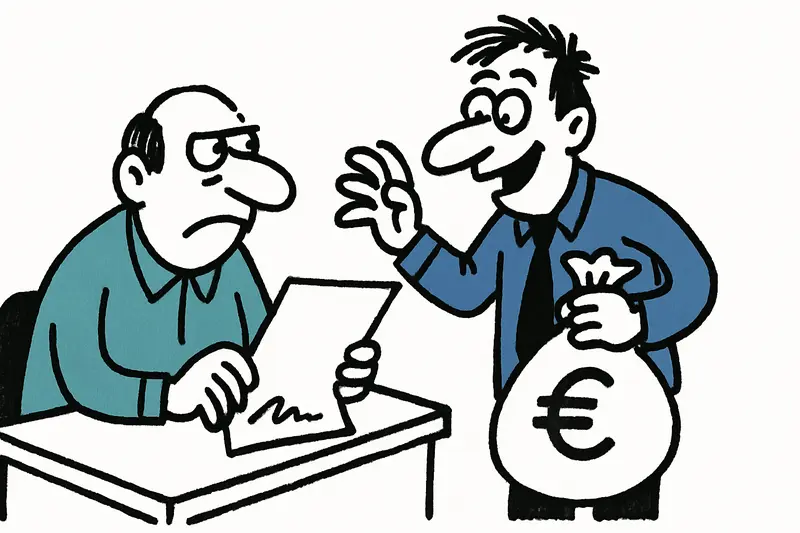
Powers of Attorney Abused: How Could a Notary Employee Fraudulently Obtain Loans Over €450,000?
Powers of Attorney Abused: How Could a Notary Employee Fraudulently Obtain Loans Over €450,000?
An employee of a notary office in Palma admitted to forging powers of attorney to obtain loans exceeding €450,000. How could the system allow this to happen?
Powers of Attorney Abused: How Could a Notary Employee Fraudulently Obtain Loans Over €450,000?
Key question: What gaps in controls and practice allow such cases on Mallorca?
On a grey morning outside the courthouse in Palma, when a column of Vespas passes along the Passeig Mallorca and the smell of freshly brewed coffee drifts from the bakery into the cold air, one sits more easily in the seat of a court observer than a judge. It was here that an unusual case was heard: an employee of a notary office admitted to manipulating powers of attorney to obtain loans for himself and relatives. The amount named by the public prosecutor exceeds €450,000.
At the heart of the accusations is the following sequence: what began as a limited power of attorney allegedly became a broad general power of attorney, supposedly signed by the employee's wife. With these papers, loans were taken out — including a personal loan and a mortgage-backed loan. Later, similar actions followed with documents allegedly concerning the sister and properties in Esporles. The defendant has partially confessed; the prosecution is seeking around seven years' imprisonment.
Critical analysis: Systemic failures rather than a lone offender?
The obvious question is not only, “Was the man criminal?” but: How could this go practically unnoticed? The notarial environment is regarded here as a safeguard as elsewhere: bank employees rely on public notarizations, and citizens trust the formal security of notarial acts. That several documents in different notaries appeared to be "genuine," as one witness noted, points to structural weaknesses — not just individual misconduct.
Initial weaknesses that become apparent: identity and signature checks are often paper-based and can become routine, as in When the padrón lies: Identity theft in Mallorca and the system's vulnerabilities, and in incidents involving fake driver's licenses in Palma. Separation of responsibilities within small notary offices is not always present; colleagues view procedures as trustworthy. Banks frequently check only formal authenticity, not the actual authority behind a power of attorney, a problem also highlighted by Arrest in Palma: How Fake Transfers Undermine the Luxury World. And if an employee has access to internal templates or files, the risk increases that documents can be manipulated without anyone immediately becoming suspicious, as in Employee allegedly defrauded company in Palma with forged invoices for €150,000.
What is missing from public debate
Much is said about the individual case — about the confessor, the figures, the prosecutor's demands. Little, however, is discussed about: the supervisory authority overseeing notaries; internal control mechanisms within notary offices; the verification paths used by banks; and informing the families affected. Also rarely addressed is whether there are similar, less well‑cleared cases. Victims are often private individuals who lack the time or resources to mount a full legal defense.
A slice-of-life scene from the island
Imagine a sunny November afternoon by the church in Esporles: the awning of a café, an older man reading the newspaper, children giggling on the square. It is in places like these that plots of land lie which are of great emotional and economic importance to locals. A forged document affecting such a parcel hits a family directly — not only financially, but in memories and future plans.
Concrete proposals for solutions
1) Stricter identity verification: Notaries and banks should be required to be able to verify digital ID data, for example via secure state interfaces, instead of relying on paper alone.
2) Centralized registers: A mandatory, access-protected database of notarial powers of attorney would allow traceability — similar to land registry entries. Every issued power of attorney would have to be recorded there with a timestamp and the issuing notary.
3) Documentation requirements: Video recordings of signings could provide clarity in disputes (with data protection-compliant rules).
4) Internal controls in notary offices: Staff rotation, a four-eyes principle for especially far-reaching powers of attorney, and regular external audits.
5) Banks: Independent verification of the grantors' authority through direct contact with the signatories, not solely via notarial documents.
6) Strengthen oversight: A regional supervisory body for notaries with transparent statistics on violations and sanctions.
7) Victim support: Establishment of a fund or advisory service for those affected that can provide quick initial legal assistance.
Conclusion
The case in Palma is more than the act of a single employee. It exposes how much trust in routines on Mallorca — among notaries, banks and clients — can become a trapdoor. Someone puffing a cigar at Plaça Cort or walking their dog does not expect something shady behind forms. It is not enough to react to individual cases. We need clear technical and organizational rules so that powers of attorney remain what they should be: a reliable instrument of legal representation — not a lever for fraud.
What matters now: concrete reforms and transparent controls, not just outrage in the marketplace.
Frequently asked questions
How could someone use a power of attorney to take out loans fraudulently in Mallorca?
What are the warning signs of forged notarial documents in Mallorca?
Why can banks in Mallorca miss a fake or altered power of attorney?
What controls should notary offices in Mallorca have to prevent fraud?
What happened in the Palma notary fraud case involving more than €450,000?
Why is Esporles mentioned in the Mallorca notary fraud case?
What can people in Mallorca do if they suspect a power of attorney has been misused?
How could Mallorca improve oversight of notaries and document checks?
Similar News
Large-scale Anti-Tourism Graffiti at Cala Mendia: Protest or Vandalism?
On the morning walkers discovered an approximately 50-meter-long slogan against tourism on the wall above Cala Mendia. W...
Bomb threat before Jet2 flight in Tenerife: A reality check for security protocols
A passenger reported a bomb in luggage shortly before departure in Tenerife. Evacuation, baggage checks, delays — and ma...
Who is stripping Mallorca's coast bare? Why entire slopes are being removed for villas
On Mallorca steep slopes are again being removed to make way for luxury construction sites. Who bears the responsibility...
Robber Falls While Fleeing in Sant Agustí: Who Takes Responsibility?
During a purse-snatching in Sant Agustí, a non-commissioned officer chased the suspect; the man jumped from a bridge and...
Bomb threat on board? Why the Tenerife incident concerns us in Mallorca
A passenger on a Jet2 flight from Tenerife to London triggered an evacuation and intensive security checks. The result: ...
More to explore
Discover more interesting content

Can Cap de Bou

Townhouse Lleo 72
