
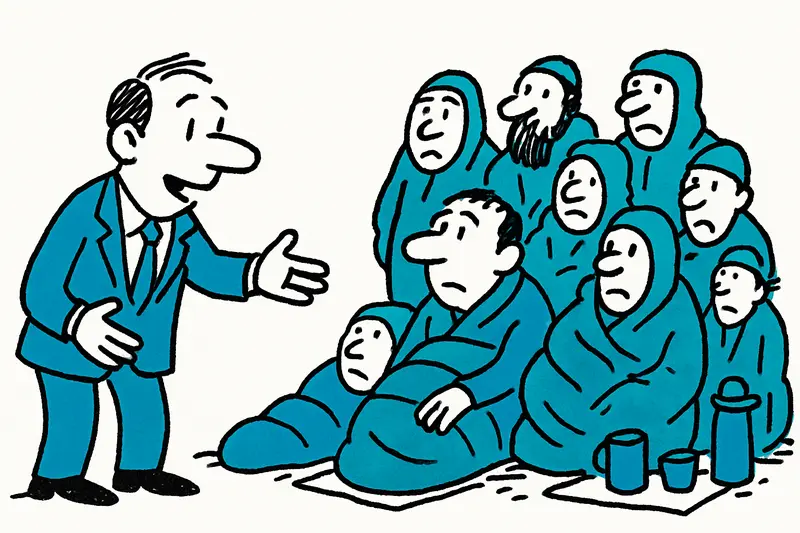
After the prison clearance: Who will look after the 200 people from the Ocimax area?
After the prison clearance: Who will look after the 200 people from the Ocimax area?
Two weeks after the violent eviction of the old prison ruin, many of the roughly 200 former residents are now living on the street. Why there is no concrete plan and which short-term and structural solutions Mallorca needs now.
After the prison clearance: Who will look after the 200 people from the Ocimax area?
Key question: Why are people suddenly left without a plan and shelter after a police-ordered eviction?
It is early in the morning, the streetlights in the neighborhood near the Ocimax shopping center cast a yellowish glow on wet doorways. People sit by the portals with sleeping bags, a thermos sits on cardboard, and somewhere there is still a faint smell of smoke. These are the immediate consequences of the eviction of the old prison ruin: around 200 people, most recently living in the derelict building, are now on the street or dispersed across nearby neighborhoods. The city justified the eviction with recurring fires and safety concerns; similar clearances have occurred elsewhere on the island, notably Manacor clears settlement: When rental profits push people into shacks. The problem is: where should those who previously found shelter in the facility go?
Political actors are arguing. The Social Democrats at City Hall criticize that no viable alternatives were organized before the operation and presented the city council with a list of private apartments belonging to officeholders: allegedly 42 apartments plus a hotel with about 30 beds would together accommodate around 156 people – data, the Social Democrats say, are based on published asset declarations of those politically responsible. On the other side, the city administration, the island council and the regional government point to logistical and legal obstacles to quickly providing suitable accommodation.
The Catholic Church has stepped in: Bishop Sebastià Taltavull invited representatives from authorities and church relief organizations and indicated that church facilities could be considered for temporary intake. They talk about possibilities to house the most urgent cases in the short term – but concrete commitments are still lacking.
Critical analysis: the picture is threefold, and that is the problem. First: the eviction itself – understandable for safety reasons after repeated fires. Second: the planning – which clearly was not sufficient to absorb the sudden disappearance of a large, vulnerable group. Third: the aftermath – people spread into neighborhoods, emergency relief structures respond improvisationally: neighborhood associations report that former residents seek shelter in building entrances; social organizations collect tents and sleeping bags.
What is missing from the public debate is a clear roadmap of who takes short-term responsibility and binding timeframes. There is no transparent breakdown of what capacities the city, the island council, the regional government and church providers can actually provide. Nor is there a public discussion of how many of those affected need medical or psychological help, assistance with residency status, or long-term housing support. Without this information every discussion about quick placements into private apartments or hotels remains piecemeal. This debate plays out against wider reporting that more than 800 people now sleep on Mallorca's streets, underscoring the scale of the island's housing challenges.
An everyday scene from Palma: a resident in a side street near Ocimax reports how, in the evening, people were sleeping with blankets in the stairwell while firefighters were still checking the last fire sites. A butcher across the street donated bread and coffee in the following days, volunteers rolled out sleeping bags. Such spontaneous aid alleviates the situation briefly but cannot replace coordinated action by the authorities; similar grassroots situations have been reported in other locations, for example Between Concrete and Surf: Squatters at Espigol Beach — Where Should the People Go?.
Concrete, immediately actionable proposals:
1) Establish a central coordination office within the island council that connects the city, regional authorities, the church and NGOs and queries capacities daily. A single point of contact prevents duplicated efforts.
2) Quickly open suitable public buildings (vacant community halls, school annex rooms outside teaching hours) as temporary shelters for the coming weeks, staffed with social services on site.
3) A temporary hotel program with simplified contracts and public funding for those acutely affected – alongside ownership checks, for example into the properties named by the opposition.
4) Mobile teams of social workers, doctors and lawyers to assess individual needs in emergency shelters (trauma care, documents, housing search). Each person needs at least one file and one caseworker for the coming weeks.
5) Short-term funds for neighborhood initiatives and in-kind donations (tents, sleeping bags), with coordinated distribution so offers do not pile up in one place and run out in another.
In the long term the island administration must learn from this crisis: there needs to be a registered, regularly updated inventory of vacant public spaces, an agreement with church and civil providers on emergency capacities, and a binding protocol for evictions that ensures accommodation before people end up on the street.
Conclusion: The eviction was a necessary response to safety risks. Equally urgent now, however, is a planned aftermath: without fast, coordinated measures the problem risks being displaced into courtyards and portals around Ocimax – where neighbors roll up blankets in the morning and social helpers must improvise. Politics and administration should not only give reasons for an eviction but also bear responsibility for solving the consequences. Otherwise all that remains is an open promise – and people who continue to freeze.
Frequently asked questions
Why were people evicted from the old prison area near Ocimax in Palma?
What happens to people who lose shelter after an eviction in Mallorca?
Are there emergency shelters for homeless people in Palma?
What help is available for people sleeping rough in Mallorca?
What is the role of the Church in Palma’s homelessness response?
Can hotels or private apartments be used for emergency housing in Mallorca?
What should neighbours do if homeless people start sleeping near their building in Palma?
Is Mallorca prepared for large emergency evictions like the one near Ocimax?
Similar News
Palma, Palma de Mallorca, Palma‑Mallorca: What is it really about?
The debate over the city's name is more than grammar: it concerns identity, law and branding policy. A sober reality che...
Warning to Bathers: Nipping Fish in Cala Major and Other Coves — a Reality Check
In Cala Major and several beaches around Mallorca, bathers report painful “nips”. Who are the animals, why are they gett...

Rental Car Theft in El Arenal: What This Incident Reveals About Our Gaps
A teenager steals a running rental car in El Arenal, flees on foot, climbs over walls and is caught by the Guardia Civil...

Red Rope in Palma's Library: What Helps Against Selfie Tourism — and What's Missing
Palma's city library cordoned off an area with a red rope to keep selfie tourism away from reading and working activitie...

Fort San Carlos: Museum, Harbor Dispute — and a Conflict That Demands Answers
The military museum at Fort San Carlos sits right on Palma's harbor, with unexpectedly quiet rooms filled with cannons a...
More to explore
Discover more interesting content

Can Cap de Bou

Townhouse Lleo 72
