
Dangerous Finds at Campos Flea Market: What the Incident Tells Us
Military explosives, ammunition and prohibited weapons were found at a flea market in Campos. The key question: How safe are Mallorca’s markets really?
Dangerous Finds at Campos Flea Market: What the Incident Tells Us
Key question: How could an entire arsenal be openly offered at a market — and what is missing in everyday protection?
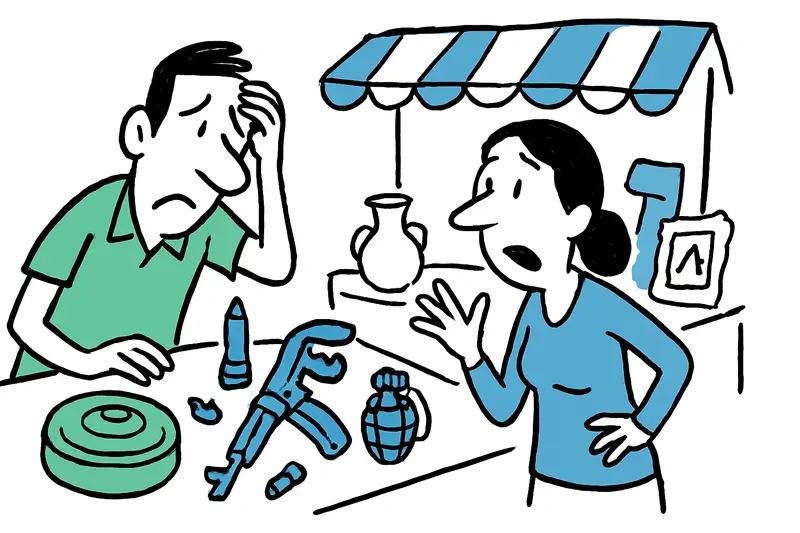
Saturday morning at the Campos flea market: vendors spread out old records, ceramics and bags, children tug at balloons, and somewhere the scent of fried ensaimada wafts through the air. Among the usual stalls, however, was an unusual sales table — with metal boxes, cartridges and items that looked military. The Guardia Civil arrived, cordoned off the area, and explosives experts inspected and secured the finds. The owner is 66 years old; officers seized everything and initiated criminal proceedings for illegal possession of weapons.
The facts are clear: three hand grenades and four military bombs without deactivation proof, numerous hunting cartridges, military-type ammunition, six category-4 airguns, two paintball guns, a modified slingshot, a sword cane, two other stabbing weapons and a muzzle-loading firearm declared unusable — all displayed for sale. The deployment of explosives specialists underlines the danger of the situation.
Critical analysis: At first glance the incident appears to be an isolated case: a bold vendor overstepping boundaries. In fact, it reveals structural gaps. Flea markets are lively, often improvised places; inspections are carried out sporadically, not continuously; similar gaps were exploited in Hidden Compartments and Fake Sneakers: Major Raid in Can Picafort Raises Questions. It is not enough to react only after a material danger is present. Saying authorities are overstretched is not an excuse — it is an indication that prevention, clear rules and controls need to be more closely linked.
What rarely comes up in public debate: Who is responsible for the goods offered at markets? Market operators, the municipality, municipal enforcement services, the sellers themselves — and what concrete inspection obligations do they have? Currently much relies on trust and voluntary commitments—an approach that failed in cases like Stolen Collectibles: How a Palma Second-Hand Shop Stirred Up Booksellers. That works for pots and second-hand clothing, but not for potentially lethal material. Also rarely discussed is the proper way for private individuals to legally and safely dispose of old ammunition and non-functional military relics.
A slice of everyday life: A group of tourists stops, pulls out phones, locals whisper in Mallorcan. The market manager, a larger man in a fluorescent vest, explains that some sellers had only registered shortly beforehand; incidents involving counterfeit goods, like Packages Full of Counterfeits: Van with Over 700 Fakes Stopped in Palma, show how illicit items can circulate quickly. The feeling remains: markets are part of island life — loud, colourful, chaotic — and precisely in that lies the danger that hazardous items sink like corks in the sea.
Concrete solutions, not only well-meaning appeals: First, mandatory pre-registration: sellers on public markets must register with ID and a specific description of their goods. Second, clear prohibitions and checklists: ammunition, military explosives and certain weapons should generally be excluded from sale at public flea markets; sales should only take place in authorised specialist shops or through authorised channels. Third, visible certificate requirement: for any permitted weapon a valid document must be displayed at the stall. Questions over dubious paperwork in other sectors, such as art, show why this matters: When Pictures Lie: Why Mallorca's Art Market Must Rethink Now. Fourth, communicate disposal routes: municipalities should provide collection points for old ammunition and non-functional explosives together with the Guardia Civil and civil protection. Fifth, training for market staff: how to recognise altered, atypical or military-looking objects and whom to notify immediately.
Practically implementable would also be a simple control cycle: spot checks by municipal enforcement and the Guardia Civil on busy days — not to suffocate every business, but to create deterrence. Digital support: a simple seller form with mandatory fields (item description, origin, possible licence number) can create much transparency. It costs money — but less than deploying explosives teams in the middle of a crowded market.
Handling of seized material must also be transparent. In this case the items were examined and taken into custody; the procedural path includes a report to the government delegation and potential criminal proceedings. Such procedures should be summarised by administrations in short, comprehensible guides for market operators — so questions can be answered quickly and do not lead to uncertainty.
In conclusion: Flea markets are as much a part of Mallorca as the sea and the Tramuntana, but a piece of normality must not become a security gap. The incident in Campos is a wake-up call: not every item belongs in a sales box between vinyl and lamps; and not every seller has the paperwork they should. The solution is less state hysteria than pragmatic rules, clear responsibilities and a little more attention on site — from organisers, authorities and all of us.
Frequently asked questions
What happened at the Campos flea market in Mallorca?
Are weapons and ammunition allowed at flea markets in Mallorca?
How should old ammunition or military items be disposed of in Mallorca?
What safety checks should flea markets in Mallorca carry out?
Why are flea markets in Mallorca harder to control than regular shops?
Is the Campos flea market still safe to visit in Mallorca?
What should I do if I see something suspicious at a market in Mallorca?
Who is responsible for safety at flea markets in Mallorca?
Similar News
Warning to Bathers: Nipping Fish in Cala Major and Other Coves — a Reality Check
In Cala Major and several beaches around Mallorca, bathers report painful “nips”. Who are the animals, why are they gett...

Rental Car Theft in El Arenal: What This Incident Reveals About Our Gaps
A teenager steals a running rental car in El Arenal, flees on foot, climbs over walls and is caught by the Guardia Civil...
Red Rope in Palma's Library: What Helps Against Selfie Tourism — and What's Missing
Palma's city library cordoned off an area with a red rope to keep selfie tourism away from reading and working activitie...

Fort San Carlos: Museum, Harbor Dispute — and a Conflict That Demands Answers
The military museum at Fort San Carlos sits right on Palma's harbor, with unexpectedly quiet rooms filled with cannons a...
Old Town Under Pressure: When a Doorway Becomes a Sleeping and Shower Place
For months a woman has been living with a parasol, a clothes rack and personal belongings next to the social welfare off...
More to explore
Discover more interesting content

Can Cap de Bou

Townhouse Lleo 72
