
Giant at Moll Vell: the "Star Princess" in Palma — fascination and open questions
The new "Star Princess" made a short, spectacular stop in Palma. Wonder on the Passeig del Born — and the question of what sustainable cruising must look like in the future.
Giant at Moll Vell: the "Star Princess" in Palma — fascination and open questions
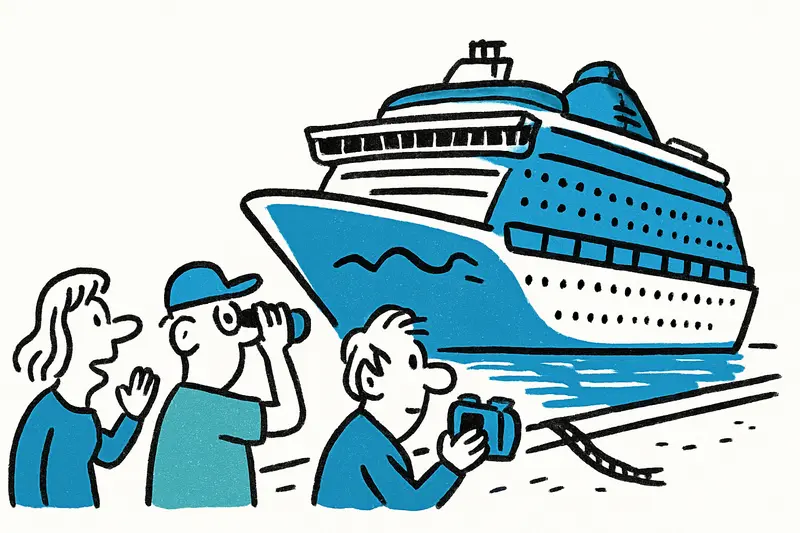
Yesterday morning, shortly after 09:15, a ship's horn lowered over the Passeig del Born and announced something that changed the daily life at the harbor for a few hours. The Star Princess, fresh from the shipyard and with more than 20 decks a true behemoth, docked at Moll Vell for around ten hours. I stood on the harbor wall with a café con leche in my hand and heard the usual mix of sounds: seagulls crying, the clatter of cameras, the murmur of curious voices — retirees with binoculars, parents with children and a photographer who had been waiting in prime position since 7 a.m.
More than just a photo opportunity
The numbers are impressive: about 345 meters long, roughly 47 meters wide, room for around 4,300 passengers and about 1,500 crew members. Architecturally, the ship looks like a floating city: sun decks, a waterfall above the bridge, large glass surfaces at the stern and an open atrium as a social space with bars and stages. The image of passengers waving from their balconies while a few seagulls circle above the stern evokes strong emotions — a surreal contrast between fishing boats and tour buses.
The symbolic nature of the brief visit
The ten-hour stay was official and symbolic at the same time: a representative of the port authority presented a commemorative plaque to the captain, and then the Star Princess continued its first western Mediterranean route before heading overseas at the end of October. For Palma, a city used to major arrivals, such a colossus is still remarkable — because it is larger than what many everyday scenes at the harbor usually depict.
The often overlooked debate
Some regard such moments as pure spectacle — others see economic opportunities: jobs, port revenue, guests spending time in the old town. But beyond the amazement there are concrete questions that often get too little attention in public perception. The central guiding question: How sustainable is this growth path for Palma really? The shipping company emphasizes LNG propulsion as a step toward climate friendliness. But environmentalists and port initiatives warn: LNG reduces certain pollutants, but methane slip and the overall energy demand remain problematic.
Infrastructure, air quality, safety
Little discussed is whether Palma's port infrastructure is designed for several of these mega-ships at the same time. Shore power connections, which would make it possible to shut down engines while in port, are not yet widely available. That means: even with supposedly "cleaner" fuel, diesel generators keep running — with effects on fine particulate matter, nitrogen oxides and noise. Another often underestimated point is emergency preparedness: larger ships require different evacuation concepts, close cooperation with rescue services and space on the quay and access roads.
What Palma could do concretely
Reducing the frequency of visits is politically sensitive because it would also reduce revenues. Still, pragmatic alternatives can be named: the accelerated expansion of shore power at Moll Vell would be technically feasible and would significantly reduce emissions during berthing times. Time slotting could also be introduced so that not multiple mega-ships are moored in the port at the same time — that would reduce burdens on air quality, traffic and the city's appearance. A transparent emissions and energy statistics for each port call would clearly show how "green" a concept really is in practice.
Good opportunities, if used
There are also positive aspects that could be leveraged: Palma could direct visitor flows by designing excursions and activities sustainably — favoring smaller, local providers, setting limits for mass excursions and introducing levies that flow into local ecological measures. Close cooperation between the port authority, city administration, conservation organizations and the shipping companies can create rules that better balance economy and environment.
A personal impression
In the afternoon, when the sun was lower and the light gilded the stern of the Star Princess, passengers still stood at the rail waving, some photographers packed up. The city sounded on as usual: scooters in the alleys, voices from the cafés and the regular calling of the seagulls. The moment was beautiful and shows the potential of maritime fascination — at the same time it is a reminder: Palma should take the opportunity to shape rules and infrastructure so that such encounters in the future worsen the air less and benefit the island more.
The ship continued on its journey, heading for its naming ceremony in Fort Lauderdale and then to the Caribbean. For us the question remains: do we want to keep merely marveling on Mallorca — or use these arrivals as an occasion to make port policy sustainable?
Frequently asked questions
Why do so many people go to Moll Vell in Palma when a cruise ship arrives?
How big is the Star Princess in Palma compared with a normal cruise ship?
Is LNG really a cleaner fuel for cruise ships in Mallorca?
Does Palma have shore power for cruise ships at Moll Vell?
What kind of impact do big cruise ships have on air quality in Palma?
Is it safe for Palma to receive several mega cruise ships at the same time?
What should visitors know before going to Palma’s harbor for a cruise ship arrival?
What could Palma do to make cruise tourism more sustainable?
Similar News

Dizziness at the Wheel: When the Access Road to Sa Calobra Becomes a Nightmare
A trip to the gorge of Sa Calobra ended in panic for a holidaymaker: not the sea, but the hairpin roads of the Tramuntan...

Four Years for the Hammer Blow in Sa Pobla: Is the Sentence Enough?
A dispute over €50 ends fatally: How could it come to this, and does the sentence answer the questions behind the act? A...

Cala Bona: New residents' parking — who really benefits?
The municipality of Son Servera has completed a parking lot with 50 spaces (plus two disabled spaces) behind the Hotel C...
Defy off Mallorca: A beautiful facade on the high seas?
The 94-meter superyacht "Defy" of US billionaire Ken Griffin lies off the coast — luxury, technology and questions: Who ...

When Fruit Becomes a Luxury: Why Prices in Mallorca Are Rising So Painfully
Figures from the INE show: Fresh food in the Balearic Islands has become significantly more expensive year-on-year. What...
More to explore
Discover more interesting content

Can Cap de Bou

Townhouse Lleo 72
