
When “staying with friends” becomes a business: How illegal holiday rentals on Mallorca grow beyond control
When “staying with friends” becomes a business: How illegal holiday rentals on Mallorca grow beyond control
Many owners list apartments as "staying with friends" and thereby evade controls. Why authorities are often powerless, what is missing from the debate, and which solutions are realistic.
When “staying with friends” becomes a business: How illegal holiday rentals on Mallorca grow beyond control
Key question
How can a business model be stopped that sounds formally harmless – "staying with friends" – but in practice circumvents taxes, regulations and neighborhoods?
It often starts with an innocuous message: noon at Plaça d'Espanya in Palma, the market vendor packs up his oranges, and from an open window next door the ping of a messenger app can be heard. "Anyone looking for an apartment in El Terreno in April? Good location, garden, close to the Paseo Marítimo." One listing, a few photos, and within hours neighbors, regular visitors and acquaintances have the information. This is the practice that leaves inspectors baffled.
The official figures provide clues: of around 19 million visitors to the Balearic Islands, more than 3.5 million reported that they did not stay in a hotel or registered holiday accommodation; 2.2 million named "with friends or acquaintances" as an option. Many stays that are in fact commercially organized end up in this statistic – without a license, without taxes being paid, sometimes in residential buildings where holiday rentals are prohibited, a problem highlighted in Huge gap in the registry: Nearly 8,000 unregistered holiday apartments in Mallorca.
Critical analysis
The difficulty lies in proving it. Authorities now use automated analyses of public platforms like Airbnb and Booking to detect apparently illegal listings; nevertheless platform responses vary, as shown when Airbnb Puts the Balearic Islands Under Pressure: Deleting Illegal Listings — What It Means for Mallorca removed some offers. But as soon as offers are made via messenger, private groups, Telegram or directly within acquaintances, these tools are worthless. Operators instruct guests to claim during inspections that they stayed for free with friends. A neighbour who suspects something needs solid evidence – which is rarely available.
There is also an incentive problem: for some owners the income is too attractive to give up the risk, and increasingly landlords and neighbors in Palma discover that supposed long-term tenants secretly sublet their flats, as reported in When Long-Term Tenants Turn into Holiday Landlords: The Inquilinos Pirata in Mallorca. Enforcement agencies have limited resources; the legal scope does not always allow forcing platforms or payment providers to cooperate. Where clear display of license numbers is missing, many offers remain visible online.
What is missing from the public debate
The debate often focuses on blacklistings and higher fines. Less attention is paid to technical and organisational levers: why are payment flows hardly used to identify commercial overnight stays? Why is there no mandatory field for the tourism license in every online booking form that automatically blocks a booking if absent? Also underrepresented is the perspective of tenants in the building: affected neighbours experience noise, rubbish and changing strangers – this needs to be more visible.
Everyday scene from Mallorca
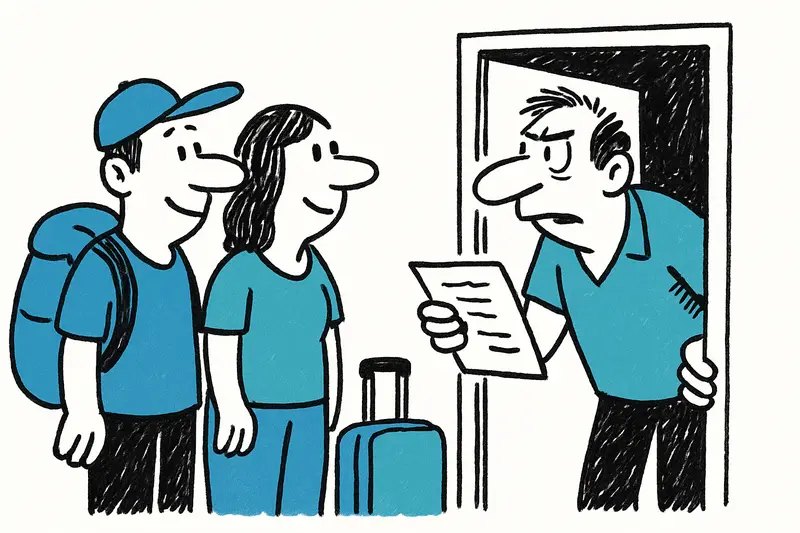
A Tuesday morning in El Terreno: an older woman brings bread back into her flat, and a young couple with backpacks stands at the door. They explain they are guests of "friends." The concierge saw three photos of a reservation confirmation, but no license number. The neighbour notes down the car registration plates but does not dare to file a complaint for fear of retaliation. Many cases therefore remain in the shadows.
Concrete approaches
1. Mandatory license field: Platforms must require a valid license number. If it is missing, no booking option may be offered. That would be technically feasible and increase transparency.
2. Data cooperation on an EU-compliant basis: Authorities could collaborate with payment providers and hosting platforms on a privacy-compliant, aggregated basis to identify commercial rentals – without disclosing personal data.
3. Incentives as well as penalties: A simplified regularisation procedure for small-scale hosts, tied to a maximum number of occupancy days and clear neighbourhood rules, reduces black-market incentives.
4. Local reporting and evidence offices: Municipalities could provide anonymous reporting channels and simple reporting templates (photos, times, payment receipts) so that complaints do not fail for formal weaknesses.
5. More mobile inspections and energy checks: Plausibility checks based on electricity and water consumption, combined with targeted spot checks, often provide reliable indicators for regularly rented units.
6. Neighbourhood outreach: Information campaigns in Spanish, Catalan and German explain rights and obligations and show the difference between a visit to friends and commercial rental.
Conclusion
"Staying with friends" is in many cases a cover. Those who want to curb the practice need not only higher fines, but networked technology, clear proof requirements and low-threshold reporting channels for residents. Otherwise the problem will move further into closed groups and chats, while the burden on residential neighbourhoods remains. In the streets of Palma you can hear the harbour horn in the evening, the clatter of wheeled suitcases, and somewhere in the quarter another listing: the recurring signal that rules must be found that also hold in a digital world.
Frequently asked questions
How common are illegal holiday rentals in Mallorca?
Why are illegal holiday rentals in Mallorca so hard to prove?
What should neighbours in Mallorca do if they suspect an illegal holiday rental?
How do authorities in Mallorca detect illegal holiday apartments online?
Is staying with friends in Mallorca the same as illegal holiday rental?
What kind of evidence helps report an illegal rental in Mallorca?
Why do illegal holiday rentals keep spreading in Palma and Mallorca?
What rules could help reduce illegal holiday rentals in Mallorca?
Similar News

More water than last year: Mallorca's reservoirs breathe easier
September rain refilled the Tramuntana's reserves: overall fill around 35 percent, Cúber at 40.42 percent, Gorg Blau at ...
Three Luxury Hotels in Banyalbufar: Lots of Money, Many Questions
A Danish investor plans three exclusive accommodations in Banyalbufar — including the historic Son Valentí. The announce...
2.1 tonnes of cocaine on sailing yacht off Spain's coast – a reality check for the coastguard
A 14-metre yacht was seized with 2.1 tonnes of cocaine. Who monitors the ports, how does the international hunt succeed ...

Heat Bonus in Mallorca: 100 Euros Extra for Outdoor Staff at MarSenses
MarSenses pays employees who worked outdoors in August an extra €100 as recognition. Lighter uniforms, reduced hours for...
Renovating in Mallorca: What You Really Can Do Without Neighbour Consent
Many think they can do whatever they want in their apartment. That's partly true — but only as long as structural elemen...
More to explore
Discover more interesting content

Can Cap de Bou

Townhouse Lleo 72
