
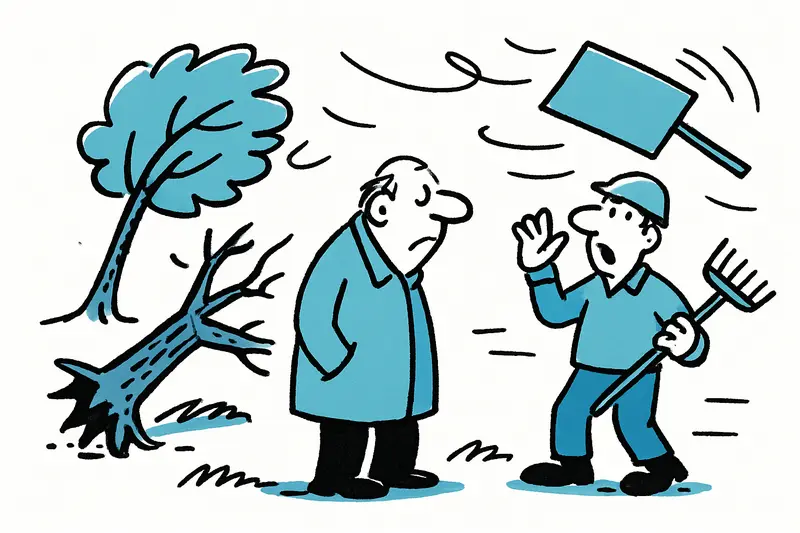
Storm 'Nils' brings first damage – Are we prepared for such storm events?
Storm 'Nils' brings first damage – Are we prepared for such storm events?
Storm 'Nils' hit Mallorca with gale-force gusts: promenades closed, trees toppled, port closures and flight cancellations. A reality check: what is missing in preparedness?
Storm 'Nils' brings first damage – Are we prepared for such storm events?
Main question: How well are the city, island administration and infrastructure really prepared when gale-force winds arrive?
In the morning the wind tore over the Bay of Palma so strongly that spray hit the mole and signs fluttered through the air. On the promenade by the harbour – the Paseo Sagrera – the city has now put up barriers, similar to those at Ribera Park on Playa de Palma and in the area below Castell de Bellver. Anyone who was by the sea saw waves several meters high and videos from places like Colònia de Sant Jordi documenting the raging water.
The national weather service AEMET has issued an orange warning for large parts of the island, detailed in Storm Alert: Is Mallorca Prepared for the Deluge?. Reports speak of gusts around 130 km/h at coastal and lower measuring stations, with even stronger peaks recorded on exposed summits. The consequence: port authorities restricted traffic – including the port of Ibiza – and Palma airport reported cancellations and delays on connections; flights to and from Germany were also affected, as noted in Orange storm cripples Palma: parks closed, markets cancelled.
Rescue and emergency services conducted numerous operations: in the Balearics the number of missions in the morning was over a hundred, on Mallorca it was at least 88, with hotspots in Palma, Inca and Calvià, described in Night Storm Hits Andratx and Calvià – Are We Really Prepared?. The work of the emergency crews was visible, but the concentration of incidents reveals structural questions.
In Sant Elm in the southwest, municipal authorities reported fallen trees and closed roads. Such incidents repeat themselves in the same coastal and park areas: older avenue trees along promenades, pine trees by the sea and green strips that become hazard sources in storms.
What is often missing in the public debate is the question of preventive infrastructure maintenance and coordinated procedures between municipalities, port operators and the airport. Communication is currently causing confusion: warnings come from AEMET, local authorities inform via social media channels, and the airport uses display boards and its own notices. For residents, employees and tourists this creates the impression that information could flow more clearly and quickly.
Critical analysis: The acute response works: closures, technical deployments, emergency calls. However, shortcomings become apparent in prevention. Regular tree inspections along vulnerable routes are patchy. Port contingency plans exist but vary in scope and need unified standards. At the airport there is often no easily accessible, multilingual point of contact for cancelled flights and alternative transport.
Missing so far from the public conversation is an honest inventory of tree risks, clear responsibilities for the maintenance of public green spaces and binding, multilingual crisis communication that reaches both tourists and residents. The question of how ports can be protected from heavy seas in the medium to long term also remains partially unclear.
An everyday scene: on the Passeig Sagrera a team of municipal workers moves in, cutting tools hum while an older man stands at the café window watching the wind. Children who usually play in parks are staying home today. Such observations show that urban planning and the routine of safety measures also depend on small, daily decisions.
Concrete solutions that can be implemented quickly:
- Systematic tree inventory in promenades and access areas with prioritisation of vulnerable specimens and annual pruning measures.
- A common, multilingual alarm and information channel that links AEMET warnings with local measures and simultaneously consolidates port and airport information.
- Unified contingency protocols for ports: defined protection zones, early-warning mechanisms and procedural instructions for relocating and securing vessels.
- Airport emergency plans with central information points, replacement transport options and clear rights for affected passengers to avoid long waits and unsafe situations.
- Expansion of training for volunteers and municipal staff so that initial securing measures can be carried out quickly and in a coordinated manner.
What everyone can do: bring garden furniture inside, secure boats, avoid going onto piers, heed official warnings and travellers should check flight status before departure. A small emergency kit in the car (blanket, water, flashlight) is often useful.
Punchy conclusion: 'Nils' is more than a storm day. It is a mirror: we see where inspections are missing, how important coordinated communication is and that investments in prevention ultimately cost less than constant clean-up after each storm. City administrations, the Consell, port and airport operators must now take visible steps forward and turn the lessons from these operations into lasting measures.
Frequently asked questions
How bad can storm winds get in Mallorca during an orange weather warning?
Is it safe to walk along the seafront in Palma during a strong storm?
What should I do in Mallorca when flights are delayed or cancelled because of bad weather?
Which parts of Mallorca are most exposed to storm damage?
Why are parks and promenades sometimes closed in Palma during storms?
What should I pack in the car in Mallorca during storm season?
How do storm warnings reach residents and tourists in Mallorca?
What can Mallorca do better to prepare for future storms?
Similar News
More water than last year: Mallorca's reservoirs breathe easier
September rain refilled the Tramuntana's reserves: overall fill around 35 percent, Cúber at 40.42 percent, Gorg Blau at ...
Three Luxury Hotels in Banyalbufar: Lots of Money, Many Questions
A Danish investor plans three exclusive accommodations in Banyalbufar — including the historic Son Valentí. The announce...
2.1 tonnes of cocaine on sailing yacht off Spain's coast – a reality check for the coastguard
A 14-metre yacht was seized with 2.1 tonnes of cocaine. Who monitors the ports, how does the international hunt succeed ...
Heat Bonus in Mallorca: 100 Euros Extra for Outdoor Staff at MarSenses
MarSenses pays employees who worked outdoors in August an extra €100 as recognition. Lighter uniforms, reduced hours for...
Renovating in Mallorca: What You Really Can Do Without Neighbour Consent
Many think they can do whatever they want in their apartment. That's partly true — but only as long as structural elemen...
More to explore
Discover more interesting content

Can Cap de Bou

Townhouse Lleo 72
