
Who cleans up? The man, his catamaran and the gap in Alcúdia's harbor system
Who cleans up? The man, his catamaran and the gap in Alcúdia's harbor system
A 63‑year-old Finn has lived for years on his catamaran 'Mumua' – now the boat is stuck in sa Marina. The coastal authority demands removal within a week. Who bears responsibility and which solutions are missing in Mallorca?
Who cleans up? The man, his catamaran and the gap in Alcúdia's harbor system
Lead question: Who owns the problem – the boat owner, the authorities or the infrastructure?
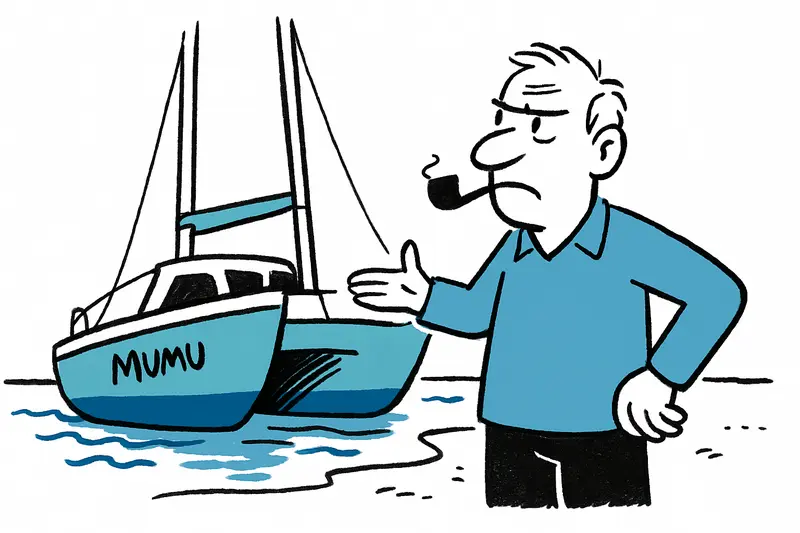
On the shallow edge of the Bay of Alcúdia lies a colorfully painted catamaran half in the water, half in the view of passers-by. The Mumua is the name of the vessel, its owner is Timo, 63, a Finn with a pipe in his mouth. For about two months the boat has rested in knee-deep water in front of sa Marina. The coastal authority has now set a deadline: one week to clear the bathing area – otherwise a fine procedure is threatened.
The scene is familiar: tourists on towels, cyclists along the road between Alcúdia and Port de Pollença, children wading curiously up to the boat and giggling while drivers slow down to take photos. In the heat it smells of sea, old diesel and sunscreen. The problem behind the curious picture is bigger than a single grounded catamaran; broader strains on cleanup capacity are described in Almost 37 Tons of Waste: What Mallorca's Cleanup Fleet Really Tells Us.
Critical analysis
The fact is: Timo had been anchored off Port de Pollença. He says he could not find berths. A snapped line let the Mumua drift; a hole in the hull opened on the rocks at sa Marina, and the vessel is unmanageable. Authorities and providers talked about a technique that can be slid under the hull and inflated to lift the yacht so it can be towed. Questions about who takes responsibility for such operations echo debates in Binissalem Suffocates in Waste: Who Cleans Up - and Who Pays?. Until then the boat lies in the bathing area – and thus in the middle of a conflict between safety, environmental risk and social vulnerability.
The coastal authority demands clearance. That is legally understandable: beach zones must remain free, hazardous substances must be kept away, and bathers must not be endangered. On the other hand there is a person whose home has been lost – at least temporarily. Public debate often lacks the connection between maritime infrastructure, social policy and rapid, transparent decision-making. Local collection efforts and the scale of debris have been highlighted in reporting such as Who cleans up the sea? Almost eight tons of waste off the Balearic Islands — and the uncomfortable answers.
What is missing in public discourse
Few talk about why berths are scarce in some parts of Mallorca or how long waiting lists for permanent moorings are. Also little discussed are clear rules and short-term aid mechanisms when an inhabited vessel runs aground – from securing against oil loss to social support for the person on board. The question of whether owners like Timo could receive assistance with salvage and temporary accommodation usually remains unaddressed.
Everyday scene from Mallorca
In the late morning a delivery van passes by and the drivers wave to the man. An elderly couple who walk the promenade every morning stop, look at the boat and say, 'He's been here a long time.' On the beach a lifeguard briefly talks to the owner about children's safety while a bus from the town beeps shortly and moves on. Such often fleeting encounters shape the picture: no big fuss, but many small annoyances and worries.
Concrete solutions
1) Immediate measures: The harbor master and the coastal authority should jointly check whether oil or fuel leakage is imminent and, if necessary, arrange an oil boom and emergency sealing. Safety comes first. 2) Coordination for salvage: The proposed lifting device under the hull is practicable; what matters is a quick contract with a certified salvage company with a clear deadline and transparent cost breakdown. 3) Social relief: If the vessel is inhabited, the town or municipality should offer temporary accommodation or advice before legal steps escalate. 4) Long term: An island-wide inventory of berths, transparent waiting lists and an emergency fund for salvaging inhabited boats could defuse future cases. 5) Legal clarity: Uniform rules to distinguish 'abandoned' from 'inhabited' boats and a faster procedure for disposing of found vessels would reduce authorities' workload.
Some hard facts
The man says he has lived aboard his Mumua for around ten years; he used the yacht in the Mediterranean and previously worked as the manager of an import company. In recent weeks he has received several purchase offers. He is considering selling the boat and investing in a motorhome. He reports attempted break-ins and that people have entered the boat; the shallow access makes the vessel easily reachable. He also recalls a dramatic crossing from Barcelona to Mallorca in stormy conditions – winds he describes as 'hurricane-like' and very high waves.
Pointed conclusion
The situation of the Mumua is less an isolated spectacle than a symptom: an island under pressure on harbor spaces, unclear emergency paths for inhabited boats and the tension between enforcing beach law and humane treatment of a person without an easy alternative. Authorities have every power to protect the bathing area. But that does not mean the solution can be to leave someone on the street overnight without clarified procedures for salvage and accommodation. Mallorca needs clear, fast procedures for cases like this – technical, legal and social. Otherwise another boat will be lying in shallow water tomorrow and the road will once again become a spectator stand.
Frequently asked questions
What is the weather like in Mallorca in late spring?
Can you swim in Mallorca in late spring?
What should I pack for Mallorca in late spring?
Is late spring a good time to visit Mallorca?
What is Pollensa like in late spring?
What is Palma like in late spring?
What is Alcúdia like in late spring?
Are beaches in Mallorca busy in late spring?
Similar News
Failed before the first flight: How Fischer Air's plans for Palma were ground down
Announced routes, repeated postponements and now apparent insolvency: Why the Fischer Air project for Mallorca is not me...

Seconds in the Water: 19-year-old Fights Her Way Out of Flooded Car in Palma
A 19-year-old managed to rescue herself from her half-submerged car after sliding under the Verge de Lluc underpass. Res...

Between Dream and Reality: Thorsten Legat and the Challenges of FC Germania Mallorca
The former Bundesliga pro has assembled a colorful squad in a short time. But how realistic is the grand plan for promot...

Arrest warrant at check-in: Why two travelers at Cologne/Bonn Airport suddenly had to pay
At Cologne/Bonn Airport, federal police in mid-September found two German passengers subject to enforcement measures. Bo...

Balearic Islands as a New Route: A Reality Check on Rising Boat Migration
For the first time the Balearic Islands are ahead of the Canary Islands in boat arrivals. What do the numbers really say...
More to explore
Discover more interesting content

Can Cap de Bou

Townhouse Lleo 72
