
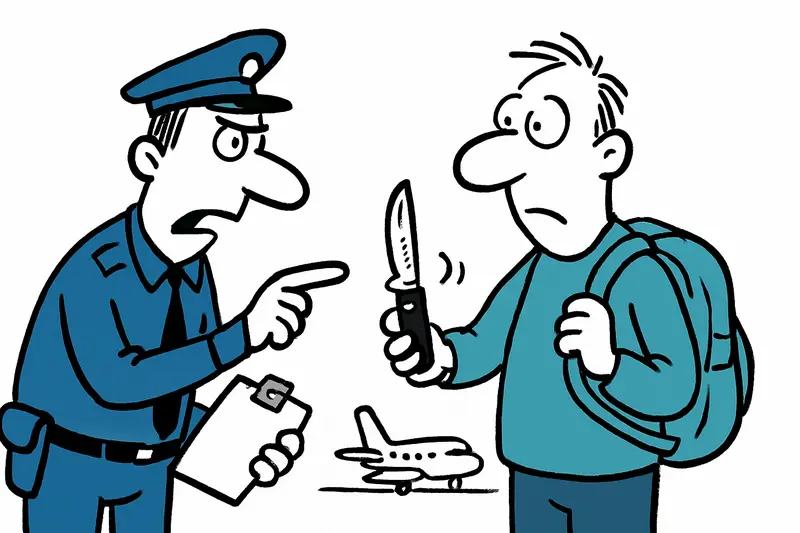
Switchblade in a backpack — and still on board: A reality check from Erfurt–Weimar Airport
Switchblade in a backpack — and still on board: A reality check from Erfurt–Weimar Airport
A 21-year-old was stopped at Erfurt–Weimar Airport with a switchblade in his carry-on. Why he was still allowed to board his flight to Mallorca raises questions.
Switchblade in a backpack — and still on board: A reality check from Erfurt–Weimar Airport
Key question: How secure are our controls when an object classified as a weapon is discovered — and the passenger flies shortly afterward?
On June 20, Federal Police at Erfurt–Weimar Airport stopped a 21-year-old passenger: security officers found a switchblade in his carry-on, a knife classified as a weapon under German law. The knife was confiscated and an investigation for violating the weapons law was opened against the young man. Nevertheless, he was later allowed to board the flight to Mallorca after authorities determined that he was not carrying any other dangerous items.
At first glance that sounds contradictory. If someone has an item that is not allowed under national law, they shouldn't simply be allowed to continue traveling, right? The short answer is: it depends on the circumstances. Crucial questions are: Was the man arrested or merely warned? Were there indications of a concrete threat, or was this an isolated find without further suspicion? And: what powers did the officers on site have without waiting for a court procedure?
It's not only the discovery itself that is critical, but the signal such cases send. Travelers at Palma's Son Sant Joan airport hear announcements daily, suitcases roll across the tiles, taxi drivers and porters negotiate cash transactions; local reporting of incidents like Rollator as a Hiding Place: Arrest at Palma Airport – Questions for Security and Prevention underlines this everyday context.
In public debate there has so far been no clear presentation of how authorities and airports practically proceed in such situations. Media reports mention the find, sometimes the ongoing investigation, but rarely the decision-making paths between the Federal Police, airport management and the airline — coverage of cases such as Cartridge in Hand Luggage: What Mallorca Travelers Need to Know Now illustrates that focus. Who decides whether a passenger is barred from flying, as in incidents like Hidden in the lavatory: the Zurich stowaway and what it means for Mallorca travelers? How long can a plane wait? And how are other passengers protected if a case is not as clear-cut as in Erfurt?
From everyday life in Mallorca a simple comparison can be drawn: at a bus terminal staff react immediately if a backpack looks suspicious — they hold the driver, call the police and do not let the bus depart. Airports could need similar but more structured standards: fixed time windows for police actions, clear escalation steps and a binding information chain to the crew of the affected flight.
Concrete proposals that would improve the situation: First, binding procedures for confiscated items that are classified as criminal offences — including the question of whether a flight must be postponed until clarification. Second, more transparency toward affected passengers: a short, understandable notice explaining why a person is allowed to travel or not would avoid speculation and frustration. Third, regular coordination between the Federal Police, airport operators and airlines so that each case is handled consistently. Fourth, more signage and education for travelers: which items are prohibited and what consequences they face if they carry them.
There are practical limits: not every discovery justifies an arrest, and flight schedules are tightly timed — incidents such as E-cigarette on board: How a small puff causes major disruptions on Mallorca routes show how quickly services can be disrupted. But security decisions should not appear random to outsiders. For Mallorca holidaymakers this means: packing with open eyes not only reduces the risk of personal problems — it also contributes to the security feeling of everyone else.
Pointed conclusion: the incident in Erfurt shows that controls work — dangerous object detected, secured, investigations initiated. What is missing is clarity about how consequences are implemented and how the decision to let someone continue flying is explained to the public. Airports are places where any ambiguity about security hits hard. A bit more procedure, a bit more communication — and boarding in Mallorca would feel a little safer.
Frequently asked questions
What happens if security finds a weapon in a passenger’s carry-on when traveling to Mallorca?
How do airports decide whether a Mallorca-bound passenger is allowed to fly after a security find?
What packing tips help Mallorca travelers avoid security issues?
How can travelers stay informed about security procedures at Palma de Mallorca Airport?
What happened at the Erfurt–Weimar incident involving a switchblade and a Mallorca-bound passenger?
Why do security decisions sometimes feel unclear to the public, even when a weapon is found, for Mallorca travelers?
What improvements are suggested to make security handling more transparent for Mallorca travellers?
What practical steps can Mallorca holidaymakers take to contribute to security and a sense of safety?
Similar News

Missing 24-year-old from Bavaria found on Mallorca
The 24-year-old woman from the Augsburg area who had been missing since August 3 was found on Mallorca. Family members, ...

Heat and Power: Why the Balearic Islands Are Sweating Now — a Reality Check
Weeks of heat waves, rising cooling demand and suddenly flickering lights: Mallorca, Ibiza and Formentera have seen an i...

When the Water Taps Run Dry: Why Tankers Are Not the Solution
In villages like Deià, Valldemossa or on Menorca, municipalities are limiting water use because of drought. Who decides,...

Ryanair Flight Diverted to Barcelona: An In-Flight Emergency and the Questions That Follow
A Ryanair jet from Pisa to Málaga landed in Barcelona after a passenger became acutely ill. Why these cases need more at...

Alarm in Port de Pollença: What now for the polluted bay?
Hundreds of people protested on the beach of Port de Pollença. The environmental organization Arrels Marines demands a p...
More to explore
Discover more interesting content

Boat Tour with BBQ along Es Trenc Beach

Private transfer from Mallorca Airport (PMI) to Pollensa
