
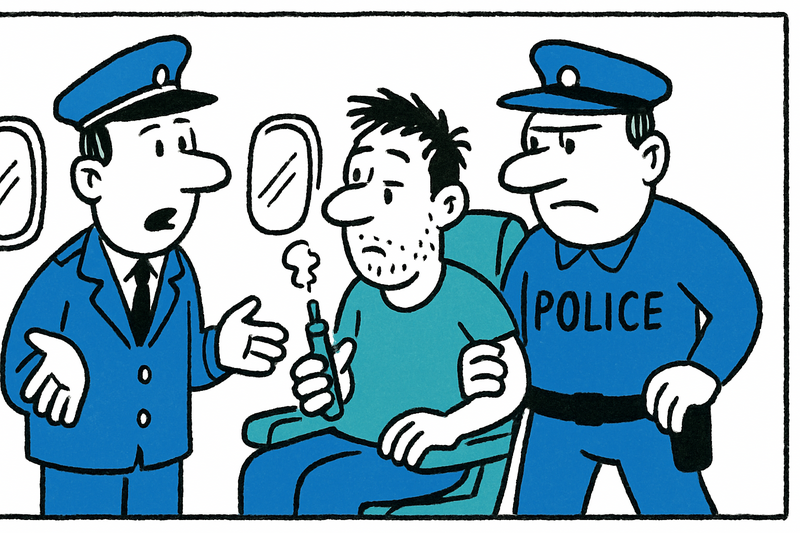
E-cigarette on board: How a small puff causes major disruptions on Mallorca routes
A 21-year-old set off a smoke alarm in an airplane lavatory — police escort, two-hour delay and a lifetime Ryanair ban. What does this say about flight safety and the handling of e-cigarettes?
A spark, much commotion: Incident on a Ryanair flight causes delays
At the end of June, summer heat in the UK and early check-in queues: a flight from Edinburgh to Alicante was thrown into uproar because a 21-year-old Scot activated his e-cigarette in the cabin toilet. The event was brief — a beeping smoke detector, a pilot leaving the cockpit, and six police officers on standby — but it led to around two hours of delay. For holidaymakers continuing to Mallorca or beginning their return journey at Palma (Son Sant Joan), this is a familiar scenario: small disturbances in the chain can quickly have large consequences, as described in Cigarrillo electrónico a bordo: cómo un pequeño vapor provoca grandes alteraciones en las rutas a Mallorca.
The key question: Are the rules enough — or is practice lacking?
The public knows the rule: smoking, including e-cigarettes, is prohibited on board. This is reflected on the UK Civil Aviation Authority (CAA) website. But is the ban sufficient to prevent such incidents, or is it just a paper notice in a handbag? The case shows the intersection of technology and human behavior: a sensitive smoke detector reacts correctly, the crew follows protocol, and the police are called. But what about prevention, information and incident management?
The crew's response was swift and public: the pilot addressed the passengers, explained the situation in a factual tone — that reassures most people, but it also creates tension in cramped cabins when travelers, in the morning light of Palma's terminals, are dreaming of sunlit beaches. At Mallorca's airports, where in July the aprons hum and baggage carts buzz like bees, every delay means missed connections, missed transfers and impatient holidaymakers.
Aspects often overlooked in the debate
First: the technology. Smoke detectors in aircraft lavatories are very sensitive — they are meant to detect fires early. But they also respond to harmless steam, air fresheners or e-cigarette vapor. That leads to false alarms with significant effort, because airports and airlines cannot risk overlooking a real fire; this sensitivity is noted on the European Union Aviation Safety Agency (EASA) website.
Second: lithium-ion batteries. E-cigarettes are small electronic devices; improper handling or defective batteries can pose a fire risk. This is an underestimated safety issue that goes beyond the ban on consumption, and it is addressed in industry guidance such as on the IATA website.
Third: resource allocation. Six police officers arrived to escort a calm, cooperative passenger. For local police and the crew, that means manpower deployment and delay — and on a busy summer morning this can have cascading effects.
Concrete opportunities and solutions
So what can be done? Some pragmatic suggestions that don't sound like prohibition policy but focus on effective prevention:
Clear notices already at check-in: Prominent, multilingual notices on boarding passes, emails and at the gate; not just "No smoking," but also: "E-cigarettes trigger alarms, fines and removal from the aircraft."
Safety training for crew: De-escalation and rapid standard procedures so pilots and cabin crew can inform passengers confidently — that soothes travelers, for example while waiting in Palma, where announcements are accompanied by the low roar of the runway and the distant rustling of palm fronds.
Consider technical adjustments: Adapting detector sensitivity, intelligent sensors that better distinguish between vapor and smoke — of course only if safety standards are not compromised.
Checks before boarding: During sensitive times (peak travel season to Mallorca) intensified signage campaigns at the gate could help. Not every measure needs to escalate to police involvement; information is often cheaper than punishment.
Looking ahead — and a small local note
The young man later appeared in Benidorm and reported a lifetime ban from Ryanair. Local reporting of related incidents after landing in Palma can be found in Humo en el baño del avión: tras el aterrizaje en Palma intervino la Guardia Civil. For holidaymakers in Mallorca the practical lesson remains: anyone taking a last puff at the gate risks more than a reprimand — they put others into urgent waiting positions, make airport staff hold their breath and let golden beach hours slip away. In July, when the sun glitters over Palma and the voices on the Paseo de Marzà grow quieter, it takes little to spoil a dream start to a holiday.
Aviation has clear rules — now it's about enforcing them sensibly, understandably and fairly. Otherwise these little clouds of vapor will, quite literally, annoy us even more often.
Frequently asked questions
Can you use an e-cigarette on a plane to Mallorca?
Why can a small amount of vapor cause a delay on Mallorca flights?
What happens if someone vapes on a flight to Palma de Mallorca?
Are e-cigarettes allowed in hand luggage for flights to Mallorca?
What should holidaymakers know before flying to Mallorca in peak season?
Why do airport staff take smoking rules so seriously at Palma de Mallorca Airport?
Could using an e-cigarette on a plane lead to a ban from the airline?
What is the safest way to travel with an e-cigarette to Mallorca?
Similar News
Popular AIDA Stella Leaves Palma – a Quiet Autumn at the Harbour
The AIDA Stella has left Palma and is heading across the Mediterranean toward Antalya – a long transfer to Asia begins. ...
New Rain Alert in Mallorca: Where Danger Looms and What We Should Do
Aemet reported strong rain on Sunday in the Serra de Tramuntana and in the north and northeast — up to 20 l/m² in one ho...
Taking Off Differently: Pilot, Pere Garau Resident and Rock Musician
Andreas Thiele flies an Airbus A320 for Lufthansa, has an apartment in Pere Garau — and will release an alternative-rock...
Palma takes to the streets: Thousands demand 'Housing as a Right'
Around 3,000 people marched through Palma on Saturday to demand affordable housing. The protest followed the rejection o...
Beatings in Palmanova: Two British tourists injure taxi drivers — what needs to happen now
In Palmanova, two taxi drivers were attacked at night by apparently drunk tourists. One suffered severe facial injuries ...
More to explore
Discover more interesting content

Can Cap de Bou

Townhouse Lleo 72
