
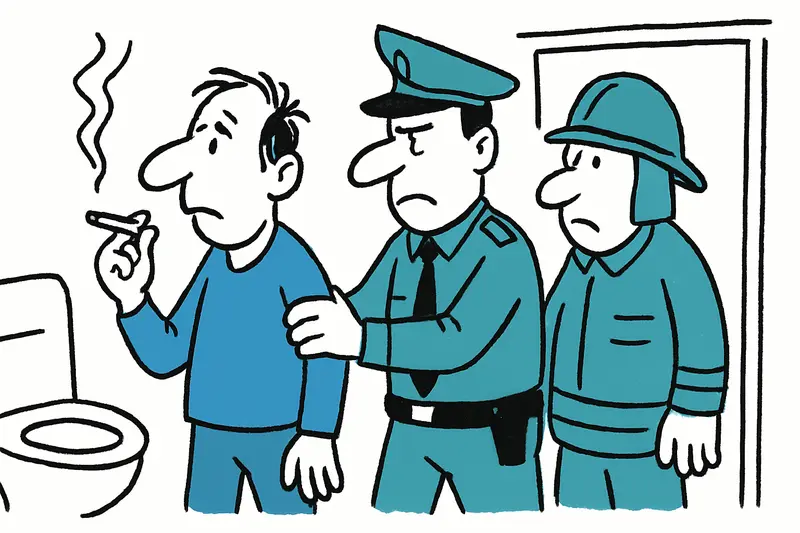
Smoke in airplane toilet: Guardia Civil intervened after landing in Palma
After a smoking incident on board a Düsseldorf flight, the crew ended the situation in Palma: fire services and the Guardia Civil were on site, and one passenger was led away.
Smoke in airplane toilet: Guardia Civil intervened after landing in Palma
A routine flight from Düsseldorf ended on the tarmac at Son Sant Joan with police and fire brigade deployment
On Tuesday, November 25, a passenger flight from Düsseldorf landed on Mallorca. Shortly afterwards the Guardia Civil led a man off the plane and a fire truck was standing on the tarmac ready. The trigger: apparently someone had smoked in the aircraft toilet — a breach of regulations that is taken very seriously in emergencies.
Key question: Is the routine reaction of airline crew and security forces sufficient — or does the issue miss the real problems?
The short version of the facts is simple: a German passenger was checked after the flight, had to provide information and was not allowed to disembark like the other passengers. A traveler who happened to witness the incident described the man as well-groomed, with a noticeable smell of alcohol. When the flight attendant confronted him about smoking in the toilet, he reportedly responded cooperatively and is said to have said he did not know. The airline pointed out that it had no information about the incident; a response from the Guardia Civil was pending at the time of reporting.
It is correct that airlines and airports react sensitively to possible sources of fire: smoke detectors in toilets are standard, and even small smoldering remains can be dangerous on board. That is why ground staff, the fire brigade or the Guardia Civil often respond immediately when there are indications, as in E-cigarette on board: How a small puff causes major disruptions on Mallorca routes. At Son Sant Joan airport, on a mild December day with around 17°C and the faint honking of buses and taxis in front of the terminal, the brief deployment caused visible excitement among the other travelers.
Critical analysis: the incident reveals several layers. First, the simple fact that people break clear rules on board is a recurring issue. Second, the response — fire truck, police — is costly and ties up personnel, and similar escalations have raised questions in other cases such as Emergency Landing at Son Sant Joan: Questions Over Arrests and Procedures, even if in the end nothing like a fire is found. Third, the role of alcohol on board is often only considered tangentially: a passenger smelling of alcohol can be more difficult to handle, and there is a lack of clear mechanisms for how to deal with this circumstance preventively.
What is often missing in public discourse is a sober debate about proportionality and prevention. Mixing safety concerns with the expectation of seeing a police action every time creates a system that quickly overreacts. At the same time, safety standards must not be diluted. The balance between prevention, efficiency and proportionality is hardly discussed — neither in the airport forecourts nor in the waiting areas at Plaça de la Reina, where locals and tourists often casually watch air traffic on such days.
Everyday scene in Mallorca: on the way from the bus station to the terminal you hear the plastic wheels of suitcases, their rattling blending with Catalan loudness. Travelers in winter jackets push through the automatic doors. Some look at their smartphones, others just scan the displays of the baggage belts. An incident like this becomes a small attraction within minutes: glances, quiet whispers, then routine — move on, wait for luggage.
Concrete solutions that would make sense here:
1. More precise initial checks: Crew and ground staff should have clear procedures to identify passengers who appear clearly intoxicated before boarding and — within permitted bounds — take measures.
2. Better communication with passengers: Awareness campaigns before departure, short notices about the smoking ban and consequences, not as a sermon but as clear information.
3. Standardized escalation levels: When is a crew interrogation sufficient, and when is the police called? Uniform protocols between airlines, airport fire services and the Guardia Civil would reduce operational costs.
4. Sanctions and documentation: Consistent but proportionate fines and a reporting system could deter repeat offenders.
Conclusion: that a cigarette is lit in an aircraft toilet is no trivial offense. The safety mechanisms on board work — smoke detectors, attentive crew, quick reaction on the ground. Still, the question remains whether every response has to be as high-threshold as it often appears. Efficiency and prevention can be improved without compromising safety. For island residents and frequent fliers this means: more clarity, less theatre on the tarmac — and for the man who arrived that November day, probably a record in the files and the unpleasant feeling that rules on board must indeed be followed.
Frequently asked questions
What happens if someone smokes in an airplane toilet on a flight to Mallorca?
Why do police and fire crews respond after a smoking incident at Palma airport?
Can you be removed from a plane in Mallorca after smoking on board?
Is smoking in an airplane toilet dangerous even if there is no visible fire?
What should passengers do if they notice smoke on a flight to Mallorca?
Are passengers allowed to smoke on flights departing from Mallorca?
How strict are airport checks at Son Sant Joan in Palma after an onboard incident?
What can lead to a police check after landing in Palma?
Similar News
Battle of the Budget Airlines: Why Wizz Air Overtook Ryanair in Late Summer — and What Mallorca Should Learn
Wizz Air gained significantly more in late summer than Ryanair. A review of the numbers, a look at the effects for Mallo...
Motorcycle crash at Portals Nous: An accident — and many unanswered questions
In the night leading into Friday a 48-year-old motorcyclist crashed heavily on the Ma-1 near Portals Nous (km 9). He suf...
Rent explosion in the Balearic Islands: Why prices rose so sharply between 2020 and 2025
New data from the Observatori show: the average rent for new contracts in the Balearic Islands was €1,390 in 2025 — almo...
First Day, First Consequences: What Palma's Rent Freeze Really Means
A new decree stops a planned eviction in Palma — but what really changes for tenants and landlords? A reality check with...
When Housing Becomes a Matter of Survival: Mallorca Between Rental Frenzy and Everyday Life
The case of 87-year-old Maricarmen showed that on Mallorca many people's lives are poised between affordable and uninhab...
More to explore
Discover more interesting content

Can Cap de Bou

Townhouse Lleo 72
