
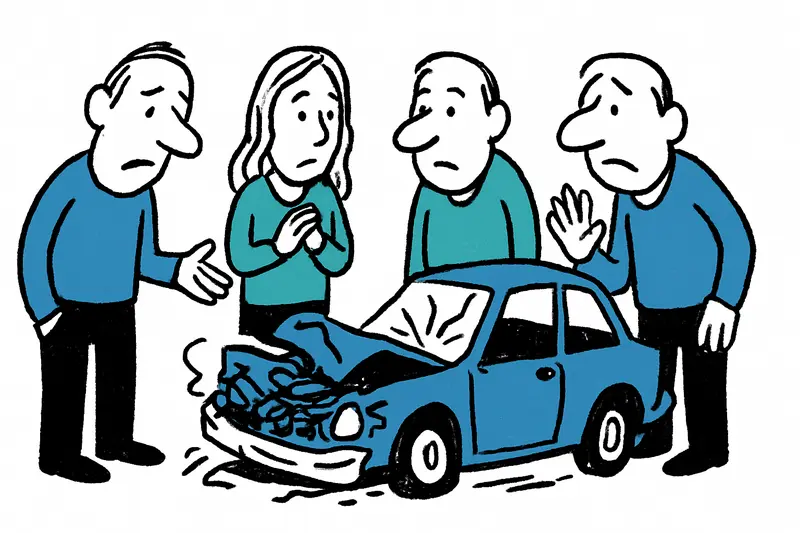
Fatal accident near Son Castelló: Three passengers come forward — where are the gaps in responsibility?
A young man died in an accident on the Carretera towards Son Castelló. Three passengers have since reported themselves to the police. Beyond investigative questions, the case highlights fundamental gaps in night mobility, vehicle legality and prevention in Palma.
New development in the Son Castelló case: More questions than answers
The blue lights had not fully faded when the first neighbors crept along the Carretera towards Son Castelló in the morning. Sirens are rare at that hour; an early morning mist hung over the road and the streetlights cast a dull, yellowish glow. According to the Policía Nacional, a 19-year-old is in custody as the presumed driver (early coverage appears in Fatality in Son Castelló Accident – Fleeing Car Occupants Raise Many Questions). Three other people, two women and one man, voluntarily reported to the police and were released after a short detention. Yet the central question that hovers over the investigation remains: How could it come to this?
The key question behind the operation
Why was the deceased seated in that particular arrangement at the scene? Who was actually driving the vehicle? Was there a valid driving licence? And: was the car even being used legally? The public prosecutor is withholding details for tactical reasons; the community, however, has already begun searching for answers — with rumours, conjecture and a few eyewitness accounts, and with local reporting noting that three occupants turned themselves in after the fatal crash.
What the authorities report so far
Officially, the Policía Nacional confirms suspicion against the 19-year-old: there are indications that he did not hold a driving licence, and the car apparently was not legally in the youth's possession (other reports suggest the sedan involved may have been stolen, see report on an apparently stolen sedan). Forensic teams are working on site, traces at the crash scene have been examined, and technical analyses have been ordered. The public prosecutor plans to release more information only after the findings have been evaluated.
Why this case is more complex than a simple night-time crash
Many reports quickly focus on keywords like “speed” or “alcohol” — both possible factors. But here another web converges: the question of vehicle legality, young people's access to cars without paperwork, and the dynamics of social networks in which cars are passed on at short notice. When several people are involved, the reconstruction process becomes more difficult: who left when? Was there an attempt to help or was the scene abandoned? Is driver flight a possibility? These are not theoretical subtleties but central issues that shape the legal and human picture.
Few perspectives that are often missing
Our neighborhoods are debating. Some say one should not rush to judgement. Others ask why young drivers have access to such vehicles at all. Too rarely considered in the public discussion are:
• The origin of the vehicles – stolen, borrowed, uninsured? A car without papers is a risk factor.
• Social mechanisms – young people swap cars or are lent one at short notice. Online groups on messaging apps play a role in this.
• Night infrastructure – those out late often have few alternatives: sparse night buses, expensive taxis, no safe meeting points.
• Reluctance to report – neighbors notice things but do not report them out of fear of consequences or because anonymous reporting does not seem easy.
Concrete opportunities for prevention
The Son Castelló case shows where politics and society can act. Small, concrete measures could save lives:
1. Checks and clear proof of ownership – targeted inspections especially late at night, together with a practical procedure for checking vehicle documents and insurance status.
2. Traffic education with practical relevance – in schools and youth centres: not only theory but real examples, legal consequences and role-playing that show what driving without papers can mean.
3. Expand night infrastructure – reliable night bus lines, pickup benches or state-supported taxi options for young people could reduce the temptation to use unregistered vehicles.
4. Strengthen anonymous reporting channels – digital reporting tools that protect neighbors while being practical at the local level; coupled with prevention work by municipal staff.
5. Cooperation with rental companies and workshops – garages and rental agencies should be obliged to report suspicious cases (missing papers, unusual transfers) anonymously, as highlighted in local analysis such as Spotlight on Son Castelló: Why the occupants fled — and what the municipality must do now.
Investigation status and legal perspective
The statements of the three passengers are now being examined. Relevant is not only whether criminal offences have occurred, but also which civil-law questions arise — for example liability issues, insurance coverage and ownership. Technical analyses (braking distances, vehicle damage, data from the vehicle) will be decisive in clarifying the exact sequence of events.
An appeal to the neighborhood
The police continue to call on witnesses to come forward: who saw unusual vehicle movements, who saw the car in question parked at a certain spot before the crash, or who has relevant photos or videos. Every observation counts. In a densely populated area like Palma, neighborhood cooperation can significantly advance investigations.
Why this incident concerns us all
Beyond the grief for a lost life, it is a question of how we as a society deal with youth mobility, informal vehicle use and night-time infrastructure. Such incidents can only decrease if we tackle the root causes: better controls, targeted education and night-time options. This is not bureaucratic fine-tuning but safety work that protects people.
We are following the case. The editorial team is monitoring the investigation and will report further as soon as verified information is available. Our deepest sympathy goes to the bereaved. In Palma the sirens echo for a long time — and with them the question of how many of these nights could be prevented by sensible measures.
Frequently asked questions
What should I know about the investigation into the crash near Son Castelló in Mallorca?
Can you drive in Mallorca if you do not have a licence?
What happens if a car involved in a crash in Mallorca was stolen or not legally owned?
Why do some Mallorca crashes involve several passengers coming forward later?
What should I do if I witness a serious traffic accident in Palma or Son Castelló?
Is it common for young drivers in Mallorca to use cars without proper paperwork?
How does night-time transport affect road safety in Mallorca?
What is Son Castelló in Mallorca known for, and why does it appear in traffic news?
Similar News

When coercive fines aren't enough: Could holiday rental owners soon face prosecution?
The island administration is stepping up action against unauthorized holiday rentals: high daily coercive fines up to €5...

Palma Airport on an Expansion Course — Who Decides How Much Growth the Island Needs?
Aena and Madrid are planning multi-million euro investments for Son Sant Joan and project higher capacities. Concern is ...
Who Gets Left Out? Why Overbookings Will Hit Many Mallorca Travelers This Summer
On hot check-in days at Son Sant Joan, frustrated travelers pile up. New figures from Reclamador.es show that a large sh...
When the Handyman Came: How an Engagement Ring Disappeared in Mallorca and What It Says About Trust
During a repair in Andratx a highly personal engagement ring went missing — a case that calls not only for punishment bu...
How Burglars Test Fincas in Mallorca — and What You Can Do About It
The Spanish National Police warn of a simple but effective trick: small markings on doors reveal whether a finca is occu...
More to explore
Discover more interesting content

Can Cap de Bou

Townhouse Lleo 72
