
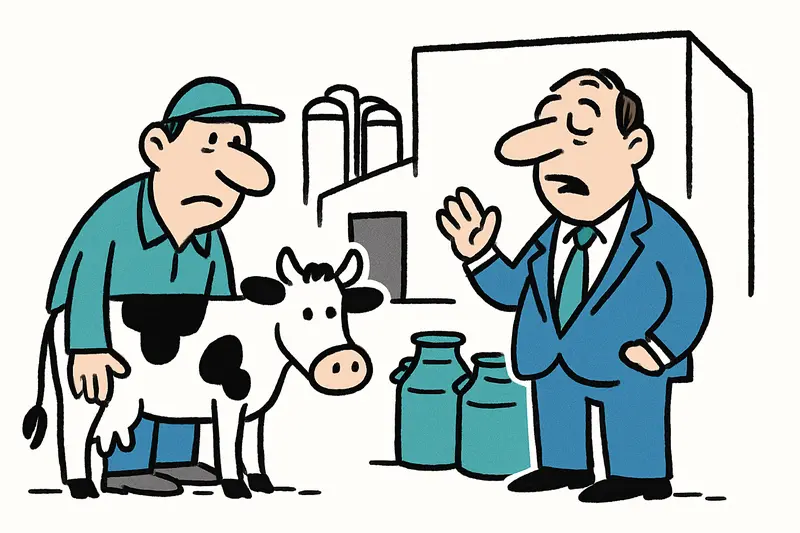
Traditional Dairy on Mallorca Facing Closure: Who Will Pay the Price for the Disappearance of Island Milk?
Traditional Dairy on Mallorca Facing Closure: Who Will Pay the Price for the Disappearance of Island Milk?
The closure of the 68-year-old dairy in Palma tears open supply chains: 14 employees, three farms and 300,000 liters of island milk per month suddenly have no buyer. Who will replace the value of local processing?
Traditional Dairy on Mallorca Facing Closure: Who Will Pay the Price for the Disappearance of Island Milk?
Key question
Who takes responsibility when a business that processed island milk for almost seven decades shuts down overnight — and what are the consequences for farmers, employees and the island's economy?
Summary of the facts
The dairy in Palma, which bottled brands such as Agama and the Laccao Tetra Paks, is slated to close later this year. The operation has existed for around 68 years and is part of a large beverage corporation based on the Spanish mainland. After months of negotiations about rescue models — in which a possible state participation of around 25 percent was also discussed — no economically viable solutions were found. The factory currently only has 14 employment contracts left — in the early 1990s there were about 220 employees — and the remaining milk suppliers from three farms together deliver around 300,000 liters per month. The brands will remain; however, bottling will be relocated to the Spanish mainland. Workers are being offered positions in other parts of the corporation.
Critical analysis
The mere statement that the brand will remain does not help the dairy farmers and those small suppliers. Production and processing are two different values: pasteurizing, packaging, short-term storage, local logistics — all of this generates income locally. If bottling is moved to the mainland, this added value disappears from the island.
Negotiations were apparently held, but it remains unclear which figures destroyed the business case. Were there realistic offers for transitional financing? How long would state funds or a public-private model have had to run? And: why were the suppliers apparently informed so short-term that they now lose their buyer within weeks?
What is missing from the public discourse
There is a lot of talk about lost jobs and the symbolic anger of local politics — which is understandable — but hardly anyone asks the long-term question of supply security and regional resilience: How do we secure the island's supply of fresh dairy products if processing structures disappear, as discussed in Milk, Big Mac, Postage: Why Many Prices on Mallorca Hurt? What role do trade agreements and the shifts described in When the Cold Case Steals the Menu: How Supermarkets Are Changing Mallorca's Lunch play in a corporation's decision to relocate production? And finally: what ecological costs arise from additional transport of milk from the mainland compared with local processing?
Everyday scene from Campos
On market day in Campos, when the Plaça Major still smells of freshly baked ensaimada and tractors trundle down the street to the village center, people talk about cows and their spring selections. For many here, milk is not an abstract product but a piece of daily rhythm: the milk supplier who empties the tanks early on the farm, the neighbor who tends the calves. The end of the dairy is for them not a management problem but the end of a small local industry that linked the blare of sirens on the country road to the rhythm of agriculture.
Concrete solutions
1. Short term: An emergency purchase fund from the regional government to compensate farmers for at least six months would have provided time to explore alternatives. State storage of milk for use in social programs or schools is possible.
2. Medium term: Support for the creation of cooperatives or smaller, modular pasteurization and bottling facilities. Mobile pasteurization units can bridge the gap and position local brands as premium products.
3. Procurement policy: Municipalities and hotels could be required to meet minimum quotas for regional milk production. Bundled orders from regions and large buyers can make investments in local processing economically viable.
4. Contract and transparency rules: Supply contracts between corporations and farmers should include minimum notice periods so that farms are not left facing closure within a few weeks. The public sector can act as a mediator when strategic supply issues are at stake.
Why this is not just a farmers' problem
If an island loses a stage of processing, local logisticians, maintenance businesses, delivery services and retailers also lose out. Tourists then buy products packaged on the mainland — there is less substance to the narrative of "local." So this is about income drivers, not just nostalgia; the effect on hospitality is visible in pieces such as Empty Tables, Tight Wallets: Mallorca's Gastronomy at a Crossroads.
Concise conclusion
It is not a law of nature that dairy processing must move off islands. What matters are contractual conditions, political design and quick, smart action on the ground. If regional politics now only reacts symbolically and management is merely declared "undesirable," in the end the milk will remain in Tetra Paks — and the island will lose a piece of economic independence.
The question is not only whether the brand stays on supermarket shelves. The question is who will pay the farmers, who will create the jobs and how Mallorca will maintain its capacity to process food — and thus a degree of independence. If we do not discuss this seriously, the next chapter is already written: even more island products that are only "made in mainland."
Frequently asked questions
Why is the Mallorca dairy in Palma closing?
What happens to Mallorca milk brands if bottling moves to the mainland?
How many workers are affected by the closing dairy in Palma?
Will Mallorca farmers still have a buyer for their milk?
What could Mallorca do to keep local milk processing alive?
Why does the closure of a dairy matter beyond farming in Mallorca?
How secure is Mallorca’s supply of fresh dairy products?
What is happening in Campos around the Mallorca dairy closure?
Similar News
Palma, Palma de Mallorca, Palma‑Mallorca: What is it really about?
The debate over the city's name is more than grammar: it concerns identity, law and branding policy. A sober reality che...

Warning to Bathers: Nipping Fish in Cala Major and Other Coves — a Reality Check
In Cala Major and several beaches around Mallorca, bathers report painful “nips”. Who are the animals, why are they gett...

Rental Car Theft in El Arenal: What This Incident Reveals About Our Gaps
A teenager steals a running rental car in El Arenal, flees on foot, climbs over walls and is caught by the Guardia Civil...

Red Rope in Palma's Library: What Helps Against Selfie Tourism — and What's Missing
Palma's city library cordoned off an area with a red rope to keep selfie tourism away from reading and working activitie...

Fort San Carlos: Museum, Harbor Dispute — and a Conflict That Demands Answers
The military museum at Fort San Carlos sits right on Palma's harbor, with unexpectedly quiet rooms filled with cannons a...
More to explore
Discover more interesting content

Can Cap de Bou

Townhouse Lleo 72
