
Trees in Front of the Cathedral: Court Allows Felling – Was That the Only Solution?
Trees in Front of the Cathedral: Court Allows Felling – Was That the Only Solution?
An administrative court lifted the temporary injunction: 18 Bellasombra trees on Plaça Llorenç Villalonga may be felled due to alleged danger. Residents protest – is traffic safety a better standard than urban greenery?
Trees in Front of the Cathedral: Court Allows Felling – Was That the Only Solution?
Judicial decision hits the neighborhood: 18 Bellasombra to be removed, citizens are outraged
Is the removal of the 18 Bellasombra on Plaça Llorenç Villalonga truly the only option when it comes to people’s safety? That question has been hanging in the air since an administrative court in Palma lifted a temporary injunction. The city insists on the intervention: reports from the municipal parks and gardens department describe severely damaged specimens showing signs of disease and an increased risk of falling branches – especially during strong winds or heavy rain. The judges gave priority to this view and thus revoked the previously granted reprieve.
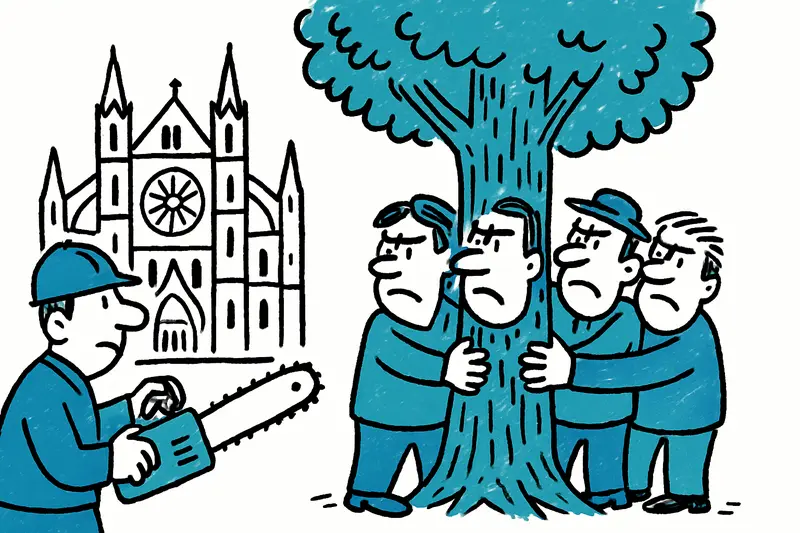
The ruling has immediate, tangible effects on site. On the square, not far from the cathedral and Parc de la Mar, residents have taken a demonstrative stand: hands on bark, voices in a circle – a scene similar to others seen around the city when urban greenery is threatened, as reported in Controversia por 17 ombúes en la Plaza Llorenç Villalonga: ¿Quién decide sobre el verde urbano?. At the same time, an online petition gathered 1,224 signatures within 24 hours. For many people in the neighborhood the decision is a blow, reflecting wider opposition documented in Alarma en Palma: el vecindario se opone a las talas de árboles en la Plaza Llorenç Villalonga. The square provides shade, meeting space and is part of the city’s character.
It remains necessary to question how alternatives were examined. The citizens’ initiative proposed cordons and temporary closures. The city and the court point out that fences on the square were quickly removed and were later even found in Parc de la Mar. Moreover, a permanent closure could hinder access for emergency services – an argument the judges considered weighty. This makes clear: the weighing of public safety against the preservation of greenery is not a purely technical process; it is also a matter of spatial organization and governance.
What has so far been lacking in the public discourse: first, an independent, publicly accessible documentation of the tree inspections; second, reliable figures on the frequency and nature of the hazard (which branches, what heights, how often do wind events occur that could cause problems); third, a concrete plan for transitional measures that could reduce operational intervention without completely denuding the square. Instead of presenting only the alternatives ‘felling versus closure’, intermediate steps are often missing, such as crown securing, professional removal of dead branches, provisional supports or a renewed independent expert inspection by tree specialists outside the municipal structure.
From a practical perspective there are additional questions: who monitors whether the barriers are maintained? How is it prevented that temporary measures are quickly bypassed? And: in what form will replacement trees be selected? The city has announced that after the planned felling it will plant 20 new trees – nominally an increase. But without information on species choice, planting location, maintenance concepts and a financing plan, the promise remains vague.
Concrete solutions that could help now: 1) A third, independent tree assessment, publicly accessible and with clear recommendations for action. 2) A documented phase of crown securing and techniques such as temporary supports before large-scale felling takes place. 3) A marked rescue corridor that allows restriction measures without blocking fire brigade access. 4) A binding reforestation plan: local, resilient species, fixed maintenance intervals and involvement of neighborhood groups in the care of young trees. 5) A municipal tree registry with health status and inspection date for each planting – that builds trust.
The scene on the Plaça remains lively: children playing under the crowns, older people with shopping bags, a delivery van waiting at the edge, tourists seeking shade. The square is not an abstract point on a map but part of everyday Palma. These everyday conversations are neglected when decisions are made solely behind expert reports and in courtrooms.
The conclusion is sharp: safety must not become an all-purpose trump card, yet it would be naïve to ignore the real dangers of such weakened trees. A more transparent, staged approach would have been preferable – examined, documented and with clear transitional rules that protect people while respecting the city’s green substance. The now announced reforestation is a step; whether it is more than a symbol will depend on how openly and concretely the city implements the plan and whether the neighborhood is involved in its execution.
Frequently asked questions
Why are the trees on Plaça Llorenç Villalonga in Palma being felled?
Are unsafe trees in Palma always cut down, or can they be protected first?
Why did the court in Palma allow the felling to go ahead?
What are residents in Palma asking for instead of cutting down the trees?
Will new trees be planted after the trees are removed in Palma?
Why does Plaça Llorenç Villalonga matter so much to people in Palma?
How can a city in Mallorca balance tree safety and protecting urban greenery?
What is the best way to follow tree felling decisions in Palma?
Similar News
The Painter Who Lived Mallorca: Franz Taussig and His Century-Old Secret
A hundred years ago a young Viennese arrived in El Terreno, sketched the island and called himself Francis Caron. Today ...

Airport dispute: Bridge, forecasts and the question of responsibility
A video by the Spanish transport minister has ignited the dispute over DORA figures, capacities and local governance pow...

The Painter Who Invented Himself: How a Young Viennese Drew Mallorca
A hundred years ago a 19-year-old draftsman arrived in El Terreno. His diary and sheets, long known under the pseudonym ...
Released with Conditions: The Plus Ultra Suspicion and a Mallorcan Finca as Residence
A Dutch entrepreneur, sought in connection with the Plus Ultra case, was extradited to Spain after his arrest in Germany...

Haute Nuit in Puerto Portals: Fashion, Art and Indulgence by the Water
On October 2 the Lobster Club in Puerto Portals will be transformed into a stage for curated fashion, art and culinary e...
More to explore
Discover more interesting content

Can Cap de Bou

Townhouse Lleo 72
