
Frightening Seconds over Palma: Two Flight Attendants Injured
During the landing approach to Palma, around 180 passengers experienced severe turbulence. Two flight attendants suffered head injuries. An incident that raises questions about safety on board.
Frightening seconds over Palma: two crew members injured
Late on Sunday evening a brief but violently intensifying storm turned an otherwise calm approach to Palma into a scene many will remember. A Ryanair flight from Vitoria-Gasteiz encountered such strong turbulence on final approach that two flight attendants were injured and had to be taken away by ambulance after landing. Around 180 passengers later disembarked visibly shaken but physically unharmed, as reported in "An Outrage" at Palma Airport: Why Did Passengers Disembark — and the Plane Fly Off Empty?.
How it happened — and what people heard on board
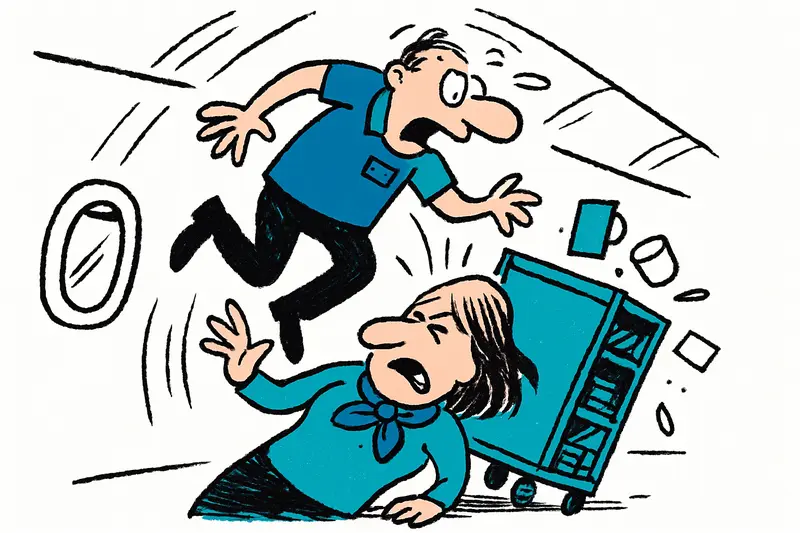
A passenger described the event like this: 'It wasn't a jolt, it was a blow. Suddenly cups flew and a service cart tipped over.' The onboard sounds — the clatter of crockery, screams, the hum of the air conditioning — mixed with the distant drone of Son Sant Joan's landing lights. Outside, the storm was active: short showers, deep rumbles, the smell of wet tarmac, while lightning lit the edges of the clouds in the distance.
Two crew members apparently suffered head injuries after a service cart toppled and a colleague was thrown against the ceiling. Rescue teams waited at the passenger stairs, treated the injured and took them to hospital. There was no final statement on the exact severity of the injuries that evening; authorities are investigating the incident.
The central question: could this have been prevented?
That's the question that remains — and one we should not dismiss as mere bad luck. Turbulence is a known risk, especially in the transition from late summer to autumn when local storm cells and downdrafts can occur over the Balearics. But 'known' doesn't mean 'unavoidable'. Three aspects are often underexposed in public debate:
1. Cabin organisation and securing service equipment. Service carts are heavy but not indestructible. A tipping cart can become a weapon. Locking mechanisms, parking brakes and latches must be reliable — and staff should have clear rules about when carts may be moved or must be secured.
2. Communication and decision-making in the cockpit. Pilots can, at short notice, choose different routes, altitudes or hold patterns to avoid weather cells. What matters is how quickly and on what information basis such decisions are made. Were there warnings about the local storm? Were service times adjusted on board in time?
3. Safety culture and the seat-belt rule. Many passengers recall such incidents and say: 'If I'd been belted, I'd have been safer.' But the seat-belt rule is only as effective as its enforcement. If there is no example-setting behaviour during service, the willingness to stay belted decreases.
Concrete improvements
Practical lessons can be drawn from the incident — for airlines, travellers and the airport alike:
• Better securing of service carts: verifiable locks, automated brakes, mandatory parking devices before take-off and landing.
• Clearer work instructions: crew should be moved immediately into safe positions at the first signs of instability, similar to a 'safety phase' before an expected entry into turbulence.
• Improved real-time weather information: closer integration between airport meteorology, airline operations and the cockpit to detect sudden cells earlier.
• Passenger awareness: short, concise announcements before boarding and during the flight; a friendly but firm reminder to keep seat belts fastened, even if it's 'just a little bump'.
What matters now
For those affected, a thorough medical assessment and subsequent support are the priority. For everyone else, the small metal strap on the seat can prevent a great deal of harm. Those who fly to and from Mallorca regularly know how quickly summer storms can change — and should view the seat-belt sign as more than a formality.
Authorities are reviewing the incident and the airline will have to report; local coverage of other Palma runway events can be found in Turmoil on Palma's Runway: What to Know About the Air‑Arabia Incident. For the island it is a minor shock between lights and the sound of waves, a reminder that technology, procedures and people must work together so that such frightening seconds do not turn into something worse. And an appeal to everyone involved: a little more care costs almost nothing but can save a lot.
Frequently asked questions
How dangerous is turbulence on flights to Mallorca?
What should I do if a flight to Palma gets very bumpy?
Is it safe to keep your seat belt on during a Mallorca flight?
When is turbulence more common around Mallorca?
What happens after an incident on a flight landing at Palma Airport?
Which airport is Palma in Mallorca usually called?
What should airlines improve to make flights to Mallorca safer in storms?
Should I worry about flying to Mallorca during storm season?
Similar News
Mistaken identity with fatal consequences: Brutal assault in S'Aranjassa — what's missing in the follow-up?
At S'Aranjassa a visitor to a finca was tied up, beaten and thrown out of a van. Three men have been arrested, including...
High heel slips, car accelerates: accident on Camí de Son Hugo
A woman lost a high-heeled shoe on the forecourt of the sports facility at Camí de Son Hugo. The car accelerated, mounte...
Phone Scam: How Two Hotel Employees at Playa de Palma Lost Thousands of Euros
One morning in September, two reception employees at Playa de Palma were pressured by alleged alarm-company staff — in t...

When the Wallet Becomes a Danger: Attack in Peguera and Lessons for Mallorca
In Peguera, two women are said to have stolen the wallet from a 75-year-old German couple. When the victim intervened, t...
Plata stays Plata: Young people take over, Llonguets remain
A small bar on Carrer de l'Argenteria will continue: Tolo Serra hands the place over to young Mallorcans at the end of t...
More to explore
Discover more interesting content

Can Cap de Bou

Townhouse Lleo 72
