
New mandatory V16 breakdown light in Mallorca: Which expiry date drivers need to know
New mandatory V16 breakdown light in Mallorca: Which expiry date drivers need to know
Since January 2026 the V16 has been mandatory in Mallorca. Key question: How reliable are the devices in practice when expiry dates, batteries and connectivity fail?
New mandatory V16 breakdown light in Mallorca: Which expiry date drivers need to know
Key question: Do we rely on a small device without checking whether it will still do what it promises tomorrow?
Since the beginning of 2026 a new light has been in almost every glove compartment: the V16 'baliza', which in Spain largely replaces the classic warning triangle, as explained in V16 Mandatory in Mallorca: What Drivers Really Need to Know. On Passeig Mallorca in Palma, in the morning traffic on the Ma-20 or on the car park at Playa de Palma, you now more often see the small yellow box lying in open car doors. A good idea in itself – only: many users do not know that these devices have a technical lifetime.
The most important facts, short and concrete: the device and the packaging show an expiry date. This is the deadline until which the manufacturer guarantees the correct function of all electronic and communication components. The legal regulation further prescribes a minimum standby time and requires that an activated V16 must light for at least 30 minutes. Telecom companies are not allowed to charge private customers extra for the required radio connections under the law; a minimum availability of the connection of 12 years is provided, as reported in V16 Warning Light: What Will Be Mandatory in the Glove Compartment in Majorca from 2026 — a Reality Check.
Sounds reassuring. The flip side: what does this expiry date mean in everyday life? This is where the criticism begins. Who buys a device, puts it in a drawer and looks eight years later to see whether the battery still has power? And how many lights disappear when a used car is sold without any information about the remaining service life?
Critical analysis: the regulation focuses on minimum requirements – but it does not guarantee that a device will still send error-free signals after three years of storage, a shock or severe heat exposure in a hot car. Manufacturers give a warranty period; practice in Mallorca shows: cars are often parked in the sun, sand from the beach gets into compartments, and when buying quickly at the petrol station people rarely read the fine print. It is also unclear how authorities or the Technical Inspection Service (ITV) are supposed to check compliance with these deadlines. Will expired V16s be criticized during checks? In the public debate a precise answer is missing.
What is missing from the debate? First: concrete inspection and replacement pathways for affected drivers. Second: affordable disposal and take-back options so that expired devices are not carelessly thrown in the trash. Third: transparent information for second owners when vehicles are sold. Fourth: clear rules on whether and how dealers must check used devices at the time of purchase.
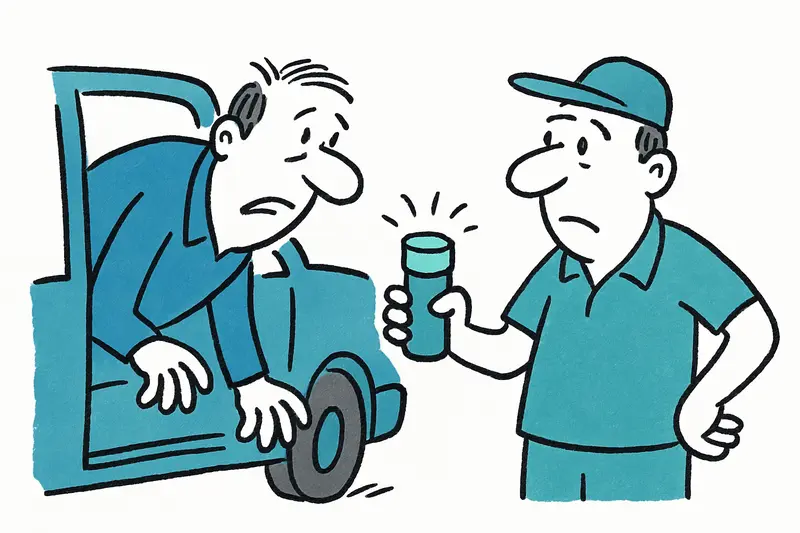
Everyday scene from Mallorca: on Saturday morning I was at the petrol station on Avinguda de Joan Miró. A retiree leafed through the packaging, chose a V16 and asked the cashier how long the thing would last. The answer: a shrug. That's how it looks – many questions, little practical guidance at the point of sale.
Concrete solutions that would help immediately: 1) Clear labelling with a clearly visible production and expiry year on the outside of the device. 2) Information duty when selling a vehicle: sellers must inform buyers in writing about the remaining service life and condition of the V16. 3) Free testing events by municipalities or automobile clubs before peak travel times (for example before the summer holidays). 4) Training for workshops and ITV stations so that expired or defective devices are detected during inspections. 5) Cooperation with petrol station chains for low-cost battery replacement campaigns or take-back of expired devices.
One further detail deserves attention: the legal promise of a 12-year connection availability does not mean that the hardware itself will function unchanged for 12 years. Radio modules, seals, charging electronics – all of this ages. So anyone who wants to be on the safe side should not dismiss the expiry date as mere fine print.
Piercing conclusion: the V16 is a step forward – provided we do not treat it like a pretty accessory. A look at the packaging and the device before purchase, an annual quick check (battery, seals, visibility of the date) and simple municipal offers could prevent a lot of trouble. In Mallorca, where heat, sand and short shopping stops shape everyday life, a small ritual pays off: check the V16, note the expiry date, keep spare batteries in the glove compartment. Then the technology really provides safety – not just a good feeling.
Frequently asked questions
What is the weather like in Mallorca in spring?
Can you swim in Mallorca in spring?
What should I pack for Mallorca in spring?
Is spring a good time to visit Mallorca?
What is Port de Sóller like in spring?
What is Sóller like in spring?
What is Sóller Port like in spring?
What is Pollença like in spring?
Similar News

When the Wallet Becomes a Danger: Attack in Peguera and Lessons for Mallorca
In Peguera, two women are said to have stolen the wallet from a 75-year-old German couple. When the victim intervened, t...
Plata stays Plata: Young people take over, Llonguets remain
A small bar on Carrer de l'Argenteria will continue: Tolo Serra hands the place over to young Mallorcans at the end of t...
Unnoticed in the Luggage Compartment: How a Boy Traveled More Than 100 Kilometers in a Team Bus
A minor traveled in the undercarriage of a team bus for more than 100 kilometers until his cries for help were heard. A ...

Cap Vermell Grand: Second Michelin Key – a Gift for the East
The Cap Vermell Grand in Capdepera has been awarded its second Michelin key. For the region this elevates the luxury off...

Eurowings lets four aircraft carry names – a friendly idea that also reaches Mallorca
Eurowings is launching a campaign: four Airbus A320s are to carry the first names of people who help others in everyday ...
More to explore
Discover more interesting content

Can Cap de Bou

Townhouse Lleo 72
