
Shortly before major demonstration: Vandalism at a real estate agency in Palma — Do the ends justify the means?
Shortly before major demonstration: Vandalism at a real estate agency in Palma — Do the ends justify the means?
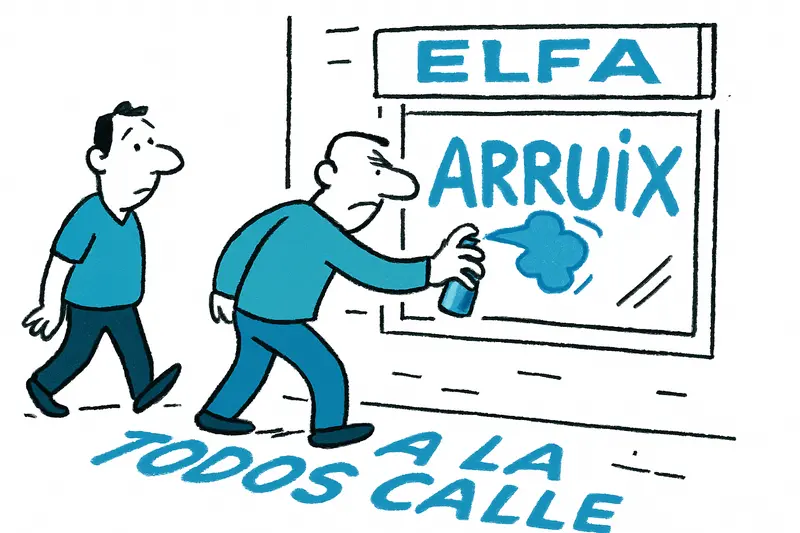
Shortly before the large demonstration against mass tourism, a real estate agency on Carrer Verí in Palma was sprayed with slogans. The action raises a fundamental question: Does property damage hurt the cause or draw attention to the housing shortage?
Shortly before major demonstration: Vandalism at a real estate agency in Palma — Do the ends justify the means?
Graffiti on the shop window, slogans on the pavement and the question of impact and responsibility
In the early morning on Carrer Verí there was the smell of strong coffee and freshly swept asphalt. Between delivery vans opening their loading areas and tourists still struggling with city maps, black lettering lay in front of the shop window of a real estate agency: slogans referring to a planned protest date, the word „arruix“ and the call „todos a la calle“. The agency brokers high-priced properties to international buyers and thus stands symbolically for a conflict that has been flaring up in Mallorca for months.
The immediate guiding question is: who wins, who loses when protest turns into property damage? Some activists believe visible actions sharpen public attention on the housing shortage and runaway prices, a dynamic addressed in Palma after the Protest: How Freedom of Expression and Everyday Life Can Be Balanced. Other residents and shop owners perceive damage to property as a provocation that makes constructive conversation harder and reduces support in the city.
Looking at the recent sequence of incidents, a pattern emerges. In several places on the island, real estate agencies and shop windows have been damaged in recent months, locks glued and facades daubed, a trend noted in Palma Cleans Up — Who Pays, What Remains?. In early July there were arrests of young suspects. Some groups within the protest movement have distanced themselves from destructive methods; other publications online contained prior hints of direct actions that explicitly described such measures, as covered in Red mark at the pool: Protest in Palmanova causes unrest.
A sober analysis reveals two problems. First: escalation provokes a counterreaction. When investigations and arrests follow, the debate shifts from urban policy demands to law enforcement and security. Second: symbolic targets — luxury brokers, holiday rentals — are easy to name. Concrete political demands, such as creating permanently affordable housing or binding controls on short-term rentals, are often missing from the publicly visible forms of action.
What is currently missing from the public debate is an achievable package of measures that translates the anger on the streets into tangible proposals. It is not enough to see slogans on facades; what is needed are clear demands to the town hall and the island government: more transparent buyer registers, stricter enforcement of existing rental rules, a mandatory share of social housing in new developments and consistent sanctions against illegally rented flats. Families sending children to school in the morning need more than moral outrage.
A look at everyday life helps to understand the mood. On the way from Mercat de l’Olivar you hear market people complaining about rising rents. On the Paseo Marítimo residents watch holidaymakers fill the beaches during the day and enliven the streets in the evenings. In neighborhoods with a strong tourist influence small shops disappear; successors are often holiday lets or investors who earn only seasonal income. That creates displacement — and desperation that vents itself in actions like the recent one, similar to incidents reported in Scratched Cars in Santanyí: Scratches Instead of Holiday Peace.
Concrete, practicable proposals: the city administration could launch a subsidy program for renovating flats for locals, accompanied by rent bindings of at least ten years. A publicly accessible register of all holiday apartments and their owners would create transparency. Fines against intermediaries who knowingly serve illegal short-term renters would need to be increased. At the same time, protest movements need clear rules: what legitimate, peaceful actions look like, how uninvolved people are protected and how damage can be avoided.
Prevention is no substitute for political change. Police and judiciary must pursue criminal acts. At the same time, authorities should support forums where residents, business owners and activists sit at the same table to work out concrete solutions. When demands become tangible, property damage loses its fuel: the feeling of powerlessness of many people.
My conclusion is brief and somewhat uncomfortable: property damage attracts attention but destroys trust. Trust is the currency with which politics and society negotiate change. Those who truly want to change Mallorca's housing market need more strategy than spray cans, more transparency than symbolism and more spaces for negotiation than for escalation.
Frequently asked questions
What is the role of vandalism in Mallorca's housing protests, and does it help or hurt the cause?
What concrete policy steps could Mallorca adopt to tackle housing affordability?
How should authorities in Mallorca respond to protests to maintain dialogue and safety?
Why are luxury real estate and short-term rentals a central debate in Mallorca's housing scene?
In Palma, what steps could the city take to curb illegal short-term rentals and improve housing transparency?
What kind of long-term rent protections could be realistic in Mallorca to support local families?
What role do community forums play in solving Mallorca's housing issues?
What should residents know before participating in housing-related demonstrations?
Similar News

More water than last year: Mallorca's reservoirs breathe easier
September rain refilled the Tramuntana's reserves: overall fill around 35 percent, Cúber at 40.42 percent, Gorg Blau at ...

Three Luxury Hotels in Banyalbufar: Lots of Money, Many Questions
A Danish investor plans three exclusive accommodations in Banyalbufar — including the historic Son Valentí. The announce...
2.1 tonnes of cocaine on sailing yacht off Spain's coast – a reality check for the coastguard
A 14-metre yacht was seized with 2.1 tonnes of cocaine. Who monitors the ports, how does the international hunt succeed ...

Heat Bonus in Mallorca: 100 Euros Extra for Outdoor Staff at MarSenses
MarSenses pays employees who worked outdoors in August an extra €100 as recognition. Lighter uniforms, reduced hours for...
Renovating in Mallorca: What You Really Can Do Without Neighbour Consent
Many think they can do whatever they want in their apartment. That's partly true — but only as long as structural elemen...
More to explore
Discover more interesting content

Can Cap de Bou

Townhouse Lleo 72
