
Red mark at the pool: Protest in Palmanova causes unrest
An activist team dyed the hotel pool water blood-red one morning — guests were unsettled and the police are investigating. How much protest can Mallorca's tourism withstand?
Red water, red faces: Protest action in the middle of Palmanova
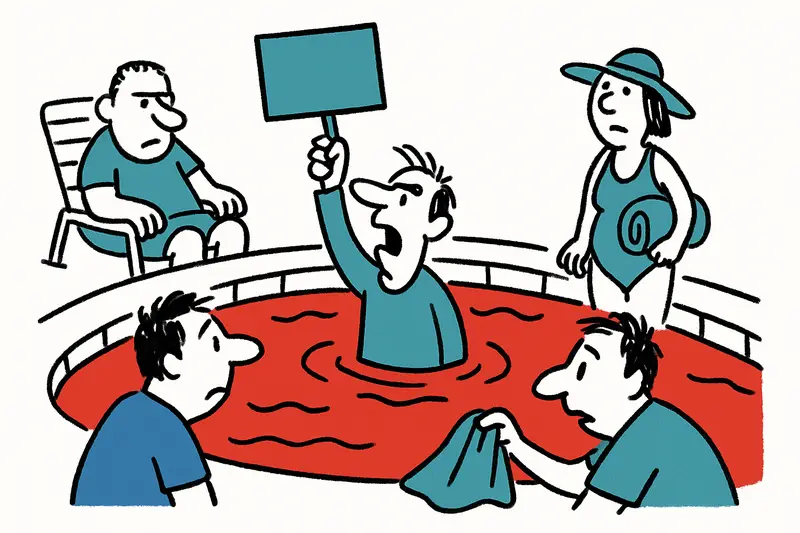
On an otherwise uneventful morning in Palmanova a hotel pool briefly turned into a scene from a film: at 11:30 a.m. sunbathers and families were stunned by deep red water while the usual smell of chlorine lingered in the air and a few seagulls circled above the promenade. For some guests this ended a relaxed start to the day.
The action and its immediate consequences
Eyewitnesses report that a small group of activists had brought posters and loudly explained that the dyed water was meant to remind people of victims of a distant conflict. Within minutes staff pulled towels out of the water, parents lifted children from the pool, and the reception tried to calm the situation. After about an hour the pool was skimmed, refilled and cleaned — at least superficially clear again.
There were apparently no injuries, but guests were angry and unsettled. Three visitors received brief medical attention for stress-related symptoms. Police and the Guardia Civil secured footage; investigations are ongoing.
Between outrage and understanding: What moves the island
On the promenade opinions were divided. A waiter spoke of decreased tips that day, an older hotel guest wondered why such actions would take place “where children play.” Other locals expressed understanding for the anger about violence but criticized the choice of location; other recent demonstrations, such as Lifeguards stage protest at Can Pere Antoni — a wake-up call for Mallorca's beaches, have also divided opinion. This ambivalence runs through conversations in bars, at market stalls and taxi ranks, as seen with New xenophobic graffiti at Playa de Palma – How is the island reacting?: solidarity with sufferers meets existential fears tied to the tourist season.
The central question: How far can protest go when tourism and safety are affected?
This is the core question that remains after the action. On one side is the constitutionally protected right to draw attention to grievances. On the other are hotels, places where holidaymakers are allowed to expect safety and peace. When protest methods involve immediate interference with property, hygiene or the safety of children, the boundaries shift. Incidents elsewhere, for example Tumults at Playa de Palma: When Controls Threaten the Beach Scene and Brawl at Playa de Palma: Why a verbal exchange could have ended fatally, illustrate how quickly tensions can escalate.
Aspects that are often overlooked
Less discussed are the practical consequences of such actions: Who pays for the cleaning and any temporary closure of the pool? How does the hotel's insurance react? What long-term effect does a viral video have on bookings in the coming weeks? And not least: what psychological burden does this place on staff, who are often the first point of contact?
There is also an environmental question: what substance was used, and is it really harmless for filtration systems, drinking-water installations or the sewage system? Authorities worked during the day of the action to identify the dye; clear information on this is lacking in many reports.
Concrete steps — what would help now
Instead of falling into blanket condemnation, pragmatic answers are needed. Suggestions we heard from local stakeholders include:
For hoteliers: Emergency plans for incidents on the premises, staff trained in de-escalation, clear communication to guests (in German, English and Spanish) and a checklist of local service providers for rapid cleaning.
For authorities: Rapid tests to identify coloring agents, transparent public information, clear legal frameworks for interventions on hotel premises and a standardized reporting and documentation procedure to secure evidence.
For civil society and activists: Seek dialogue instead of surprise actions in family areas. If the goal is attention, protests in busy downtown areas or at official media events are often more effective and less dangerous for uninvolved people.
A look ahead
The action in Palmanova is symptomatic of a time when local summer cafés and hotel pools become stages for global issues. Mallorca remains a place where voices are raised — that is part of democracy. But the island also needs reasoned approaches so that the tourism sector and public debate are not played off against each other.
Authorities continue to investigate, and the hotel has announced it will review internal procedures. In the coming weeks guests should be able to expect calm and clear information — and the debate about forms of protest that directly affect many people here must continue.
Frequently asked questions
Is it still safe to use hotel pools in Mallorca after a protest action?
What should holidaymakers in Mallorca do if a protest happens at their hotel?
Can protest actions in Mallorca affect hotel guests and families directly?
What are the rules for protests in Mallorca if they affect private hotel property?
Why did the Palmanova pool protest cause such a strong reaction in Mallorca?
What happens if a hotel pool in Mallorca is contaminated with dye?
When is the best time to visit Palmanova in Mallorca if you want a quieter stay?
How do Mallorca hotels usually communicate with guests during unexpected disturbances?
Similar News
Fire at the Son Hugo Parking Lot: When a Neighbourhood Dispute Becomes a Fire Catastrophe
Three motorhomes in the parking lot by the Son Hugo indoor pool burned out completely. Police suspect arson following a ...
DANA on the Way: When Mallorca Will Get Wet and Stormy — and How We Should Respond
AEMET announces a DANA: From Sunday onward, locally very heavy, persistent rainfall, thunderstorms and strong winds are ...
Fire in Son Hugo: Who protects people living in caravans?
A fire destroyed several caravans in the Son Hugo parking lot. A 34-year-old was arrested. The incident raises bigger qu...
Crack in the Heart of Palma: Hole under the Cathedral Steps Causes Concern
A cavity of up to five cubic meters was discovered beneath the stairs to Palma's cathedral. Why action was taken only no...

S'Aranjassa, Schinkenstraße and Silence: How the 'Bierkönig' Case Must Be Reopened
Almost 29 years after the murders many questions remain. More than 100 tips came in after a TV reminder of the case – ti...
More to explore
Discover more interesting content

Can Cap de Bou

Townhouse Lleo 72
