
When the Water Taps Run Dry: Why Tankers Are Not the Solution
In villages like Deià, Valldemossa or on Menorca, municipalities are limiting water use because of drought. Who decides, who pays — and what's missing from the public debate? A reality check with everyday scenes, analysis and concrete proposals.
When the Water Taps Run Dry: Why Tankers Are Not the Solution
A reality check on water scarcity in municipalities from Mallorca to Menorca
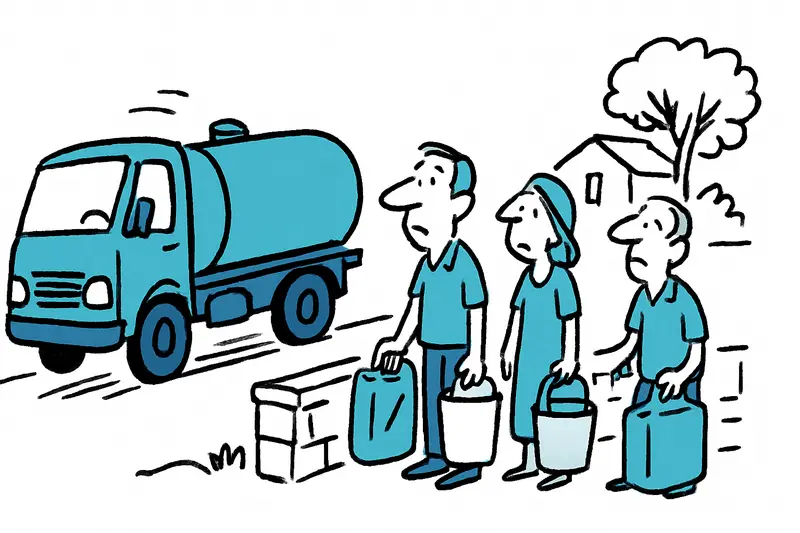
Early in the morning in Deià, when the lemon trees still carry dew on their leaves, a heavy tanker climbs the steep Camí. Hotel staff and some residents wait with jerrycans; in the plaza you can hear the clinking of bottles and the distant call of a delivery worker. Since August 14, parts of the municipality have had the network interrupted on Mondays, Wednesdays and Fridays – this is not a distant statistic, this is the sound of everyday life.
That municipalities such as Deià, Valldemossa, Esporles or Sóller on Mallorca and towns like Mahón, Es Mercadal, Sant Lluís or Es Migjorn Gran on Menorca are currently restricting water use is well known. The Directorate General for Water Resources has recorded these measures; the key facts are clear: some places organize tanker deliveries, in Deià of the weekly 3,500 cubic meters of consumption as much as 1,225 cubic meters (35 percent) arrive by truck, Lloret de Vistalegre reduced network pressure in June, and other municipalities coordinate only sporadically with facilities such as Son Pacs.
Key question: Why do those in charge repeatedly resort to short-term measures — interruptions, pressure reductions, tankers — instead of pushing for sustainable, binding solutions?
Critical analysis: Tankers are expensive, a logistical patchwork and only provide acute relief. They obscure structural problems: lack of central coordination, undersized infrastructure, rising consumption due to tourism and irrigation, and the effects of longer dry periods. When a municipality receives 35 percent of its needs by truck, that is no longer an emergency plan but normality — with consequences for costs, emissions and budget planning. Added to that is the question of responsibility: water restrictions are currently decided locally; therefore there is no complete, up-to-date overall picture across all municipalities. That makes efficient crisis management difficult.
What is missing from the public discourse: honest figures on cost distribution (who pays for tankers and additional treatment?), transparent information for tourism businesses, impacts on agriculture and ecosystems, as well as a compulsory reporting obligation for restrictions. Long-term alternatives are also rarely debated, such as targeted reuse of treated wastewater, small-scale desalination for remote communities or the energy coupling of solar power and desalination. Technical solutions are often dismissed as expensive — sometimes that's true, but without clear comparison they remain untested.
Everyday scene: In Sóller the tram rings in the afternoon, tourists get off, locals buy bread. In the side streets you hear that some neighbors shower less often, the plants in courtyards are wilting and the municipal cleaning crew comes less frequently to the small alleys. Such observations are not an exaggeration; they show how restrictions reach into daily life.
Concrete solutions, without political buzzwords: 1) Central reporting platform: a mandatory, publicly accessible list of all municipalities with the type and extent of restrictions. 2) Prioritization and true cost allocation: clear rules on which user groups are prioritized and transparent billing of tanker costs (municipality, regional aid, possibly a contribution from large commercial users). 3) Investments in decentralized desalination and water reuse where grid connection is lacking — combined with photovoltaics to reduce costs. 4) Immediate programs for rainwater capture and storage in municipal buildings and hotels. 5) Tariff incentives: tiered pricing that actually rewards water-saving behavior. 6) Regional emergency reserve: pooled water reserves that can quickly be moved between municipalities instead of each town relying individually on tanker deliveries.
These measures are not new, but they need two things: binding planning and political backbone. Without clear rules the situation remains a patchwork of interruptions, improvised tanker deliveries and warm words in press statements.
Pointed conclusion: Tankers are the symptom, not the solution. Anyone in Deià, Valldemossa or on Menorca who thinks in the morning of jerrycans and trucks should ask: which long-term infrastructure and governance strategy are we replacing with this? As long as decisions are made ad hoc at the municipal level and there is no mandatory transparency, people, agriculture and tourism will repeatedly pay the price — in money, quality of life and in the question of how resilient our islands really are.
Frequently asked questions
Why is water scarcity a recurring issue on Mallorca and Menorca, and why aren't tanker deliveries a long-term solution?
What would a resilient, long-term water strategy look like for Mallorca?
How do water restrictions affect daily life in Mallorcan towns such as Sóller or Deià?
What practical steps can visitors or residents take to cope with water limits in Mallorca?
Why does Deià rely on tanker deliveries and what does that say about its water supply?
What are the visible effects of water restrictions in Sóller?
Could regional cooperation improve water security across Mallorca and Menorca?
What role could desalination and water reuse play for island communities lacking consistent grid connections?
Similar News

Ryanair Flight Diverted to Barcelona: An In-Flight Emergency and the Questions That Follow
A Ryanair jet from Pisa to Málaga landed in Barcelona after a passenger became acutely ill. Why these cases need more at...
Alarm in Port de Pollença: What now for the polluted bay?
Hundreds of people protested on the beach of Port de Pollença. The environmental organization Arrels Marines demands a p...

Micaela Schäfer: Between Playa de Palma and a Berlin Law Firm — New Calm, an Old Tomcat and Solid Finances
The party artist from the Ballermann scene appears surprisingly down-to-earth: a new relationship with a Berlin lawyer, ...
At Playa de Palma: Fire in Residential Building – six people rescued on the roof, what is missing in prevention?
In the evening a fire broke out on the first floor of a five‑storey building on Calle Trasimé. Six residents fled to the...
New License Requirement for Mini-Boats in Mallorca: Protection Measure or Tourism Brake?
From October 1 renters of small recreational boats in the Balearics must present a boating license. Critical questions r...
More to explore
Discover more interesting content

Boat Tour with BBQ along Es Trenc Beach

Private transfer from Mallorca Airport (PMI) to Pollensa
