
Alarm in Port de Pollença: What now for the polluted bay?
Hundreds of people protested on the beach of Port de Pollença. The environmental organization Arrels Marines demands a package of measures against wastewater, illegal anchoring and heavy boat traffic. We examine what is missing and how the bay can really be saved.
Alarm in Port de Pollença: What now for the polluted bay?
Key question
How can the bay of Port de Pollença be restored without cutting off access for residents and small boat owners?
What happened on Sunday — and why it is more than an image with a swim ring
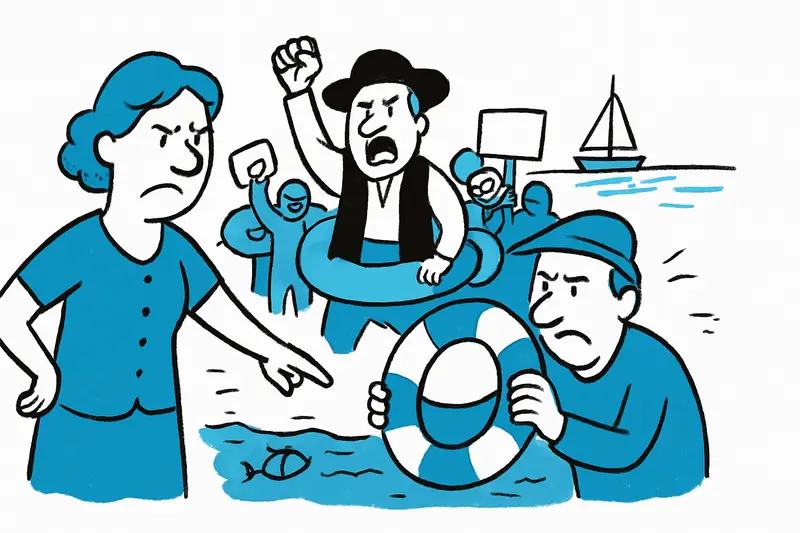
In the late morning, more than two hundred people gathered on the stretch of sand at Port de Pollença. It was not a rigid protest with a megaphone, but a mixture of a human chain, placed lifebuoys, inflatable paddling pools and local dances. A theatrical character in rural costume, who has appeared at actions in recent months, walked through the crowd. The whole scene seemed both festive and urgent: people wanted to make clear that they want their sea back — clear water, safe places to swim and a seabed that is not constantly covered by sediments or anchors.
Critical analysis: What is really bothering people?
The situation, as described by Arrels Marines, consists of several interlocking problems: outdated wastewater pipes, sediment resuspension caused by artificial interventions along the coast, mass anchoring often placed incorrectly, and heavy boat traffic at excessive speeds. All of this adds up to poorer water quality and damaged seagrass and habitats. The symptom — turbid water, accumulations of debris — is visible. The underlying problem, however, is a mix of lacking infrastructure maintenance, lax enforcement and old planning that no longer fits current use.
What is missing from the public discourse
The debate too often focuses on individual aspects: "The wastewater must go" or "The boats are a nuisance." What is usually missing is the perspective that considers the catchment area and the entire coastal planning. There is little clarity about responsibilities along the sewage network, the funding of long-term maintenance and the capacities of maritime monitoring authorities. Also often overlooked are the small users — fishers, families with rowboats — whose needs can be sidelined by bans. Without their acceptance many measures are doomed to fail.
Everyday scene from Mallorca
Early in the morning, before the tourist buses arrive, an old fisherman pulls his boat ashore on the Passeig while two children build a sandcastle with a flag on the beach. In the distance engines honk, boats cut across the water surface, and the smell of fried fish mixes with sea air. This is Port de Pollença: not a postcard-perfect monument, but a place where daily life and tourism meet in a small space. That people are raising the alarm here publicly has to do with the experience of these daily encounters — and with the fear that what they love could be permanently lost.
Concrete solutions — practical and local
The demands of the environmental organization include many useful elements. Based on the measures discussed, some concrete steps can be formulated that could be implemented immediately or tested as pilots:
1) Immediate sewer network program: Prioritized mapping of the oldest pipes, rapid repairs at known leak points and installation of digital sensors in critical sections so disturbances are detected early.
2) Regulated anchoring zones: Creation of a binding registry of problematic anchoring sites, installation of a demand-oriented buoy field with a clear capacity study and affordable alternatives for local skippers.
3) Speed limits and monitoring: Temporary zone with a maximum of ten knots up to Punta Avançada, clearly marked and in the first phase controlled with boat radar and increased presence of the local coastguard.
4) Renaturation pilot: Small sections where artificial structural elements are removed and natural substrates are restored — accompanied by citizen scientists and dive teams documenting progress.
5) Funding and incentives: Use of parts of the sustainable tourism levy for co-financing; grants for owners who renature vulnerable coastal areas.
6) Participation and mediation: A local committee of residents, fishers, port authorities and environmentalists to accompany measures, moderate conflicts and create transparency in berth allocations in the harbor.
Why this can work — and where caution is needed
The combination of structural measures, clear regulation of boat traffic, monitoring and participatory governance has a chance of success because it addresses several sources of disturbance at once. Enforcement will be more difficult: controls need personnel, fines must be imposed, and short-term losses of convenience for some users must be represented politically. Without clear responsibilities and transparent financial planning everything remains symbolic.
Conclusion
The protest in Port de Pollença is not a mere ritual; it is a wake-up call from the island's everyday life. What matters now is to make the demands technically feasible and to involve the people on site. If authorities seize the opportunity, a protest can become a pragmatic program — with repaired pipes, orderly anchoring areas and a seabed that can breathe again. The question from the headline remains: can this be achieved without local people losing out? The answer depends on who pays and who controls — and on whether politics and administration have the courage to plan for the long term instead of patching things short-term.
Frequently asked questions
What factors are driving the polluted conditions in Port de Pollença’s bay?
What practical steps could improve water quality in Port de Pollença without sidelining locals?
What are the proposed anchoring solutions for Port de Pollença?
How could boat speed around Punta Avançada be monitored?
What role do residents and small boat users play in resolving the bay’s problems?
How could renaturation be tested in Mallorca’s bays?
Why does everyday life in Port de Pollença matter for water policy?
What funding options could support coastal restoration around Mallorca?
Similar News

Ryanair Flight Diverted to Barcelona: An In-Flight Emergency and the Questions That Follow
A Ryanair jet from Pisa to Málaga landed in Barcelona after a passenger became acutely ill. Why these cases need more at...

Micaela Schäfer: Between Playa de Palma and a Berlin Law Firm — New Calm, an Old Tomcat and Solid Finances
The party artist from the Ballermann scene appears surprisingly down-to-earth: a new relationship with a Berlin lawyer, ...

At Playa de Palma: Fire in Residential Building – six people rescued on the roof, what is missing in prevention?
In the evening a fire broke out on the first floor of a five‑storey building on Calle Trasimé. Six residents fled to the...

New License Requirement for Mini-Boats in Mallorca: Protection Measure or Tourism Brake?
From October 1 renters of small recreational boats in the Balearics must present a boating license. Critical questions r...

After the Storm: Mallorca Breathes Easy — Warm Weekend with Short Showers
The thunderstorm left its mark, but calm returns for the weekend: sun, summer temperatures around 32 °C, isolated shower...
More to explore
Discover more interesting content

Boat Tour with BBQ along Es Trenc Beach

Private transfer from Mallorca Airport (PMI) to Pollensa
