
Who decides over Mallorca's airports? A reality check after the demo in Palma
Who decides over Mallorca's airports? A reality check after the demo in Palma
Hundreds of people marched through Palma, demanding fewer flights, an end to night flights and more say in decisions. What it's really about — and what's missing.
Who decides over Mallorca's airports? A reality check after the demo in Palma
Key question: Who owns the airspace above our island — Madrid, Aena or the people living here?
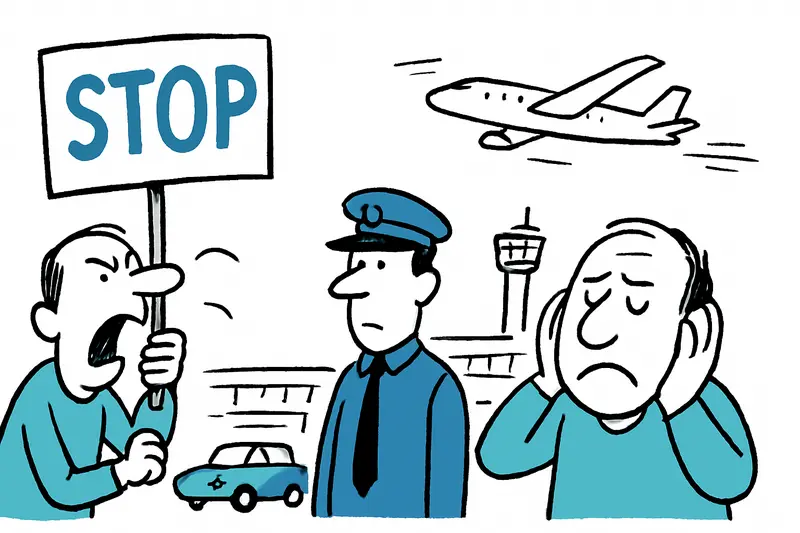
On Sunday people strolled through the Passeig-Mallorca corners, carrying placards, a voice repeatedly calling: Stop more traffic. The police spoke of a few hundred participants, the organizers of up to 3,000 – numbers that differ but express a common feeling: frustration about what is being planned at Son Sant Joan airport. Outside, on that late-summer day (28 °C in Palma), convertible taxis drove by and in the distance a landing plane hummed – the nations of the debate made audible.
In short: the demonstrators demand fewer flight movements, limits on private aviation and an end to night flights. They also call for greater participation of Balearic institutions in decisions about expansion and capacity. These points are not mere emotions; they touch on noise, quality of life, spatial planning and the question of how much tourism an island can cope with.
Critical analysis: figures, politics and contradictions
The document DORA III is on the table: among other things, Aena predicts up to about two million additional passengers for Mallorca until 2031 and around 50 million for the Balearic airports overall. Such sums change infrastructure, traffic and neighborhoods — but they are presented by an operator that belongs to the state network. The island government, by contrast, has long since passed rules to limit beds, cruise passengers and rental car numbers. This parallelism leads to an obvious conflict: local restriction on the one hand, state expansion planning on the other.
Political voices from the island – including members of the Consell and the head of government – have pointed to this contradiction and demand more co-decision. That is understandable: those who feel the pressure should also have an ear in decisions that could increase it. At the same time, the "is it really an expansion?" debate raises questions: Aena talks about modernization and adaptation, critics see a real capacity increase. The gray area uses time – and time changes the island.
What is often missing in the public debate
First: concrete data on private aviation movements and their share of noise and CO2. Second: a transparent, independent cost-benefit analysis that also illuminates housing quality, health costs from noise and follow-up costs. Third: a clear long-term strategy for seasonality – a lot of traffic in just a few months is not the same as movements evenly distributed over the year. The media debate often revolves around slogans; sober counting and modelling are missing.
Everyday scene
Evenings in Platja de Palma: a restaurant owner wipes down, guests still sit outside, suddenly a deep hum – the conversation falls silent. Children point to the sky, an older resident shakes his head. This is not an abstract planning problem, this is life here. The question of how often these nights are disturbed decides about open windows, health, sleep – and about whether people stay or move away.
Concrete solutions
- Immediate measure: moratorium on new long-haul connections until an independent environmental and social impact assessment is available. - Short term: binding night-flight quiet hours with clear sanctions; slots only against higher fees for particularly noisy movements. - Medium term: introduction of a co-governance body in which the Balearic government, municipalities and local representatives have real veto rights on capacity questions. - Economic: differentiated landing and parking fees that burden private jets more heavily; revenues earmarked for noise protection and public transport. - Promote alternatives: strengthen ferry connections, night trains/buses in the high season to substitute short flights.
Conclusion
The protests in Palma are more than loud dissatisfaction; they are a wake-up call. It is not enough to look at Aena's technical plans or local throttling intentions in isolation. Mallorca needs binding rules, transparent figures and real participation for those who live with the noise and the pressure. Otherwise the island parliament against noise will soon become an island without quiet evenings. Do we decide now – or do we let the runway continue to write stories we will regret later?
Frequently asked questions
What is the best time of year to visit Mallorca for sunny weather and swimming?
Are Mallorca beaches suitable for families with kids?
What should I pack for a Mallorca beach trip?
What are the must-do activities for first-time visitors to Mallorca?
Is Mallorca windy, and how does wind affect beach days or water sports?
What’s the best time to avoid crowds in Mallorca?
How easy is it to get around Mallorca without a car?
Is it safe to swim in Mallorca’s sea?
Similar News

The "Bierkönig" Case of 1997: A Mallorca Mystery Returns to Television
Almost 30 years after the triple murder in S'Aranjassa, a German TV program is bringing the case back into the public ey...

When a Shop Becomes a Scene: Violence in Son Gotleu and the Consequences for the Neighborhood
A shop owner in Son Gotleu beat a teenager with a metal bar. What lies behind such an escalation, and what is missing in...

Nazi Shout at Ballermann: Why the Münchner Kindl Had to Act
During a performance at Ballermann a guest shouted "Sieg Heil"; singer Alex Engel stopped the show and had him removed. ...

Almost three decades after the shootings: The unsolved "Bierkönig" case and the search for answers
The 1997 murder at a finca in S'Aranjassa remains a mystery. A German TV program has brought the case back into discussi...

Neighbor Dogs Kill Family Dog Binta – Who Is Responsible?
In Santa Eugènia, five German Shepherds mauled the family's dachshund Binta. The owner demands responsibility instead of...
More to explore
Discover more interesting content

Can Cap de Bou

Townhouse Lleo 72
